


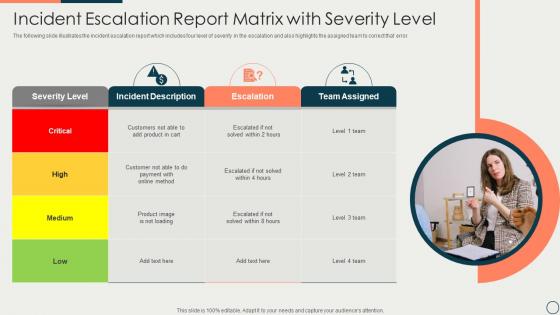
Incident Escalation Report Matrix With Severity Level




Try Before you Buy Download Free Sample Product
 Impress Your
 Audience
 100%
100% Editable
 Save Hours
 of Time


The following slide illustrates the incident escalation report which includes four level of severity in the escalation and also highlights the assigned team to correct that error.
People who downloaded this PowerPoint presentation also viewed the following :
Incident Escalation Report Matrix With Severity Level with all 6 slides:
Use our Incident Escalation Report Matrix With Severity Level to effectively help you save your valuable time. They are readymade to fit into any presentation structure.





FAQs for Incident Escalation Report Matrix
So an Incident Escalation Matrix is your game plan for when stuff breaks. It maps out who to contact and when - like "app down 15 mins = call team lead" or "revenue hit = straight to director." Trust me, you'll thank yourself later when it's 2am and everyone's half-asleep trying to figure out next steps. Without one, you either blow up everyone's phone or waste time debating who should handle what. Get your stakeholders on board early and actually test the process beforehand. Way better than winging it during a real crisis.
Okay so basically a regular escalation is just that boring ladder thing - call your boss, then their boss, whatever. But an Incident Escalation Matrix? Way smarter. It actually maps out WHO needs to know based on what type of problem you're dealing with and how bad it is. Like, database crash at 2am? Different people than if the website's just running slow. You're not just following one dumb path anymore - you're getting the right folks involved right away. Honestly wish more places used these properly. Trust me, build the matrix first before you set anything else up. You'll thank yourself later when you're not accidentally pinging the CEO about minor stuff.
Set up clear severity levels (P1, P2, etc.) with specific timeframes for escalating each one. List exact contact info for who gets notified and when. Make sure you define decision-makers' roles and authority levels - I've watched incidents drag on forever because nobody knew who could actually approve fixes. Map out your communication channels and vendor contacts too. The whole thing needs to be super simple to follow when you're panicked and everything's breaking. Oh, and test it regularly! Keep those contact details fresh because calling a dead number during an outage is basically the worst.
Don't just grab someone else's escalation template - I learned this the hard way. Map out who actually makes decisions in your company first, then figure out their real availability (not what they claim). Your severity levels should match what actually hurts your business. Honestly, most companies overthink this part. Adjust those timeframes based on when your support team is actually working. Pick the right people for each level of chaos. Here's the thing though - test it with a couple real scenarios before you roll it out. You'll probably need to fix stuff once people start panicking.
So basically, incident severity drives your whole escalation process. P1 stuff gets escalated immediately to senior folks and your critical response team. Lower priority things? Just dump them in the regular support queue. Your severity matrix should map out exactly who to contact and when - honestly saves you from those awkward 3am calls to the wrong person. It's kinda like a fire alarm system, you know? You wouldn't wake the fire chief over burnt toast. Check your severity level first, then follow whatever escalation chain you've got set up. Makes the whole process way less of a guessing game.
Look, an escalation matrix basically tells you exactly who to call when shit hits the fan. No more panicking about whether to wake up the senior engineer at 2am or not. You set severity levels upfront - like if Level 1 can't fix it in 30 minutes, boom, it goes to Level 2 automatically. Saves so much time instead of having tickets just... sit there while everyone's confused about next steps. Honestly wish more places used them properly. Start by writing down how you currently handle escalations and see where the gaps are.
Don't make your escalation paths super rigid - people need to jump levels during real emergencies. Unrealistic timeframes are another trap that forces unnecessary escalations. Crystal clear criteria for each level too, not fuzzy stuff like "significant impact." You'll definitely want after-hours contacts listed (trust me on this one after a brutal weekend outage). Keep that thing updated religiously - calling dead numbers is the worst. Oh, and test it quarterly with practice runs. Sounds boring but it'll save your butt when things go sideways.
Quarterly reviews are the minimum, but honestly that's not enough. After any big incident that went sideways or when you get new team leads, definitely update it. New people always catch stuff we miss - it's weird how blind we get to our own processes. Organizational changes too - new hires, leadership shuffles, whatever. The real thing though? Just make sure contact info isn't outdated and your escalation paths actually reflect how things work now. I've seen too many matrices that look like they're from 2019.
Dude, yes! These matrices are lifesavers. Picture this - your Level 1 person gets hit with a database crash at 2 AM. Instead of freaking out, they just check the matrix and know exactly when to ping the DBA team based on how bad it is. Same thing with security stuff - you'll know right away if you need legal or PR involved. Honestly, it just stops those awful "shit, we should've called them way earlier" situations. Been there too many times! Next incident you deal with regularly, just sketch out who to call when. Future you will be so grateful.
For your escalation matrix, I'd go with ServiceNow, Jira Service Management, or PagerDuty - they're pretty solid for automated rules and keeping everything in one place. Though honestly? A decent SharePoint or Confluence page works fine too if you don't need all the bells and whistles. Lucidchart's my go-to for the visual flowchart stuff since people actually understand those diagrams. Just pick whatever your team's already comfortable with and will actually maintain. You can always start basic and upgrade later if it's not cutting it.
Honestly, communication makes or breaks your escalation matrix. I've watched teams completely fall apart during outages because nobody knew what the hell they were doing. You need super clear criteria for when to escalate, who does what, and contact info that's actually current. People either panic and escalate everything, or they sit there doing nothing while the system burns. Keep the language simple - no fancy corporate speak. Short sentences work better when everyone's stressed. Also, review it with your team regularly because outdated info is worse than no info. Trust me on this one.
Start with some basic incident response training - tabletop exercises work great for walking through different scenarios. Get your team comfortable with whatever ticketing system you use since that's where escalation paths live. Honestly, good documentation matters way more than formal training because people's brains just shut off when things go sideways. Everyone should know exactly where to find the escalation matrix and actually practice using it when there's no fire to put out. Oh, and quarterly drills are clutch for keeping this stuff top of mind - otherwise people forget and you're back to square one.
So this matrix thing is basically your roadmap for who talks to who when stuff hits the fan. No more departments doing their own thing while everything falls apart. Picture this: IT spots a system crash and instantly knows to ping Customer Success, or Legal gets auto-called for data breaches. Honestly, the "someone else will handle it" assumption kills more companies than you'd think. Everyone gets their lane mapped out with clear triggers for when to escalate. When chaos strikes, you just grab that printed matrix and follow the arrows - no thinking required. Trust me, your future panicked self will thank you.
So I'd focus on mean time to resolution and customer satisfaction scores first - those tell you the most. Escalation rates are huge too, especially unnecessary ones (that's usually your triage being wonky). Check if issues keep bouncing between teams - honestly that drives me crazy and it's a dead giveaway something's broken in your process. Resolution accuracy at each level matters too. Monthly tracking works well for spotting trends. You want most stuff handled at tier 1 without tanking satisfaction. Start with maybe 3-4 metrics though - too much data just becomes noise.
Your escalation matrix is basically gold for audits - regulators eat that stuff up because it proves you're not just winging it when things go wrong. Shows clear accountability and response times, which hits all the right notes for SOX, HIPAA, whatever you're dealing with. Nobody wants to be that person explaining why they couldn't reach anyone during a crisis, trust me. It keeps you on track for SLAs too. Oh, and document everything (obviously) but actually review those paths every few months. Things change fast and outdated contact lists are worse than useless.
-
I was mind-blown by the services that SlideTeam provided me. Thanks a ton!
-
Excellent Designs.