


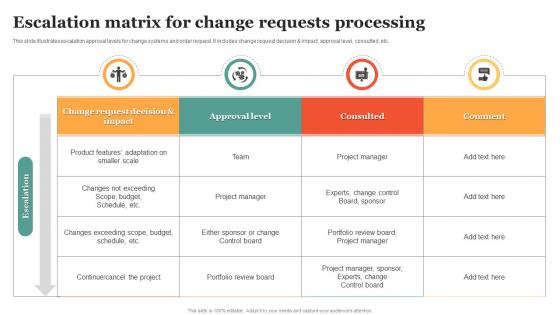
Escalation Matrix For Change Requests Processing




Try Before you Buy Download Free Sample Product
 Impress Your
 Audience
 100%
100% Editable
 Save Hours
 of Time


This slide illustrates escalation approval levels for change systems and order request. It includes change request decision and impact, approval level, consulted, etc.
People who downloaded this PowerPoint presentation also viewed the following :
Escalation Matrix For Change Requests Processing with all 6 slides:
Use our Escalation Matrix For Change Requests Processing to effectively help you save your valuable time. They are readymade to fit into any presentation structure.





FAQs for Escalation Matrix For
An escalation matrix is a structured framework that defines clear pathways for resolving issues, complaints, or decisions by specifying who handles problems at each level and the timeframes involved. It streamlines organizational communication, enhances accountability, and ensures faster resolution of critical issues, with many organizations finding that systematic escalation processes significantly improve customer satisfaction and operational efficiency.
An escalation matrix improves crisis communication by establishing clear reporting channels, defining decision-making authority at each level, and ensuring rapid information flow through predetermined contact protocols. During emergencies, organizations like hospitals and financial institutions find that structured escalation paths minimize confusion, accelerate response times, and enable coordinated decision-making, ultimately delivering faster crisis resolution and maintaining stakeholder confidence.
Key components include clear trigger criteria, defined escalation levels, designated personnel at each tier, specific timeframes for response, and established communication protocols. These elements work together by streamlining issue resolution, minimizing response delays, and ensuring appropriate expertise handles complex problems, with many organizations finding that structured escalation ultimately delivers faster customer service and improved operational efficiency.
An escalation matrix differs from regular reporting structures by providing specific triggers, timelines, and alternative pathways for addressing urgent issues that bypass normal hierarchical channels. While regular reporting follows predictable management layers for routine communication, escalation matrices enable critical problems to reach appropriate decision-makers quickly, with many organizations finding that this strategic combination delivers faster resolution and enhanced operational efficiency.
Organizations should determine escalation levels by analyzing issue complexity, required expertise, decision-making authority, and potential business impact across different scenarios. Through systematic assessment of response times, resource availability, and stakeholder hierarchy, companies can create structured pathways that streamline problem resolution, minimize operational disruptions, and ensure critical issues reach appropriate decision-makers efficiently.
Technology streamlines escalation matrix management through automated workflows, real-time monitoring systems, intelligent routing algorithms, and integrated communication platforms. These solutions enhance operational efficiency by reducing response times, ensuring proper escalation paths, and maintaining comprehensive audit trails, with many organizations finding that automated systems deliver faster resolution and improved customer satisfaction.
Escalation matrices can be tailored by customizing escalation triggers, response timeframes, approval hierarchies, and communication channels specific to each department's operational requirements and risk tolerance. Sales teams might escalate customer complaints within hours through direct manager channels, while IT departments may require technical severity classifications and longer resolution windows, ultimately ensuring department-specific efficiency while maintaining organizational consistency.
Best practices for designing an escalation matrix include defining clear trigger criteria, establishing realistic timeframes, identifying appropriate stakeholders at each level, creating automated notification systems, and documenting resolution authorities. These frameworks streamline incident management by ensuring faster response times, reducing communication gaps, and maintaining accountability, with many organizations finding that well-structured matrices significantly enhance operational efficiency and customer satisfaction.
Issues requiring escalation typically include customer complaints beyond standard resolution, technical outages affecting multiple systems, budget overruns exceeding departmental authority, legal or compliance violations, safety incidents, and cross-departmental conflicts. These situations demand higher-level intervention because they impact organizational reputation, require strategic decision-making, or exceed individual managers' authority, with many companies finding that clear escalation protocols minimize response times and ensure appropriate resource allocation for critical business continuity.
An escalation matrix helps in conflict resolution by providing clear escalation pathways, defined authority levels, and structured timelines for addressing disputes at appropriate organizational tiers. This systematic approach streamlines decision-making, reduces resolution delays, and ensures conflicts receive proper attention from qualified stakeholders, ultimately enhancing workplace harmony and operational efficiency.
Escalation triggers include response time breaches, severity level increases, customer satisfaction drops, resource capacity limits, and regulatory compliance risks. These metrics enable organizations to automatically escalate incidents when SLA thresholds are exceeded, critical systems fail, or stakeholder impact intensifies, ultimately ensuring faster resolution and maintaining service quality standards.
Escalation matrices should be reviewed quarterly and updated whenever organizational changes, new technologies, or process improvements occur. Regular reviews ensure contact information remains current, escalation timeframes stay realistic, and procedures reflect actual business operations, with many organizations finding that proactive updates significantly reduce response delays and improve incident resolution effectiveness.
Organizations can train employees on escalation matrices through comprehensive onboarding programs, role-specific workshops, scenario-based simulations, and regular refresher sessions that cover decision criteria and communication protocols. These training approaches enhance by providing clear escalation pathways, practicing real-world scenarios, and establishing consistent response procedures, with many companies finding that structured training programs significantly reduce resolution times and improve customer satisfaction across all service levels.
Challenges hindering escalation matrix effectiveness include unclear escalation criteria, inadequate staff training, poor communication channels, lack of leadership buy-in, and insufficient documentation processes. These obstacles can create confusion in decision-making, delayed response times, and inconsistent issue resolution, with many organizations finding that regular matrix reviews and comprehensive training programs ultimately deliver improved operational efficiency and stakeholder satisfaction.
Stakeholder feedback can be integrated through regular review cycles, feedback collection mechanisms, and collaborative matrix updates that incorporate insights from end-users, management, and support teams. Organizations increasingly establish quarterly reviews where stakeholders evaluate escalation effectiveness, response times, and resolution quality, enabling continuous refinement that ultimately delivers improved incident management and enhanced stakeholder satisfaction.
-
Easy to use and customize templates. Helped me give a last minute presentation.
-
Easily Understandable slides.