


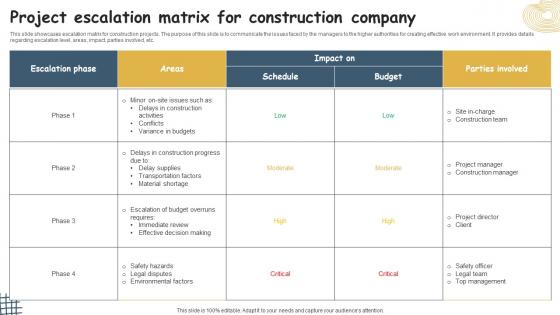
Project Escalation Matrix For Construction Company




Try Before you Buy Download Free Sample Product
 Impress Your
 Audience
 100%
100% Editable
 Save Hours
 of Time


This slide showcases escalation matrix for construction projects. The purpose of this slide is to communicate the issues faced by the managers to the higher authorities for creating effective work environment. It provides details regarding escalation level, areas, impact, parties involved, etc.
People who downloaded this PowerPoint presentation also viewed the following :
Project Escalation Matrix For Construction Company with all 9 slides:
Use our Project Escalation Matrix For Construction Company to effectively help you save your valuable time. They are readymade to fit into any presentation structure.








FAQs for Project Escalation Matrix
So a Project Escalation Matrix is basically your cheat sheet for when stuff hits the fan. You map out different problems and their severity levels, then figure out exactly who to contact for each situation. Set it up during kickoff (honestly, most people forget this step). The whole point is avoiding that panicked "wait, who am I supposed to call?" moment when you're already dealing with a crisis. Define clear thresholds, response times, and your chain of command upfront. Short version: it's your emergency contact list but way more strategic. Share it with everyone on the team so you're not the only one who knows what to do.
So basically, it's like a phone tree that doesn't suck. You map out exactly who handles what problems and when to bump things upstairs. No more people staying quiet about issues OR freaking out and going straight to the CEO over tiny stuff. Your team knows who to call, decision-makers get looped in at the right time, and problems don't just disappear into the void. Honestly, most teams are a communication disaster before they set this up. Start by looking at how things currently work (or don't work), then build proper channels from there.
You need five main things for your escalation matrix. First, severity levels - critical, high, medium, low. Then clear triggers for when to escalate up the chain. Map out who gets contacted at each level, plus specific timeframes for each step. Don't forget roles and contact info! Honestly, the worst part is when you escalate to someone who quit months ago and nobody updated the list. Keep it simple enough that stressed-out people can actually follow it. I'd test those contact paths every few months - you don't want surprises during a real crisis.
Set up your escalation based on impact and urgency - how much does it mess with your timeline/budget and how fast do you need it fixed? I make a basic matrix with critical/high/medium/low for both. Budget overruns over 10%, missed big milestones, stakeholder drama - that stuff goes straight to your project sponsor. Medium problems can probably hit your team lead first. Here's the thing though - be super specific about your thresholds. Don't just write "major issues" because that means different things to everyone. Write down actual examples for each level so your team knows exactly when to escalate and who to bug about it.
Think of an escalation matrix as your backup plan when shit hits the fan. You'll get way faster decisions on big risks because people actually know their role instead of passing the buck around. Honestly, the best part? You start seeing patterns in what keeps going wrong - it's kind of shocking sometimes. Rather than just scrambling when problems pop up, you're forced to think through risk levels ahead of time. My advice is nail down those thresholds first. What counts as "high risk" vs "medium"? Most matrices totally bomb because they're too wishy-washy on this part.
Look, you've gotta spell out actual responsibilities for each level, not just contact info. Give your frontline people real decision-making power and clear triggers for when to escalate. Map out supervisors, managers, executives - when do they jump in? The crappy ones I've seen just dump names on a page with zero context about who actually does what. Include response times, authority limits, specific actions each role can take. Oh and definitely plan for when people are out sick or whatever. Bottom line: anyone should glance at it and instantly know who handles what without playing phone tag.
Honestly? People make escalation criteria way too vague - like, what does "high impact" even mean? Be super specific about timelines and severity levels. Don't create some crazy 6-level chain either (I swear, some companies love overcomplicating this stuff). Keep it simple. Make sure whoever you're escalating to can actually DO something about it, not just some random manager who'll panic and escalate it again. Oh, and definitely run through a few test scenarios first - you'll catch weird gaps that way. Nothing worse than realizing your matrix doesn't work when you're in the middle of an actual crisis.
Honestly, the best thing you can do is automate the whole notification process with something like Jira or Monday. Set up alerts when issues hit certain levels - saves you from babysitting every problem. Visual dashboards are clutch too since everyone can see who's handling what and where things stand. I'd probably integrate it with Slack if your team's already living in there anyway. The trick is finding something everyone will actually use (good luck with that part). Start by just mapping out what you're doing now but digitally. Short sentences work. Longer ones with natural flow keep it interesting.
So basically, escalation matrix = who decides stuff when things go sideways. Change control = the actual process for handling modifications to scope, budget, timeline, whatever. Your escalation matrix is like a decision tree - shows you when to bump problems upstairs and who's got the authority at each level. Meanwhile, change control is more about the formal steps you take when stakeholders want to switch things up mid-project. They overlap a ton though, since bigger changes usually need escalation anyway. I always think of it as: use escalation when you're stuck, use change control when someone wants something different. Does that help clarify it?
Check it every three months minimum, but honestly that's kinda the bare minimum. Major changes? Update it right away - new people joining, folks leaving, scope shifts, whatever. Nothing's worse than trying to escalate to someone who bounced six months ago (been there, it's painful). When you actually use the thing and hit roadblocks, that's your cue to fix whatever's broken. Contact info goes stale fast, and those escalation chains can get weird if you're not paying attention. Oh, and set a reminder or you'll totally forget.
Yeah, definitely works! Just adapt them to your sprint rhythm instead of those rigid corporate timeframes. I'd tie escalations to your ceremonies - like if something's still blocked after the next standup, bump it to your Scrum Master. The trick is keeping it lightweight since agile's supposed to be fast, right? Don't let it turn into some bureaucratic nightmare that kills your velocity. Honestly, I've seen teams over-engineer this stuff way too much. Match your escalation levels to however your team's actually structured. And definitely put it somewhere visible on your board so people actually use it.
Honestly, escalation matrices are lifesavers when you're dealing with multiple teams. No more sitting there wondering who the hell you're supposed to contact when something goes sideways. Decision-making gets way faster since everyone knows who actually has the power to approve stuff at different levels. You won't accidentally bug some VP about tiny issues, and big problems won't just sit there because you're scared to speak up. Oh, and the accountability thing is huge - people can't play the blame game when deadlines get missed. I'd start by figuring out where decisions usually get stuck in your current setup.
Oh man, cultural stuff totally messes with escalation matrices! People from hierarchical cultures won't want to bother the big bosses. Meanwhile, flat org cultures? They'll skip right to the CEO lol. Direct communicators escalate fast and blunt. Indirect ones will dance around problems or just... not escalate at all. Time's another thing - what feels urgent to you might feel normal to someone else. Authority gets interpreted differently too, which honestly makes sense when you think about it. Bottom line: you gotta customize your matrix for different cultures instead of hoping one approach works everywhere.
Track response time first - how fast do issues get flagged and hit the right person? Also measure resolution time since better escalations should mean quicker fixes. Look at which categories escalate most often too (bet you'll find some obvious patterns). Are things going to the right level immediately or just ping-ponging around? Those are your core metrics. Honestly, payment stuff always seems to blow up more than other issues in my experience. Start simple with these basics, then you can get fancier once you've got some actual data to work with.
You know that escalation matrix you mentioned? Actually train people on it - it'll cut your response times way down. No more issues bouncing around because nobody knows who handles what. Problems get to the right person fast instead of sitting there while someone debates whether to bug their manager. Fewer missed deadlines too since blockers don't just... sit there. Your stakeholders stay in the loop through proper channels. Honestly, even a quick 15-minute team walkthrough next week would probably save you hours of headaches later. Worth doing.
-
Excellent Designs.
-
Informative design.