

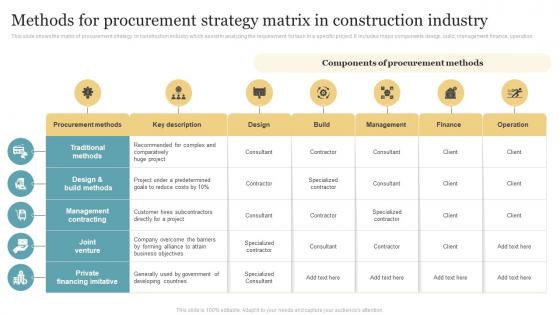
Methods For Procurement Strategy Matrix In Construction Industry




Try Before you Buy Download Free Sample Product
 Impress Your
 Audience
 100%
100% Editable
 Save Hours
 of Time


This slide shows the matrix of procurement strategy in construction industry which assist in analyzing the requirement for task in a specific project. It includes major components design, build, management, finance, operation.
People who downloaded this PowerPoint presentation also viewed the following :
Methods For Procurement Strategy Matrix In Construction Industry with all 6 slides:
Use our Methods For Procurement Strategy Matrix In Construction Industry to effectively help you save your valuable time. They are readymade to fit into any presentation structure.





FAQs for Methods For Procurement Strategy Matrix
**INPUT**: What are the key components of an effective procurement strategy matrix? **OUTPUT**: Key components include supplier assessment criteria, risk evaluation frameworks, cost optimization models, performance metrics, and strategic sourcing categories. These elements work together by streamlining vendor selection, enhancing supply chain transparency, and minimizing procurement risks, with many organizations finding that strategic matrices ultimately deliver faster sourcing decisions and significant cost reductions. [Word count: 54 words]
Organizations tailor procurement strategy matrices by analyzing industry-specific factors like regulatory requirements, supplier ecosystems, risk profiles, and market dynamics within their sector. Financial services firms emphasize compliance and security metrics, while manufacturing companies prioritize supply chain resilience and quality standards, ultimately enabling customized sourcing approaches that deliver competitive advantage and operational efficiency.
Risk assessment serves as a foundational element in developing procurement strategy matrices by identifying supply vulnerabilities, evaluating supplier reliability, and categorizing spending based on market complexity and business impact. Through systematic risk analysis, organizations can strategically position procurement categories within the matrix, enabling tailored sourcing approaches that minimize disruptions while maximizing value and competitive advantage.
Technology enhances procurement strategy matrices through AI-powered spend analytics, automated supplier risk assessments, real-time market intelligence platforms, and predictive demand forecasting tools. These digital solutions streamline category positioning by providing data-driven insights, enabling procurement teams to optimize sourcing strategies, reduce costs, and improve supplier relationships while delivering enhanced operational efficiency.
Key metrics for evaluating procurement strategy matrix success include cost savings percentages, supplier performance scores, contract compliance rates, procurement cycle time reduction, and risk mitigation effectiveness. These measurements enable organizations to track strategic outcomes across different procurement categories, with many companies finding that combining financial metrics with operational indicators delivers comprehensive visibility into procurement performance and competitive advantage.
Cross-departmental collaboration enhances procurement strategy matrices by aligning purchasing decisions with operational needs, budget constraints, and strategic objectives from finance, operations, and management teams. This integrated approach enables organizations to prioritize suppliers more effectively, streamline vendor negotiations, and optimize resource allocation, ultimately delivering cost savings and improved operational efficiency across the enterprise.
Supplier relationship management directly influences procurement strategy matrix decisions by determining partnership levels, risk mitigation approaches, and strategic sourcing classifications for different vendor categories. Strong supplier relationships enable organizations to negotiate better terms, ensure supply continuity, and leverage collaborative innovations, while relationship quality affects whether suppliers are positioned as strategic partners or transactional vendors within the matrix framework.
Organizations should avoid unclear category definitions, insufficient stakeholder buy-in, overly complex matrices, and failing to align procurement strategies with overall business objectives. Many companies find that inadequate supplier performance monitoring, poor cross-functional communication, and neglecting regular matrix updates undermine effectiveness, ultimately limiting cost savings and operational efficiency.
A procurement strategy matrix aligns with business objectives by categorizing spend based on supply risk and business impact, enabling strategic resource allocation, supplier relationship optimization, and cost management priorities that directly support organizational goals. Through systematic classification of procurement categories, companies streamline decision-making processes, enhance operational efficiency, and achieve competitive advantage, with many organizations finding that this alignment ultimately delivers measurable improvements in both financial performance and strategic outcomes.
Visualizing procurement strategy in a matrix format enables clearer strategic decision-making, enhanced supplier categorization, improved risk assessment, and streamlined resource allocation across different spend categories. This approach helps procurement teams quickly identify opportunities for cost reduction, consolidation, and supplier development, while providing stakeholders with transparent insights into purchasing priorities, ultimately delivering more strategic vendor relationships and operational efficiency.
A procurement strategy matrix helps identify cost-saving opportunities by categorizing spend based on supply risk and business impact, enabling targeted approaches like supplier consolidation, strategic partnerships, and competitive bidding. Through this systematic analysis, organizations can prioritize high-impact areas, negotiate better contracts with key suppliers, and streamline procurement processes, ultimately delivering significant cost reductions and operational efficiency.
Strategic procurement matrices focus on long-term supplier relationships, risk assessment, category management, and strategic sourcing decisions that align with organizational goals. Operational procurement processes handle day-to-day purchasing activities like order processing, invoice management, and routine vendor transactions, with many organizations finding that combining both approaches streamlines procurement efficiency while maintaining strategic supplier partnerships.
Market analysis informs procurement strategy matrix development by identifying supplier capabilities, market dynamics, pricing trends, and risk factors across different categories. Through comprehensive market research, organizations can position items within the matrix based on supply availability, competitive landscapes, and strategic importance, while benchmarking costs and evaluating supplier performance, ultimately enabling data-driven procurement decisions that optimize spend and minimize risks.
Sustainability considerations serve as critical evaluation criteria within modern procurement strategy matrices, encompassing environmental impact assessments, supplier carbon footprints, ethical sourcing practices, and circular economy principles. These factors increasingly influence vendor selection and contract negotiations, with many organizations finding that sustainable procurement strategies reduce long-term costs, enhance brand reputation, and deliver competitive advantage in an increasingly environmentally-conscious marketplace.
Organizations should revisit their procurement strategy matrix quarterly for tactical adjustments and conduct comprehensive annual reviews for strategic realignment. Market volatility, supplier performance changes, and evolving business priorities necessitate regular updates, with many companies finding that proactive quarterly assessments enable faster adaptation to supply chain disruptions, ultimately maintaining competitive advantage and operational efficiency.
-
I was confident and well prepared for my presentation for the first time ever. With SlideTeam’s templates, I could deliver one of my best presentations. Will be coming back for more!
-
SlideTeam makes creating presentations easy. Unlimited products, premium quality designs and affordable.