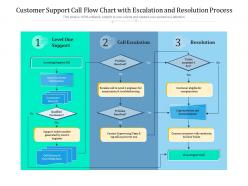
Customer support call flow chart with escalation and resolution process
Try Before you Buy Download Free Sample Product
Audience
Editable
of Time
Our Customer Support Call Flow Chart With Escalation And Resolution Process are explicit and effective. They combine clarity and concise expression.
People who downloaded this PowerPoint presentation also viewed the following :
Content of this Powerpoint Presentation
Bill Gates once said, “Your most unhappy customers are your greatest source of learning.” So, reaching out to your customers’ needs and desires and serving them have become significant challenges in this fast-paced, digitized world. For most of the top businesses, the primary way of improving customer support is to develop a streamlined workflow. This is possible only if you design an efficient and suitable customer support call flow chart.
A customer support flow chart has become necessary for businesses' call centers to be more efficient. If you are starting a new business, it helps your call center employees visualize the workflow to recognize and fix inefficiencies. A customer support call flow chart is a visual representation of the customer support service established in a company.
The flow chart structure helps visualize each of the stages and optimizes them so that they benefit the team members and improve customer experience. Moreover, it is also helpful for reducing call mismanagement by boosting productivity and establishing accountability.
To get the best templates for customer support level flow with call resolution, Click here.
Customer Support Call Flow Chart with Escalation and Resolution Process PPT Templates
SlideTeam offers well-organized customer support call flowchart PPT Templates to provide an overview of the customer service process with both escalation and resolution. This is a complete, editable, and customizable PowerPoint Presentation. Symbols, text, graphics, and visuals are used in this layout to make it an excellent tool for users. This user-friendly template is available at your fingertips to convey complex messages in a more straightforward form.
Do you want to escalate a serious issue quickly? Click here to see a flowchart of the issue and escalation process flowchart, with stages.
Template 1: Customer Support Call Flow Chart with Escalation and Resolution Process

Every business should have its own unique call flow chart, as the customer service process is also unique to each business. An adequately set flow chart helps to provide a company with an internal process and perfect solutions to make the employees work more efficiently. Suppose you are new to this segment and want to upgrade your customer service presentation with ease. In that case, SlideTeam has introduced a PowerPoint Preset to highlight three significant steps of a call flow chart, which are level one support, call escalation, and resolution. It shows each step along with a brief depiction with the help of flowcharts. Grab it soon and elevate your communication to impress your audience.
*****
Stay focused on consumer experience
When it is a matter of customer support, it is crucial to stay focused on the consumer experience. Being a customer support professional, you need to make sure that your customers have a joyous and consistent experience. A well-designed customer support call flow chart PPT Template will be sufficient to focus on your task. Our PPT slides are effective and explicit enough to provide a convincing pitch to your audience for a positive impact.
PS Guarantee customer satisfaction by choosing SlideTeam’s “Customer Service Process Flow with Technology Support” PPT templates. Click here to Access some of the creative PPT template designs.
Customer support call flow chart with escalation and resolution process with all 2 slides:
Give your audience a fulfilling experience. They will find our Customer Support Call Flow Chart With Escalation And Resolution Process elevating.
FAQs for Customer support call flow chart with escalation
So it's basically four main parts: greeting/verification, figuring out what's wrong, actually fixing it, and wrapping up. Start warm - people can tell when you're just going through the motions. Don't rush to solutions before you actually understand the problem, trust me on that one. Most calls succeed or fail during troubleshooting, so keep your cool even when they're losing theirs. Always confirm everything's working before you hang up and tell them what happens next. Oh, and write stuff down as you go - you'll thank yourself later when you're not trying to remember random details.
Honestly, having a solid call flow is a game-changer for customer service. Your agents won't be scrambling around trying to figure out what to ask next. Customers get faster resolutions because there's actually a plan in place. No more of those cringe-worthy "hold on, let me transfer you... again" situations that we've all been through. Decision trees work great - map out the common scenarios and responses. Train everyone on it properly (this part's huge). Your agents will feel way more confident, and customers can tell when someone knows their stuff. Trust me, your satisfaction scores will thank you later.
Honestly, call routing is a game-changer for customer service. Instead of randomly dumping calls into queues, you match customers with agents who actually know their stuff. No more transferring someone three times because the first guy didn't understand their billing question. Set up rules based on what the customer needs - like routing VIP clients to senior agents or sending tech issues to your tech-savvy people. I've seen companies boost their first-call resolution rates just by doing this right. It's basically like having a smart receptionist who knows everyone's strengths. Your customers won't get bounced around, resolution times drop, and nobody gets frustrated.
Honestly, I'd hit three main things: mock calls, call flows, and listening skills. Practice scenarios with your team - angry customers, tech issues, billing headaches, you know the drill. Walk them through your call flow so they actually know when to escalate vs handle it themselves (this part's huge). Active listening is where most people mess up though - they're already thinking about their response instead of really hearing the customer. I'd do regular coaching sessions reviewing real calls together. Repetition builds confidence, and confident agents perform way better. Oh, and mix up your scenarios so they don't get too comfortable with just one type of call.
Okay so first thing - get a solid CRM like Salesforce or HubSpot set up. Your agents need customer info right when calls come in, not 30 seconds later while people wait. Call routing software is huge too, automatically sends customers to the right department instead of bouncing them around. Oh and IVR systems let people handle basic stuff themselves - honestly saves so much time. There's also screen pop tech that shows customer details the instant calls connect. I'd start with CRM integration though, that's where you'll see the biggest difference right away. Combined, this stuff cuts call times by like 30-40%.
Yeah so basically every industry does their call flows totally differently depending on what customers actually deal with. Healthcare has to do all that patient verification and HIPAA compliance stuff right away. E-commerce? They skip straight to "where's my order" and returns. Banks are crazy paranoid - good luck getting past their security questions first. Tech companies usually figure out how complex your issue is before routing you anywhere. Retail just wants to get you your refund quickly and move on. Honestly though, forget the cookie-cutter templates. Just figure out what pisses off YOUR customers most and build around fixing that.
Honestly, focus on first call resolution - that's the big one since nobody wants to call back twice for the same issue. Track your average handle time and customer satisfaction scores too. Call abandonment rates will show you if people are bailing because your flow is too confusing or takes forever. Pay attention to where customers get stuck - those spots are pure gold for fixing things. I'd pull these numbers weekly and look for trends. CSAT scores are pretty telling about whether people actually liked dealing with your system or just tolerated it.
Ugh, the worst thing is when customers have to repeat their whole story after getting transferred. Such a pain. Don't make them navigate through 8 menu options either - I swear some companies think we have photographic memory! Stick to 3-4 choices max. Always give people a quick escape route to talk to an actual human, and make sure your agents can see what the customer already went through. Oh, and put the popular stuff like billing right upfront instead of burying it in some random submenu.
Honestly, start by digging into your customer feedback - surveys, call recordings, all that stuff. It's actually pretty fun once you get into it, like solving a puzzle. Look for patterns where people keep getting stuck at the same spot. Those are your biggest red flags right there. Don't just rely on feedback though - track your call resolution times and transfer rates too. Sometimes what feels broken to customers isn't what's actually broken. Once you've mapped out your top three complaint themes, pick the easiest one to fix first. Test small changes instead of blowing everything up at once. Way less risky that way.
So automation completely changed how calls work now. Customers don't talk to humans first anymore - they go through automated greetings, then self-service menus, then AI tries to help them. Your agents only get the call when it's already messy or complicated. It's crazy how fast this shift happened, like maybe 3-4 years? Anyway, this means your team jumps straight into the hard stuff. No more answering simple "what are your hours" questions. Training should focus on complex problem-solving since that's what they'll actually be doing all day.
So you'll want language selection right up front after your greeting. Route people to queues with agents who actually speak the language - and I mean really speak it, not just basic conversational level. Your staffing gets tricky because you need coverage across all languages during business hours. Keep IVR prompts short since some languages are way more verbose than English when translated. Oh, and definitely check your customer demographics first - no point offering Mandarin if 90% of your callers speak Spanish, you know? Design the whole routing system around what your customers actually need.
Honestly, callbacks are your best bet - nobody wants to sit on hold forever. Get some chatbots or IVR stuff set up for the basic questions people always ask. Your scheduling probably needs work too (most places suck at this tbh). Look at when calls spike and actually staff for those times. Skills-based routing helps get people to the right person faster instead of bouncing around. Oh, and push some stuff to your website if you can - fewer calls = shorter waits. Start with callbacks though, that'll make the biggest difference right away.
Don't just put escalation triggers at the end - scatter them throughout your call flow. Auto-escalate repeat callers and high-value customers, plus flag certain keywords. Your agents need a manual escalation button too since sometimes they'll sense something's off before the system does. Clear handoff protocols are crucial so you're not losing context during transfers (honestly, nothing's more frustrating than explaining your issue three times). Oh, and definitely track your escalation patterns - they're like a roadmap showing exactly where your initial flow is dropping the ball with customers.
Honestly, I think scripts are great for training newbies - they won't miss the legal stuff or forget to ask for account numbers. But once someone's been doing it a while? Customers totally know when you're just reading off a page. It sounds so fake. Free-flowing conversations let you actually connect with people and solve their real problems instead of just going through motions. I mean, some calls are weird and don't fit the script anyway. Maybe start with scripts then let experienced reps wing it more? Best of both worlds.
Honestly, start with getting everyone on the same scripts and templates - phone, chat, email, all of it. Use one knowledge base so your chat people aren't saying totally different stuff than your phone reps (which drives customers absolutely nuts, trust me). Cross-train your team so they actually understand how each channel works. Oh, and definitely audit what you're doing now first - you'll probably find some weird gaps between channels that you didn't even realize were there. Track the same metrics everywhere and do quality checks across the board. It's pretty straightforward once you get the foundation right.
No Reviews