


Ethical AI All You Need To Know Ppt Presentation





Try Before you Buy Download Free Sample Product
 Impress Your
 Audience
 100%
100% Editable
 Save Hours
 of Time


The PPT Ethical AI All You Need To Know is made to help individuals gain knowledge about creating and managing Ethical AI systems. This AI accountability deck starts by analyzing the problems, identifying key challenges, and providing potential solutions. The business ethics AI templates provide Ethical AI as a solution, providing its introduction, significance, and stakeholders involved. It then focuses on the Ethical Management Framework and discusses critical attributes such as transparency, bias mitigation, privacy, data security, accountability, and environmental considerations. Further, this sustainable AI deck also mentions regulatory framework, the impact of ethical AI in real-world applications, and upcoming trends in this space. This deck can be used by teams, leaders, and organizations aiming to adopt responsible AI practices. Grab it now.
People who downloaded this PowerPoint presentation also viewed the following :
Content of this Powerpoint Presentation
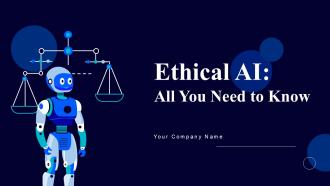
Slide 1: This is the cover slide of the presentation Ethical AI: All You Need to Know.
Slide 2: This is an Agenda slide. State your agendas here.
Slide 3: This slide shows Table of Content for the presentation.
Slide 4: This slide highlights the topics to be covered next.
Slide 5: This slide discusses the ethical challenges associated with AI technology, including unjustified actions, opacity, bias, discrimination, and autonomy.
Slide 6: This slide explores the impact of ethical challenges in AI technology, including loss of trust, social inequities, legal concerns, reputation damage, and stifled innovation.
Slide 7: This slide presents solutions to mitigate ethical challenges in AI, including implementing ethical AI, bias mitigation strategies, and strengthening accountability.
Slide 8: This is another slide highlighting the topics to be covered next.
Slide 9: This slide introduces the concept of ethical AI in terms of function/features and few key facts regarding importance, and executive perception about the technology.
Slide 10: This slide outlines the importance of ethical AI, focusing on transparency, fairness, privacy, and accountability, and their roles in fostering trust and responsible AI development.
Slide 11: This slide covers the roles of various stakeholders in Ethical AI technology, including academics, government, intergovernmental entities, non-profits, and private companies.
Slide 12: This slide highlights the topics to be covered next.
Slide 13: This slide outlines the elements of the Ethical Management of Artificial Intelligence (EMMA) framework.
Slide 14: This is another slide highlighting the topics to be covered next.
Slide 15: This slide mentions the key attributes such as transparency, fairness, privacy, accountability etc that constitute as a part of ethical ai technology.
Slide 16: This slide highlights the topics to be covered next.
Slide 17: This slide highlights the role of transparency in establishing ethical AI and few corresponding key facts regarding perception of leaders and organizations.
Slide 18: This slide exhibits the critical need for AI transparency, focusing on its benefits for trust, accountability, bias mitigation, performance improvement, etc.
Slide 19: This slide mentions the key levels of AI transparency, starting from within the AI system, then moving to the user, and finishing with a global impact.
Slide 20: This slide outlines the challenges of achieving AI transparency such as keeping data secure, explaining complex models ad maintaining transparency etc.
Slide 21: This is another slide highlighting the topics to be covered next.
Slide 22: This slide explains the concept of bias mitigation in AI ad workflow explaining how biases can result in wrongful or discriminatory data.
Slide 23: This slide outlines activities for mitigating AI bias through diverse teams, responsible AI model development, and strong corporate governance practices.
Slide 24: This slide provides key steps to avoid and mitigate AI bias, emphasizing the importance of diversity, proxy awareness, and recognizing technical limitations.
Slide 25: This slide highlights the topics to be covered next.
Slide 26: This slide explains data privacy in AI, highlighting the importance of ethical data handling and providing key statistics on privacy concerns.
Slide 27: This slide mentions the various methods of AI data collection that have privacy implications.
Slide 28: This slide highlights key AI privacy concerns for businesses, including transparency issues, unauthorized data use, discriminatory outcomes, copyright challenges, etc.
Slide 29: This slide outlines strategies for mitigating AI privacy risks, including embedding privacy in design, anonymizing data, limiting retention times, etc.
Slide 30: This is another slide highlighting the topics to be covered next.
Slide 31: This slide introduces the concept of accountability as a part of Ethical AI technology and emphasizes the significance with corresponding key facts.
Slide 32: This slide outlines the roles of various entities such as Users, Managers, Companies, Developers, Vendors etc. that help in maintaining AI accountability.
Slide 33: This slide highlights key approaches to maintaining AI accountability within the organization.
Slide 34: This slide explores the complexities of attributing accountability in AI systems.
Slide 35: This slide highlights the topics to be covered next.
Slide 36: This slide discusses the environmental implications of AI technology and showcases graphical representation of Co2 emission from training an AI model.
Slide 37: This slide covers the Key sources of AI based environment hazard which include disposable waste, energy consumption, action plans and stress on energy grids.
Slide 38: This slide outlines strategies for embedding environmental and societal wellbeing in AI systems.
Slide 39: This is another slide highlighting the topics to be covered next.
Slide 40: This slide discusses the role of regulatory frameworks in ethical AI, focusing on ensuring compliance and accountability, protecting individual rights, etc.
Slide 41: This slide highlights the topics to be covered next.
Slide 42: This slide explores the future of ethical AI, highlighting increased regulation and oversight, advances in transparency, focus on fairness and inclusion, etc.
Slide 43: This is another slide highlighting the topics to be covered next.
Slide 44: This slide depicts the future of ethical AI, highlighting increased regulation and oversight, advances in transparency, focus on fairness and inclusion, and ethical innovations.
Slide 45: This slide shows all the icons included in the presentation.
Slide 46: This slide is titled as Additional Slides for moving forward.
Slide 47: This slide demonstrates Ethical AI framework for organizations.
Slide 48: This slide exhibits Multi-stakeholder model of AI ethics in marketing.
Slide 49: This slide displays Column chart with two products comparison.
Slide 50: This is Our Vision, Mission & Goal slide. Post your Visions, Missions, and Goals here.
Slide 51: This is Our Team slide with names and designation.
Slide 52: This is About Us slide to show company specifications etc.
Slide 53: This is a Timeline slide. Show data related to time intervals here.
Slide 54: This is a Comparison slide to state comparison between commodities, entities etc.
Slide 55: This slide shows SWOT describing- Strength, Weakness, Opportunity, and Threat.
Slide 56: This is a Thank You slide with address, contact numbers and email address.
Ethical AI All You Need To Know Ppt Presentation with all 64 slides:
Use our Ethical AI All You Need To Know Ppt Presentation to effectively help you save your valuable time. They are readymade to fit into any presentation structure.










FAQs for Ethical AI All You Need To
Honestly, bias is probably the biggest headache - your training data can easily screw you over if it's not representative. People also hate black box decisions, so you'll want some transparency in how the system actually works. Privacy's obviously a big deal too. Oh, and good luck figuring out who's liable when things inevitably go sideways! I'd definitely build ethical reviews right into your process from the start. Way less painful than trying to fix everything later when you're already deep in production. Trust me on that one.
OK so basically you gotta document how your AI makes decisions and share that with everyone involved. Write down what data you're feeding it, how the algorithms actually work, and why it spits out certain answers. I know, sounds boring as hell. But explainable AI techniques are clutch here - they translate the complex stuff into normal human language. Oh and run audits regularly, that helps catch issues early. The trick is sharing all this info upfront instead of scrambling when someone demands answers later. Trust me, being transparent from the start saves you so much headache down the road.
Oh man, this stuff is everywhere and it's honestly pretty messed up. Algorithms learn from biased data, so they just copy our existing prejudices but at massive scale. You'll see it in hiring software that screens out qualified candidates, or those facial recognition systems that barely work on Black people. What really gets me is how everyone treats these decisions like they're totally neutral just because a machine made them. Healthcare, criminal justice, lending - it's all affected. The zip code thing you mentioned? Totally real. Companies really need to test their stuff across different groups before rolling it out, but honestly most don't bother.
Look, regulation basically forces companies to follow actual rules instead of just empty promises about being ethical. The EU AI Act and new US laws are making them do transparency testing and prove their systems are fair. Some companies honestly won't do the right thing unless there's legal consequences - kinda sad but true. Plus it helps the good companies compete since they're not getting undercut by sketchy ones anymore. You should probably start figuring out which regulations might hit your AI projects soon, because this stuff is ramping up fast.
First thing - dig into your training data and see who's actually represented. Document everything about where it comes from. I know, sounds boring as hell, but you'll thank me later. Check if your collection methods are accidentally leaving out certain groups. Historical data is tricky because it often has baked-in discrimination from the past. Run tests across different demographics to spot problems early. Oh, and don't just audit once - build ongoing bias checks into your whole pipeline. Models can drift over time.
Honestly, there's a few ways to tackle this. Regulatory frameworks and industry standards are the obvious ones - plus legal liability when companies mess up. Oversight bodies can audit algorithms, and there's whistleblower protections for employees who see sketchy stuff happening. Professional licensing for AI engineers is becoming more of a thing too, like how we handle doctors. The annoying part? Tech moves way faster than regulation ever will. Right now your best shot is internal ethics boards and transparent reporting while we wait around for stronger external rules. Oh, and mandatory impact assessments before rolling anything out.
Dude, this stuff is huge for getting people to actually use your product. Bias or sketchy data handling? Users will bail instantly. No one wants to mess with AI that feels unfair or creepy with their info. Being upfront about how things work makes such a difference - I've watched companies see way better adoption just from being transparent. Whether it's hiring tools or those recommendation things (honestly those can be so weird sometimes), people need to trust what's happening. Build this thinking in from the start though. Trying to fix ethics problems after launch is a nightmare.
Oh man, this stuff gets scary fast. When AI is deciding if someone gets a loan or diagnosing cancer, you can't mess around. Bias is huge - these systems can discriminate without anyone realizing it. Plus patients and customers have no clue how these decisions get made, which honestly feels pretty unfair. If something goes wrong, who's even responsible? Your friend's company definitely needs humans reviewing the big calls, regular checks for bias, and clear oversight. Life-changing decisions shouldn't be black boxes.
Honestly, you gotta bake ethics right into your process from the start. Get diverse people involved early - ethicists, community folks, experts who actually know the domain. Sounds like overkill maybe, but catching bias before launch is so much easier than dealing with angry users later. Do ethics check-ins at every milestone, like code reviews but for fairness stuff. Make it a real requirement, not something you slap on at the end. Oh and actually test your guidelines during development - wild how many teams skip that part.
So there's a bunch of frameworks out there - IEEE's Ethically Aligned Design is probably your best bet to start with since it's pretty comprehensive. Google has their AI Principles too, and Partnership on AI has one, but they're all basically covering the same stuff. Fairness, transparency, accountability, privacy, safety - you know, the usual suspects. Oh, and if you're in healthcare or finance, there's specific regulatory guidelines you'll need to check out too (way more paperwork, obviously). I'd honestly just grab the IEEE one first and then tweak it for whatever you're actually building.
Having ethicists on your team from day one is a game changer - they catch bias and fairness issues that engineers totally miss. It's like having someone constantly asking "but what if this screws over X group of people?" Your datasets get more inclusive, testing gets way better. Plus you won't get blindsided by regulations later (learned that one the hard way at my last job). Short version: get them into your actual sprint reviews and design meetings, not just those boring compliance check-ins. They'll push back on stuff in a good way.
Start with some formal training - workshops on bias and algorithmic fairness are solid. MIT and Stanford have decent online courses focused on AI ethics your devs can take. Real AI failure case studies hit different though - they're honestly the most eye-opening part. Regular team discussions about ethical scenarios you'll face help a lot. Bringing in external ethicists occasionally keeps everyone sharp. Oh, and definitely build ethics into your code review process. That way it's not just something you remember at the end. Makes it feel more natural over time.
Oh definitely! You just gotta bake in the ethical stuff right from the start - like healthcare AI that doesn't discriminate or learning tools that actually work for different kids. Get diverse people involved early (way easier than fixing mess-ups later, trust me). Make sure your training data isn't biased toward one group. Keep humans in the loop for big decisions too. I'd probably start by figuring out who might get screwed over by your AI, then build protections around that. Environmental monitoring is cool - helps communities see what's actually polluting their air.
Dude, AI is completely changing what privacy even means. Your shopping habits and typing patterns? Algorithms can figure out your health issues or political views from that stuff. It's honestly pretty creepy. We used to worry about protecting obvious things like social security numbers, but now it's about what these systems can predict about you. The whole game has shifted from "what data are you taking" to "what conclusions can you draw from it." Oh and definitely check what insights your systems might be pulling - not just the raw data you're collecting.
Oh man, this stuff gets messy fast. Nobody can even agree on what "ethical" means - your legal team wants one thing, engineers want another. Plus good luck auditing algorithms that are basically black boxes. Leadership usually just wants to check a box and move on, which is honestly pretty frustrating. Regulations keep changing too, so you're always playing catch-up. My advice? Don't try to solve everything at once. Pick one specific project, nail down what ethical looks like for that exact situation, then expand from there. Way less overwhelming.
-
Nothing beats the well-formatted and professionally designed templates offered. Kudos to SlideTeam for their amazing collection of PPT slides.
-
I can say with full confidence that all your business, academic, or professional work requirements will be sufficed with SlideTeam. Their gallery is as rich as 2Million+!!