


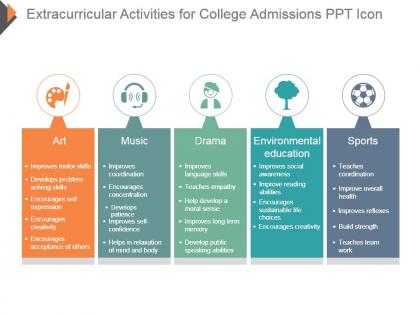
Extracurricular activities for college admissions ppt icon
You must be logged in to download this presentation.




Try Before you Buy Download Free Sample Product
 Impress Your
 Audience
 100%
100% Editable
 Save Hours
 of Time


Each of our Extracurricular Activities For College Admissions Ppt Icon gives you extra. Be assured of a good bargain.
People who downloaded this PowerPoint presentation also viewed the following :
Extracurricular activities for college admissions ppt icon with all 5 slides:
Our Extracurricular Activities For College Admissions Ppt Icon deal with difficult demands. They can cope with any condition.




FAQs for Extracurricular activities for college
Dude, extracurriculars are where you actually learn stuff that matters. Like, debate club taught me way more about speaking up than English class ever did. You get real leadership experience and meet people who are into the same weird stuff as you. Time management becomes second nature when you're juggling practice and homework. Don't just pick random activities to look good on applications though - that's pointless. Find things you genuinely care about and dive deep. Better to be really involved in two things than half-ass five different clubs, you know?
Honestly, colleges want to see you're not just a walking GPA. Pick a few activities you actually care about and stick with them - admissions people can smell resume padding from a mile away. Leadership roles are clutch if you can swing them. The whole point is showing commitment and maybe some growth as a person. Plus these activities give you solid essay material later (trust me on this one). Way better to go deep on 2-3 things than join every club that exists. Bonus points if they connect to what you want to study.
Honestly, team sports are amazing for your mental health. You get that natural endorphin boost from moving around, plus you're constantly interacting with people which helps with social skills. There's something about working toward a goal together that just hits different than doing everything solo. It builds resilience too since you're dealing with wins and losses as a group. Even if traditional sports aren't your thing, any group activity works - book clubs, hiking groups, whatever. I was super isolated last year and joining a volleyball league made such a difference in my mood day-to-day.
Okay so the big thing is cost - offer free stuff or sliding fees. Transportation's huge too, maybe partner with local groups for rides? Don't just schedule everything right after school either (I swear schools never think about kids who work or have siblings to watch). Actually promote to underrepresented groups instead of just throwing up flyers and hoping. Set up some way to track who's participating so you can catch problems early. Oh and avoid scheduling conflicts with family stuff if possible - that kills participation fast.
Sports are still huge - football, basketball, soccer obviously. Academic stuff like debate and NHS pull decent numbers too. Theater, band, and art clubs do well with the creative kids. What's really blown up though are the social justice groups - environmental clubs, community service, all that. Oh and tech stuff has gotten insane - robotics, coding clubs, esports teams that didn't even exist when we were in high school. Those categories probably cover most of what you'll see participation-wise. The esports thing still trips me out honestly, but kids are super into it now.
Honestly, extracurriculars make you way better at managing time. Sounds backwards, but when you're swamped you can't afford to mess around scrolling TikTok for hours. You start planning study sessions like they actually matter and using random free periods between classes. That whole "busy people get stuff done" thing is legit - there's just no room left for procrastination when your schedule's packed. I'd say block out your activities first, then squeeze homework around them. Most people I know are actually more productive when they're busier, which is weird but true.
Honestly, just show you care about what they're doing. Ask questions about their stuff and try to make it to games/events when you can - though you don't need to be at literally everything (that gets weird). Help with rides and gear, but don't hover over every decision they make. I always think it's good to push them to finish what they start, but also... kids change their minds and that's normal? The sweet spot is cheering them on without becoming one of those intense parents who coaches from the sidelines. Unless they actually want your input, just be supportive.
Honestly, extracurriculars are perfect for building real leadership skills. You get actual hands-on experience making decisions and managing people. Debate team captain? Student government? Charity events? All of that means navigating group dynamics and solving problems constantly. Here's the thing though - volunteers are way harder to manage than employees who get paid to listen! The trick is finding roles with genuine responsibility, not just showing up to meetings. Look for positions where you're coordinating projects or leading initiatives. That's where you'll actually learn something useful. Just don't pick something you'll hate doing for a whole year.
Honestly, burnout is the biggest thing to watch out for. You'll end up doing everything halfway decent instead of being actually good at anything. Sleep? What's that lol. Also colleges don't even want to see you doing literally every club - they'd rather see you really committed to like 2-3 things you actually give a shit about. Quality beats quantity, trust me on this one. Your social life will probably tank too if you're running around to meetings 24/7. Pick the stuff you genuinely care about and go deep with those.
Honestly, extracurriculars are where the real friendships happen. Kids bond over shared interests way more naturally than in regular classes. Working on a project together or being on the same team? That's when you actually get to know someone. Drama club rehearsals are brutal but weirdly fun - there's nothing like suffering through forgotten lines together lol. Students get specific roles in these smaller groups too, which helps them find their people. The trick is getting them to stick with it long enough for those surface-level connections to turn into actual friendships.
Honestly, tech has made extracurriculars so much more accessible now. Kids can join online clubs through Zoom, and there's apps for everything - tracking sports progress, managing teams, whatever. Rural students can actually participate in coding competitions or debate teams they'd never have access to otherwise, which is pretty awesome. Schools are using digital portfolios too so students can document all their achievements. Creative kids can showcase their work to way bigger audiences now. I mean, the trick is just making sure the tech actually brings people together instead of making everything feel disconnected, you know?
Track enrollment numbers and retention rates first - see if kids are actually staying in programs. Academic performance matters too since these activities usually help with grades. But honestly? The real gold is in talking to people. Survey students about confidence and leadership growth, ask parents what they're seeing at home. Activity leaders will tell you straight up what's working and what's a mess. Mix those stories with your hard data - that's how you show administrators the actual impact. Numbers alone won't cut it when you're trying to prove a program's worth.
Honestly, treat your schedule like money - school stuff comes first, then see what time you have left for everything else. I made this mistake freshman year joining way too many clubs lol. Block out study time on your calendar before adding activities around it. Better to really dive into 2-3 things than be mediocre at everything. Don't feel bad saying no when you're already swamped. Oh, and check your deadlines every Sunday so you don't get blindsided by that paper you forgot about.
Yeah, family background totally influences what kids pick. East Asian families often push academic stuff, music, martial arts. Latino students gravitate more toward soccer, dance, community service. But honestly, it's way more complex than just preference - there's family pressure, money issues, what their community values. Some cultures are all about individual success while others focus on group activities or helping others. I mean, you probably see this in your own classroom already. Just don't box kids in based on assumptions, you know? Help them find what actually clicks for them.
Honestly, community service is like a cheat code for building skills colleges actually want. Problem-solving and teamwork happen naturally when you're working with different people on real projects. Leadership develops too - even without an official title, you'll find yourself stepping up and coordinating stuff. The empathy part is probably the most underrated benefit. You also get project management experience, plus you learn to roll with it when plans fall apart (which they will). Oh, and make sure your friend actually documents these skills on applications - they transfer to literally everything.
-
so helpful and easy edit
-
Top Quality presentations that are easily editable.
-
Easily Understandable slides.