


F621 Service Blueprint Template Sample Blueprint 3 Process Of Service Blueprinting And Service Design




Try Before you Buy Download Free Sample Product
 Impress Your
 Audience
 100%
100% Editable
 Save Hours
 of Time


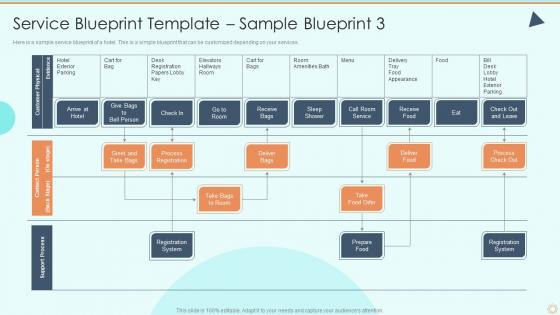
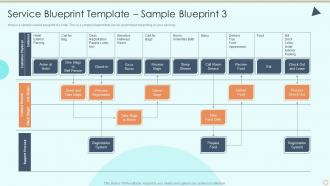
Here is a sample service blueprint of a hotel. This is a simple blueprint that can be customized depending on your services.
People who downloaded this PowerPoint presentation also viewed the following :
F621 Service Blueprint Template Sample Blueprint 3 Process Of Service Blueprinting And Service Design with all 6 slides:
Use our F621 Service Blueprint Template Sample Blueprint 3 Process Of Service Blueprinting And Service Design to effectively help you save your valuable time. They are readymade to fit into any presentation structure.





FAQs for F621 Service Blueprint Template Sample Blueprint 3 Process Of Service Blueprinting
The primary purpose of service blueprinting in service design is to visualize the entire service delivery process, mapping customer interactions, employee actions, and backend support systems to identify improvement opportunities. This comprehensive approach enables organizations to streamline operations, eliminate inefficiencies, and enhance customer experiences, with many service-oriented businesses finding that blueprinting ultimately delivers greater operational transparency and competitive advantage.
Service blueprinting enhances customer experience by mapping every touchpoint, identifying pain points, and revealing behind-the-scenes processes that impact service delivery. Through detailed visualization of customer journeys, organizations streamline interactions, eliminate friction points, and optimize staff coordination, ultimately delivering more consistent, efficient services with many companies finding significant improvements in satisfaction and operational performance.
Service blueprints include customer actions, frontstage interactions, backstage processes, support systems, and physical evidence mapping the complete service experience. These components work together by visualizing customer touchpoints, employee interactions, and operational workflows, enabling organizations to identify inefficiencies, streamline processes, and enhance service delivery while ultimately improving customer satisfaction and operational effectiveness.
Service blueprinting differs from traditional process mapping by incorporating customer interactions, employee actions, support processes, and physical evidence into a comprehensive visual framework. While traditional mapping focuses primarily on internal workflows, service blueprinting reveals both front-stage customer touchpoints and backstage operations, enabling organizations to identify service gaps, streamline customer experiences, and ultimately deliver more cohesive, customer-centered services.
Service blueprinting identifies potential service failures by mapping customer touchpoints, backstage processes, and support systems to reveal vulnerability points, process gaps, and dependencies. Through systematic analysis of each service stage, organizations can pinpoint bottlenecks, technology failures, and communication breakdowns, ultimately enabling proactive risk mitigation and enhanced service reliability across customer interactions.
Touchpoints serve as critical interaction moments between customers and service providers, including digital interfaces, staff encounters, physical environments, and communication channels. These strategic contact points enable organizations to map customer journeys comprehensively, identify pain points systematically, and optimize service delivery across all channels, ultimately enhancing customer experiences while streamlining operational efficiency.
Service blueprinting trains employees by visualizing complete customer journeys, mapping touchpoints, identifying backstage processes, and clarifying role responsibilities across departments. Through detailed process maps, staff understand how their specific actions impact customer experiences, while managers can identify training gaps, standardize procedures, and ensure consistent service delivery, ultimately enhancing operational efficiency and customer satisfaction.
Common challenges in service blueprinting include unclear stakeholder alignment, insufficient customer research, complex multi-touchpoint mapping, inadequate cross-departmental collaboration, and difficulty identifying hidden backstage processes. These obstacles often arise in large organizations where departments operate in silos, with many companies finding that dedicated workshops and iterative mapping sessions help overcome these barriers while ultimately delivering clearer service visibility and enhanced customer experiences.
Technology and digital tools assist in service blueprinting by enabling real-time collaboration, automated process mapping, and data-driven insights through specialized software platforms, cloud-based templates, and analytics dashboards. These solutions streamline blueprint creation and updates while facilitating cross-departmental input, with many organizations finding that digital blueprinting accelerates service design cycles and enhances operational visibility.
Strategies to secure stakeholder buy-in include conducting collaborative workshops, demonstrating clear ROI through process visualization, involving key stakeholders in blueprint creation, and presenting data-driven insights about customer pain points. Organizations in healthcare, financial services, and retail find that when stakeholders actively participate in mapping touchpoints and identifying improvement opportunities, they become invested champions who drive implementation success.
Service blueprints should be updated quarterly or whenever significant operational changes occur, including new technology implementations, process modifications, customer feedback insights, or service expansion initiatives. Regular reviews ensure blueprints accurately reflect current customer journeys and internal processes, with many organizations finding that proactive updates enhance service delivery efficiency, reduce operational gaps, and maintain competitive advantage in evolving markets.
Service blueprinting visualization best practices include clear lane separation between customer actions, frontstage interactions, backstage processes, and support systems, using consistent symbols and color coding throughout. These visual elements streamline complex service mapping by enabling cross-functional teams to identify pain points, optimize touchpoints, and eliminate redundancies, with organizations in healthcare, banking, and retail finding that standardized blueprints significantly enhance operational efficiency and customer experience delivery.
Service blueprinting aids new service development by mapping customer journeys, identifying touchpoints, revealing operational requirements, and uncovering potential failure points before launch. This comprehensive visualization enables organizations to design seamless experiences, optimize resource allocation, and anticipate implementation challenges, with many companies finding that blueprinting reduces development costs and accelerates time-to-market for successful service launches.
Service blueprinting proves particularly effective in healthcare, hospitality, financial services, retail, and telecommunications industries. These sectors benefit significantly from mapping complex customer journeys and backend processes, with many hospitals streamlining patient experiences, banks optimizing loan approvals, and hotels enhancing guest services through detailed blueprinting approaches.
Service blueprint effectiveness metrics include customer satisfaction scores, service delivery time, error rates, employee efficiency measures, and cost per transaction. These metrics enable organizations to identify bottlenecks, streamline operations, and enhance customer experiences, with many service-oriented businesses finding that systematic measurement ultimately delivers improved operational efficiency and competitive advantage.
-
Excellent products for quick understanding.
-
Huge collection of high-quality templates. Worth each penny.