


Feasibility Of Construction Project Feasibility Study Templates For Different Projects




Try Before you Buy Download Free Sample Product
 Impress Your
 Audience
 100%
100% Editable
 Save Hours
 of Time


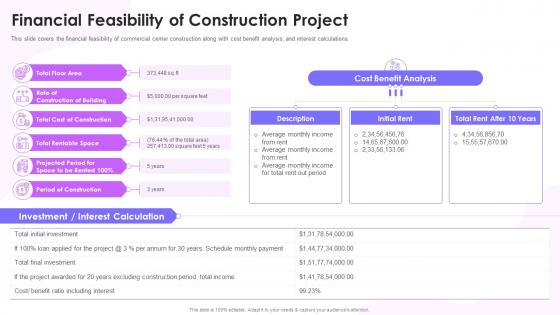
This slide covers the financial feasibility of commercial center construction along with cost benefit analysis, and interest calculations.
People who downloaded this PowerPoint presentation also viewed the following :
Feasibility Of Construction Project Feasibility Study Templates For Different Projects with all 6 slides:
Use our Feasibility Of Construction Project Feasibility Study Templates For Different Projects to effectively help you save your valuable time. They are readymade to fit into any presentation structure.





FAQs for Feasibility Of Construction Project Feasibility Study Templates
So for your feasibility study, you'll want these main sections: executive summary, market analysis, tech requirements, and financial projections. Risk assessment is huge too - seriously, don't skip that part like most people do. Also throw in operational stuff, timeline, assumptions, and resource needs. Financial projections should cover 3-5 years with different scenarios. Oh, and end with a clear yes/no recommendation. Start simple and customize based on your project type. You can always add more later if you need to get fancy with it.
Honestly, templates are lifesavers for this stuff. You won't miss key things like market research or financial projections when everything's laid out already. Saves tons of time too - no more staring at a blank page wondering where to start. Your stakeholders will love the consistency since they'll know exactly where to find what they need. I learned this the hard way after forgetting to include risk analysis in my first study (awkward). Just grab a basic template and tweak it for whatever industry you're in. Makes the whole thing way less stressful.
Honestly, the biggest mistake is just filling in the blanks without actually thinking. You end up with boring, generic stuff that completely misses what makes your project different. Don't skip sections either - I learned this the hard way when I ignored the regulatory part and it bit me later. Market conditions can surprise you too. Templates also make people lazy about doing real research. Like, you still need to dig into actual data and talk to people. Oh and customize the hell out of it for your situation. It's a starting point, not gospel.
Definitely swap out those generic sections for stuff that actually matters in your industry. Tech startups should focus on user acquisition costs and scalability - not manufacturing headaches. Restaurants need food cost breakdowns, health permits, foot traffic analysis... things that are totally irrelevant for SaaS companies. Your financial models need to match how your industry actually makes money too. Don't forget updating the risk section for sector-specific problems like regulatory shifts or seasonal swings. Honestly, I'd start by finding 2-3 solid feasibility studies from companies in your space to see what they emphasize most.
Look, financial projections are what make or break your feasibility study - they show if you'll actually turn a profit or just burn cash. Include revenue forecasts, cost estimates, cash flow stuff, and break-even analysis. This is honestly where most projects either get approved or tossed in the trash (seen it happen way too many times). Build out three scenarios - best case, worst case, and realistic. Don't just show the rosy picture because stakeholders will see right through that. Start conservative with your estimates. That way you're not overpromising and can actually hit your numbers.
Honestly, visuals are a lifesaver for feasibility presentations. Nobody wants to stare at endless spreadsheets trying to decode your financial projections. Charts and graphs make that data actually make sense to people. Plus they keep everyone awake during long presentations - which is harder than you'd think. Clean infographics work great for market analysis and risk stuff too. The key is keeping it simple though. Don't jam everything onto one crowded slide because that defeats the purpose. I always focus on the biggest findings first, then build from there. It's way easier to follow the story that way.
So you've got economic feasibility - basically will this make money and what's the ROI. Technical is huge too - can you actually build this thing? Legal covers all the compliance headaches and regulatory stuff. Then there's operational (will it work day-to-day) and schedule feasibility - is your timeline realistic or totally insane? Market feasibility gets forgotten a lot but it's super important - like, will anyone actually want what you're making? I'd tackle economic and technical first since those are deal-breakers, then add the others depending on how complex your project is.
Honestly, a solid template is like your cheat sheet for getting everyone involved at the right time. Map out when different people need to jump in - finance can review costs, end-users give feedback during market research, that kind of thing. People actually respond better when they know upfront what you need from them and when, instead of you randomly hitting them up later. Short sentences work. Build those feedback moments right into each section of your template. Oh and make it feel like a schedule everyone can see - nobody likes being surprised or feeling forgotten about. Trust me on this one.
Definitely start with the money stuff - ROI, NPV, payback period. Those are non-negotiable. Market metrics are huge too: market size, competition, your projected share. Honestly, the operational pieces can make or break you - resource needs, timeline milestones, risk scores. If there's any tech complexity (and there usually is), include feasibility metrics. Oh, and sensitivity analysis is clutch for showing what happens when your assumptions change. I always customize based on the project type, but these cover most bases.
Yeah, risk assessment gets its own section in most templates - and for good reason, it's crucial. You'll categorize risks: financial, operational, market, technical, regulatory stuff that could tank your project. Most templates have you rate probability vs impact, then figure out how to handle the big ones. Some even include those matrix things to visualize it all. Here's the thing though - don't sugarcoat anything. I've seen people downplay risks thinking it looks better, but stakeholders need the real deal to make smart decisions. Be brutally honest or it'll bite you later.
Look at the Channel Tunnel or Dubai Metro - they all used detailed feasibility templates before building anything. Airbnb and Uber did the same thing when expanding to new cities, which honestly makes sense when you think about the risks involved. Smaller stuff too, like renewable energy projects and hospital expansions. They don't wing it. What's interesting is nobody really starts from zero - they grab existing templates and tweak them for their situation. Skipping this step is basically asking for trouble, especially when you're trying to get investors or city approval. Smart money follows a process.
Dude, get a feasibility study template - it's basically your sanity check before you blow all your savings on a startup. You'll analyze market demand, competition, finances, all that boring but crucial stuff. Honestly, most founders skip this step and regret it big time later. The template stops you from making decisions based purely on excitement (we've all been there). It forces you to actually gather data instead of just winging it. Just grab a basic template online and tweak it for your industry. Way better than learning expensive lessons the hard way.
Check out your industry association first - their templates are way better than generic ones. Failed feasibility studies on JSTOR actually teach you more than the success stories, weirdly enough. SBA has solid free frameworks that won't get you in compliance trouble later. Those consulting firm methodologies are surprisingly detailed too, worth a look. I'd start industry-specific, then add academic case studies for backup. Oh, and government sites have built-in regulatory stuff already mapped out. Trade associations really know the nuances that matter.
Honestly, just bake the feedback right into your template from the start. Drop comment boxes after each big section - market analysis, financials, risk stuff. I learned this the hard way after dealing with way too many messy email threads that went nowhere. Set up review points at like 25%, 50%, and 75% done. Short sentences work better than long ones for this. Also throw in a simple matrix tracking who looked at what and when. Formal review gates sound boring but they actually save your sanity. Way better than having everyone dump random thoughts on you at the end when it's too late to fix anything major.
Honestly, start with digital stuff - every feasibility study needs tech integration and automation sections now. Sustainability's everywhere too, so throw in ESG and environmental impact parts. Remote work totally changed the game (seriously, 2019 assumptions are basically trash). Factor in hybrid operations and supply chain resilience - that's been huge since all the disruptions. Oh, and data privacy rules keep shifting. My advice? Build modular template sections you can swap around depending on the project. Way easier than starting from scratch each time.
-
Great designs, really helpful.
-
The Designed Graphic are very professional and classic.