

Feasibility report for business project project management professionals required documents




Try Before you Buy Download Free Sample Product
 Impress Your
 Audience
 100%
100% Editable
 Save Hours
 of Time


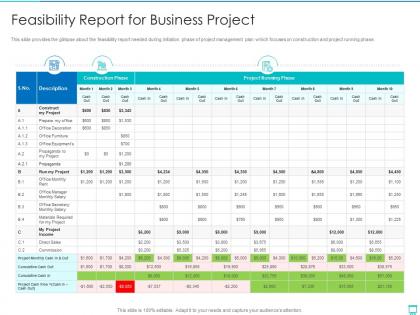
This slide provides the glimpse about the feasibility report needed during initiation phase of project management plan which focuses on construction and project running phase.
People who downloaded this PowerPoint presentation also viewed the following :
Feasibility report for business project project management professionals required documents with all 2 slides:
Use our Feasibility Report For Business Project Project Management Professionals Required Documents to effectively help you save your valuable time. They are readymade to fit into any presentation structure.
FAQs for Feasibility report for business project project management
Okay so you'll need these main sections: executive summary, project description, market analysis, technical stuff, financial projections, risk assessment, and your recommendation. Oh and timelines plus resource needs. Honestly, the exec summary is everything - most people only read that part anyway lol. Your financial section better have real numbers for costs and ROI, not some fantasy math. I'd definitely call out potential problems upfront since people hate surprises later. Short sentences work. Longer ones keep readers engaged when you vary the rhythm. Make yourself a template after this - you'll thank me later.
First thing I'd do is survey people directly - most entrepreneurs skip this but it's seriously the best data you'll get. Then dig into industry reports and census stuff to figure out your market size. Check out what competitors are doing and how they're performing. Search trends on Google and social media chatter will show you if people actually care about this problem. Oh, and don't forget to test pricing - people lie about what they'll pay until it's time to actually buy. The trick is getting info from multiple places so you're not just guessing based on one source.
Look, stakeholder analysis basically saves your butt from drama later. Map out everyone who'll be impacted - who's got the power to kill your project, who might fight you, who's actually on your side. I learned this the hard way on my last project tbh. Create those interest vs influence matrices (sounds fancy but it's just boxes). Then figure out how you'll handle each group differently. Your feasibility report needs all this documented so people can see you've thought it through. Start by brainstorming every possible person involved, then sort them by how much they care and whether they'll help or hurt you.
Okay so financial projections are honestly what make or break your feasibility report. Without solid numbers, stakeholders won't take you seriously - I've watched so many good ideas die because the math was garbage. You need revenue forecasts, cash flow analysis, break-even stuff. Show them you actually understand your market size and what things cost to run. Oh, and definitely include different scenarios - best case, worst case, realistic. Nobody trusts someone who's just being stupidly optimistic about everything. It helps investors figure out if you're worth the risk.
So first thing - check if the tech you need actually exists and works reliably. Resource-wise, do you have the right people and equipment? Risk assessment comes next (honestly this part saves so much headache later). Build a small prototype if you can - way better than guessing. I'd also look at similar projects that worked or totally bombed for reference. Oh, and document the technical limits clearly so everyone knows what they're getting into upfront. Sounds like a lot but it's worth doing right.
So you need a legal requirements section - basically cover all the regulations, permits, licenses, and compliance stuff for your industry and location. Research is gonna be boring as hell, but you gotta dig into federal, state, and local laws that might affect your project. Document everything clearly with deadlines, costs, and who's responsible for what. Include zoning laws, environmental regs, labor standards, plus any industry-specific rules. Oh and definitely mention potential legal risks and your mitigation plan. If it's a complex project, honestly just get a lawyer to review it - worth the money.
For financial stuff, stick with Excel or Google Sheets - they're honestly all you need. Project timelines? MS Project works great. SurveyMonkey's solid for market research, plus there are tons of industry databases out there. Don't overthink the tools though - I've watched people waste weeks researching software when basic options work fine. Word or Google Docs handle the actual writing and formatting no problem. The collaboration features are pretty handy too when you're working with a team. Start simple with what you already know. You can always switch to fancier tools later if you really need them.
Dude, you gotta get super specific about what could tank this thing. Skip the vague "market risks exist" bullshit - tell them exactly how competitor pricing might wreck your margins or why that regulation could kill everything. I swear, half the reports I see just dance around the bad stuff, then everyone's shocked when it hits the fan. Build a simple risk matrix showing likelihood vs impact. Always throw in your backup plans too. Honestly, stakeholders just want the real story so they can make decent decisions. Better to freak them out a little now than watch everything implode later.
Your timeline is basically the reality check for your whole project. It shows stakeholders when stuff will actually happen and whether you can hit their deadlines. Map out the big milestones and dependencies so people can spot bottlenecks early - way better than scrambling later when things cost more. I've watched so many projects crash because the timeline looked perfect but nobody thought about how tasks actually connect. Build in some buffer time too, because something always goes wrong. Oh, and flag any external dependencies that aren't in your control - that's usually what kills schedules.
Set up a simple table or side-by-side comparison - stakeholders can scan it super quickly and they love that. List each option with pros, cons, costs, and timelines. Be honest about feasibility even if you already have a favorite (and don't throw in obviously weak alternatives just to make your pick look better - everyone sees through that). Include stuff like implementation complexity, what resources you'll need, and potential risks. Oh, and definitely end with your recommendation plus reasoning, but give them enough info to decide for themselves if they think you're wrong.
Biggest mistake? Being way too rosy about costs and how long stuff takes. Also, don't get lost in technical weirdness - I swear some reports sound like robots wrote them. Document where you got your numbers because people will definitely grill you later. The "what if everything goes wrong" part is actually super important, even though it's tempting to skip. Oh, and end each section with what you think they should do next - decision-makers hate guessing what your point was. Honestly, clear assumptions up front will save you so many headaches down the road.
Honestly, just think about who's actually gonna read this thing and make decisions with it. Figure out who's paying for the project, who has to approve it, and who'd run it if it gets the green light. Usually that's executives, sponsors, department heads, maybe investors - anyone with real stake in whether this works or fails. Technical people matter too since they know if it's actually doable. I make a quick list of names and what each person cares about most. Then write for them specifically. Like, investors want ROI numbers while engineers need implementation details. Makes the whole report way more useful when you're not trying to please everyone at once.
For your feasibility report, definitely track both money stuff and operational metrics. ROI, payback period, net present value - you know the drill. Then add things like completion times, quality measures, or adoption rates depending on what you're actually doing. Pick metrics that connect to your specific problem though. Generic ones are pretty useless, honestly. Set your baselines now or you'll hate yourself later when you can't prove anything worked. Oh, and stick to maybe 3-5 key ones max. More than that gets messy fast.
Dude, visuals are a lifesaver for feasibility reports. Nobody wants to read paragraphs of dense financial data - charts and graphs make everything click instantly. I usually drop at least one good visual per section because honestly, even executives zone out after too much text. Flowcharts work amazing for processes, and comparison tables make pros/cons super obvious. Your stakeholders will actually pay attention instead of skimming. Plus timelines and risk stuff just looks more credible when it's visual, you know? Trust me, breaking up all that analysis with clear graphics supporting your main points makes the whole thing way more persuasive.
Take a step back and check if your conclusions actually match what the data shows. Get someone else to look it over - seriously, they always catch stuff you missed because you've been staring at it too long. Double-check all your numbers and sources again (I know, boring but necessary). The executive summary needs to be solid since that's probably all the higher-ups will read anyway. Make it look professional and maybe throw together a short presentation version too. Oh, and read the whole thing out loud - sounds weird but you'll hear clunky sentences you didn't notice before.
-
Visually stunning presentation, love the content.
-
Innovative and attractive designs.
-
The Designed Graphic are very professional and classic.
-
Illustrative design with editable content. Exceptional value for money. Highly pleased with the product.