

First Time Manager Training Program Guide DTE CD





Try Before you Buy Download Free Sample Product
 Impress Your
Audience
 100%
Editable
 Save Hours
of Time


Introducing our professionally created First Time Manager Training Program Guide PowerPoint presentation. This deck begins with a detailed current scenario assessment, offering managers a clear understanding of their starting point. This is complemented by a thorough skill assessment, which identifies areas of strength and opportunities for growth. It lays the groundwork for developing a tailored training plan, concentrating on essential managerial competencies. These include Leadership Skills, Task prioritization, Conflict management, Employee performance management, and Delegation skills. Moreover, the Training and Development PPT templates outline a structured training program that incorporates a variety of strategies and self-initiatives. This program encourages first-time managers to engage actively in their development, encouraging a proactive approach to learning. Key focus areas include practical exercises for enhancing leadership presence, methods for effective task delegation, strategies for resolving conflicts constructively, and techniques for effectively managing employee performance. Lastly, the Skill Analysis PPT guide emphasizes the importance of continuous feedback and evaluation by implementing a 360-degree feedback mechanism. The module is invaluable for any organization looking to cultivate practical, empathetic, and dynamic leaders. Download now.
People who downloaded this PowerPoint presentation also viewed the following :
Content of this Powerpoint Presentation
Slide 1: This slide introduces First Time Manager Training Program Guide. State your company name and begin.
Slide 2: This is an Agenda slide. State your agendas here.
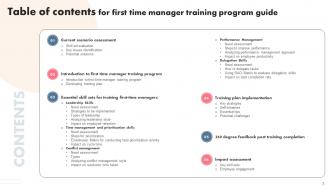
Slide 3: This slide shows Table of Content for the presentation.
Slide 4: This slide shows title for topics that are to be covered next in the template.
Slide 5: This slide depicts analysis of new manager appointed to identify critical areas requiring training and development and corresponding key insights.
Slide 6: This slide outlines potential organizational issues arising from the manager's skill deficiencies such as communication gaps, task execution, team morale, employee burnout etc.
Slide 7: This slide presents potential organizational issues arising from the manager's skill deficiencies such as communication gaps, task execution, team morale, employee burnout etc.
Slide 8: This slide shows title for topics that are to be covered next in the template.
Slide 9: This slide introduces the concept of first time manager training program and reasons for implementing which includes impact on employee retention, team performance correlation etc.
Slide 10: This slide outlines the comprehensive New Manager Training Plan, covering key details on content, resources, timeline, provider, and training status for each area.
Slide 11: This slide shows title for topics that are to be covered next in the template.
Slide 12: This slide highlights the imperative need for leadership training for managers, addressing critical competencies such as building relationships, developing people, driving change etc.
Slide 13: This slide provides practical strategies for developing leadership skills, involving asking questions, gaining hands-on experience and identifying leadership style.
Slide 14: This slide introduces various leadership styles for managers, covering Transformational, Delegative, Authoritative, Transactional, Participative, and Servant Leadership.
Slide 15: This slide showcases leadership style assessment test with statements and corresponding options with scoring scale that helps evaluate manager's leadership style.
Slide 16: This slide also showcases leadership style assessment test with statements and corresponding options with scoring scale that helps evaluate manager's leadership style.
Slide 17: This slide illustrates the improvement in employee retention before and after the implementation of enhanced leadership skills, showcasing a positive trend over consecutive quarters.
Slide 18: This slide shows title for topics that are to be covered next in the template.
Slide 19: This slide underscores the critical importance of time management and prioritization in the workplace, emphasizing their role in minimizing conflicts, enhancing customer satisfaction etc.
Slide 20: This slide outlines key steps for prioritizing team tasks effectively, covering clear goal definition, organized task lists, identifying urgent tasks and differentiating tasks.
Slide 21: This slide showcases Eisenhower Matrix for conducting task prioritization activity and relevant key instructions to be followed.
Slide 22: This slide depicts the impact of time management and prioritization on average cycle time of a project and its relevant key insights.
Slide 23: This slide shows title for topics that are to be covered next in the template.
Slide 24: This slide emphasizes vital role of conflict management skills in fostering improved relationships, increased productivity, talent retention, innovation, and a positive work environment.
Slide 25: This slide mentions various types of conflict management styles that can be applied by managers such as competing, collaborating, avoiding, compromising and accommodating.
Slide 26: This slide presents activity to be conducted to identify the potential conflict management approach of new manager appointed as per corresponding scoring criteria.
Slide 27: This slide mentions activity to be conducted to identify the potential conflict management approach of new manager appointed as per corresponding scoring criteria.
Slide 28: This slide depicts the impact of implementing conflict management strategies on average time taken to resolve them and its relevant key insights.
Slide 29: This slide shows title for topics that are to be covered next in the template.
Slide 30: This slide outlines the importance of performance management in enhancing training, morale, promotion decisions, career development, and workforce planning.
Slide 31: This slide mentions the process of managing employee performance by aligning them with company goals, developing performance outcomes, creating expectations, defining job development plans etc.
Slide 32: This slide represents role-playing scenarios for first-time managers to analyze and respond to various management challenges, helping them in develop effective decision-making.
Slide 33: This slide depicts the impact of implementing performance management initiatives on employee productivity rate and its relevant key insights.
Slide 34: This slide shows title for topics that are to be covered next in the template.
Slide 35: This slide highlights the critical importance of delegation skills for managers, emphasizing how it aids in prioritizing tasks, developing employee potential, building trust etc.
Slide 36: This slide outlines the key strategies for effective task delegation, including selecting right person for the task, explaining purpose, setting clear expectations etc.
Slide 37: This slide depicts practical exercise in delegating tasks effectively using the RACI matrix, tailored for first-time managers to enhance their delegation skills.
Slide 38: This slide displays the impact of implementing delegation skills by first time managers on task completion rate and its relevant key insights.
Slide 39: This slide shows title for topics that are to be covered next in the template.
Slide 40: This slide outlines key strategies for training new managers, focusing on developing a flexible mindset for delegation, anticipating future challenges, embracing ambiguity etc.
Slide 41: This slide displays key self-initiatives that first-time managers can undertake to foster their growth and effectiveness in their new role with emphasis on networking etc.
Slide 42: This slide presents essential tips for first-time managers to effectively transition into new role and lead teams successfully with strategies such as increasing visibility etc.
Slide 43: This slide outlines diverse challenges encountered in training first time managers and their corresponding description with solutions.
Slide 44: This slide shows title for topics that are to be covered next in the template.
Slide 45: This slide presents a comprehensive 360-degree feedback evaluation of new manager, showcasing individual ratings and average scores in Leadership, Time Management and Prioritization etc.
Slide 46: This slide shows title for topics that are to be covered next in the template.
Slide 47: This slide highlights the impact of training first time manager by identifying and improving critical areas with corresponding key insights.
Slide 48: This slide displays the impact of training first time on overall employee engagement rate with corresponding key insights.
Slide 49: This slide shows all the icons included in the presentation.
Slide 50: This slide is titled as Additional Slides for moving forward.
Slide 51: New team manager career roadmap
Slide 52: Understanding difference between manager and leader
Slide 53: This is Our Mission slide with related imagery and text.
Slide 54: This is About Us slide to show company specifications etc.
Slide 55: This is Our Team slide with names and designation.
Slide 56: This slide depicts Venn diagram with text boxes.
Slide 57: This is a Timeline slide. Show data related to time intervals here.
Slide 58: This slide displays Column Graph with two products comparison.
Slide 59: This slide describes Line chart with two products comparison.
Slide 60: This is a Thank You slide with address, contact numbers and email address.
First Time Manager Training Program Guide DTE CD with all 68 slides:
Use our First Time Manager Training Program Guide DTE CD to effectively help you save your valuable time. They are readymade to fit into any presentation structure.












FAQs for First Time Manager Training Program
Honestly, start with communication - you'll be playing translator between your team and the bosses constantly. Delegation is clutch too because doing everything yourself? Recipe for burnout, learned that one the hard way. Give feedback regularly instead of saving it all for reviews (people actually appreciate knowing where they stand). Oh, and definitely work on reading people better - emotional intelligence stuff - since you'll deal with so many different personalities. Conflict resolution too because workplace drama is inevitable. Don't try tackling all of this at once though. Pick one skill, practice it for a few weeks, then move on.
Watch how your team talks to each other first - don't rush in trying to fix everything right away. The real trick is catching problems early with quick one-on-ones before they blow up. Listen to everyone without picking sides (which honestly is harder than it sounds). When stuff does go sideways, call out specific behaviors instead of making it personal. You'll want to be super clear about communication expectations from day one. Oh, and this might be obvious, but actually model the teamwork you're expecting from them. Otherwise they'll just think you're being hypocritical.
Honestly, start with listening - like actually listening, not just waiting for your turn to talk. Put those one-on-ones in your calendar right now or you'll keep putting them off. Be super specific about what you need and deadlines, but ask for their thoughts too. Here's the thing though - everyone's brain works differently. Some need everything written down after you talk, others just want quick check-ins. I'd ask each person how they prefer getting feedback first, then actually do it that way. Don't assume they all think like you do.
Honestly, feedback is like having a cheat code for management. It shows you blind spots and helps you see how your team actually views you - not how you think they do. I used to hate getting criticism, but now I ask for it all the time instead of waiting for reviews. The key? Make people feel safe being honest. Actually listen and show you'll change based on what they say. Oh, and don't ask vague questions - be specific about situations. Try starting with someone you trust and ask about something from this week.
SMART goals are annoying to hear about but they genuinely help when you're figuring this out. Get your team to help set them instead of just telling everyone what to do - people actually care more when they're part of the process. Break the big stuff into smaller chunks you can celebrate. Regular check-ins work way better than waiting for formal reviews. Don't be afraid to pivot if something's clearly not working (I learned this the hard way). Schedule a team meeting this week to map out next quarter together. Trust me on this one.
Start with one-on-ones to figure out how each person actually likes to communicate. In meetings, call on the quiet people directly - they usually have good ideas but won't jump in. When someone's being exclusionary, shut it down right away. Don't wait and hope it'll sort itself out because honestly? It never does. Model what you want - admit when you're clueless about something and ask questions. Oh, and celebrate different backgrounds year-round, not just when HR tells you to. Creating that safe space where people can mess up and learn is everything.
Dude, emotional intelligence is what makes or breaks new managers. You've gotta read people - figure out what makes each person tick, stay cool when everything's on fire. Trust me, the ability to give feedback without destroying someone's soul? That's pure EQ right there. Plus you'll catch problems early when team members are struggling. Office politics become way less painful too. Oh, and managing your own stress reactions - huge. Start watching how people respond to what you say and do. That awareness shift alone will level up your leadership game pretty fast.
Honestly, just use whatever your company already has - Monday, Asana, or even basic spreadsheets work fine. One-on-ones are where the magic happens though. I'd grab a simple template for those meetings (wish I'd done this from day one). Keep a basic tracking sheet for each person - wins, stuff they need to work on, career goals. That's really it. Don't get sucked into buying some expensive performance software right away. The key is actually having regular conversations and writing down what you talked about afterwards. Way more important than the tool itself.
Match tasks to what people are actually good at, not just random busy work. Give them context on why it matters and what good looks like, then back off and let them figure it out. I learned this the hard way - used to hover over everything and it drove everyone nuts! Be around for questions but don't breathe down their necks. Set up milestone check-ins instead of constant pestering. When they nail it, make sure their success gets noticed by others. Oh, and start with smaller stuff first to build that trust up gradually.
Ugh, don't try being everyone's bestie - you're their boss now, not their drinking buddy. Micromanaging is tempting when you're freaking out, but resist it. Also? Use your team's brains! They know stuff you don't, so ask before making big calls. Those uncomfortable performance chats you're avoiding will bite you later - just rip the bandaid off. Set clear expectations from day one or you'll be silently fuming when nobody reads your mind (spoiler: they can't). Start with one-on-ones to figure out what each person actually wants and what's bugging them.
Honestly, you've gotta block out time for your own stuff first - literally schedule it or it won't happen. Figure out what you can actually hand off to your team (more than you think, probably). I used to micromanage everything and it was exhausting. Set up regular check-ins so people aren't bugging you all day with random questions. The biggest thing though? Tell everyone when you're in focus mode versus when they can interrupt you. Your team will respect boundaries if you're clear about them. Oh, and let them make more decisions without you - that was hard for me at first but such a game changer.
Honestly? Just do what you say you're gonna do - sounds simple but half the managers I've had couldn't even manage that. Don't fake it when you don't know something (we can all tell anyway). Listen way more than you talk, especially at first. Ask your team what they actually need instead of guessing. Own your screwups fast - shows you're not some robot. Oh, and fight for your people with the higher-ups. That loyalty goes both ways. Trust takes forever to build but like two seconds to destroy, so focus on the little daily stuff that actually matters.
Dude, you're gonna need mentoring as a new manager - trust me on this one. Going from doing the work to managing people is like switching careers entirely. Most folks get promoted because they crushed their individual role, not because they knew how to deal with difficult employees or delegate properly. Communication becomes everything. A good mentor helps you avoid those cringe moments we've all seen bad managers do. Find someone whose style you actually respect and start meeting regularly - even just coffee chats help tons. You'll learn way faster than figuring it out solo.
Honestly, just watch how your boss operates first. Some are super direct, others want everything to be a group discussion. I made this mistake with our VP - kept being way too casual when she clearly wanted formal updates with all the details. Pay attention to meeting styles and whether they want bullet points or full reports. My advice? Stay true to yourself but be flexible about *how* you communicate. Like, don't completely change your personality, but maybe dial up the formality if that's their thing. It's basically reading the room but for work relationships.
Boundaries are huge - stop trying to do everything yourself and actually delegate stuff. Block out thinking time or you'll just bounce between meetings all day like a ping pong ball. Weekly check-ins with your boss are clutch for catching issues early. Oh, and find other new managers to complain with because honestly, we're all just winging it. Don't forget to take your vacation days too - your team watches what you do more than what you say. Try blocking 30 minutes of buffer time daily this week. Trust me on that one.
-
I want to express my gratitude to SlideTeam’s presentation design services team for helping me create the best presentation of my life!
-
Informative presentations that are easily editable.