


Five major types of technological trajectories and paradigms




Try Before you Buy Download Free Sample Product
 Impress Your
 Audience
 100%
100% Editable
 Save Hours
 of Time


Our Five Major Types Of Technological Trajectories And Paradigms are topically designed to provide an attractive backdrop to any subject. Use them to look like a presentation pro.
People who downloaded this PowerPoint presentation also viewed the following :
Content of this Powerpoint Presentation
When it comes to getting things done in the realm of technology, choosing the correct one for the purpose at hand plays an important part in your business. You may also need to enlighten the management of your organization, business investors, or the general audience about technology domains accessible to your business, and their trajectories, for feasible decision-making. This process of enlightenment needs to be easy, comprehensive, and sophisticated.
What can help you greatly is SlideTeam’s 100% editable and customizable technological trajectories and paradigms template. This slide allows you to showcase five technologies and their paradigms with ease. The document alone could be sufficient enough to cater to the questions of your audience about the technology you can use in your business operations and otherwise.
A bit confused? Check out the description of the template offered below and get the required information with ease.
If you want to showcase technological paradigm and trajectory in a graphical manner rather than a descriptive one, then this template can help you achieve the same.
Template 1: Five Major Types of Technological Trajectories and Paradigms
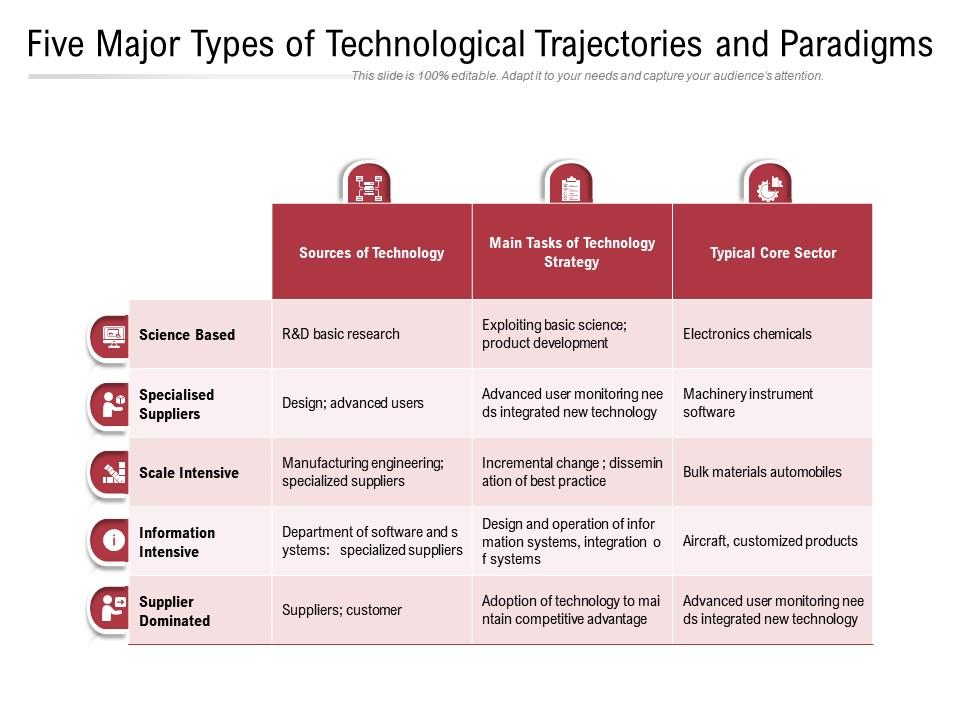
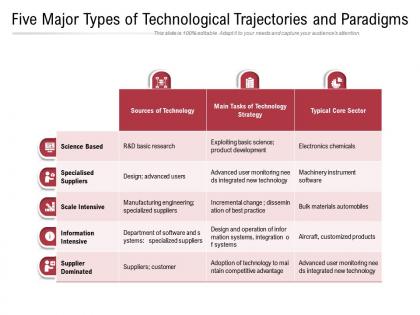
This document takes the help of a tabular structure to explain and compare five major technologies available at your disposal viz. Science-Based, Specialized Suppliers, Scale Intensive, Information Intensive, and Supplier Dominated. For comparisons on feasibility, you can represent sources of technology, major tasks technology performs in strategy, and the typical core sector. For individual technology types, you can even make a detailed, descriptive analysis. For example, the Source for Science-Based Technology could be basic research and development and more.
Here’s a flowchart that will help you explain your technology’s paradigm and trajectory in a feasible manner.
Choose the Most Suited Technology Paradigm with Ease
This concludes the technological paradigms and trajectories template provided above. Using this template, you can easily compare and select the perfect technological paradigm suited to your requirements. The slide also helps you justify your decision to proceed with one technology type over any other.
Still looking for an alternative template for technological paradigms and technological trajectories, you can check out the one offered in this template.
Five major types of technological trajectories and paradigms with all 2 slides:
Use our Five Major Types Of Technological Trajectories And Paradigms to effectively help you save your valuable time. They are readymade to fit into any presentation structure.
FAQs for Five major types of technological
Honestly, it's mostly about companies trying to outdo each other right now. Everyone's throwing money at innovation because customers expect everything to be lightning-fast and personalized - which is kinda exhausting if you ask me. VCs are still funding tons of startups, though that's slowing down lately. Plus regulations around privacy and climate stuff are pushing companies to innovate in ways they wouldn't have before. My advice? Focus on actual problems people have. That's where the real opportunities are, not just building cool tech for the sake of it.
Look, new tech basically forces old businesses to evolve or die. Think about it - Blockbuster got crushed by streaming, Uber wrecked the taxi industry, and now AI's changing everything from customer service to factories. It's wild how fast it happens. Some companies figure it out (Netflix ditched DVDs for streaming), but others just... don't make it. The smart move? Pay attention to what's coming in your space and try stuff out before you're scrambling to catch up. Companies that wait too long usually regret it.
Here's the thing - people won't take risks if they're terrified of screwing up. Build that psychological safety first. Give teams actual time for side projects (Google's 20% thing was genius, btw). Create spaces where different departments can actually talk to each other instead of staying in silos. When someone fails intelligently? Celebrate it publicly alongside the wins. Also, get your people to conferences and workshops - fresh perspectives matter. But honestly, none of this works if leadership isn't curious themselves. Executives need to ask "what if" questions or everyone else just plays it safe.
Honestly, consumer feedback is like having a GPS for product development - you'll avoid driving straight into a wall. Get people's reactions early, even with just sketches or rough concepts. Sure, everyone has opinions and some are totally useless, but the good stuff helps you figure out if you're solving an actual problem or just something you made up in your head. I've seen too many teams build entire products only to discover nobody wanted them in the first place. The key is asking for input throughout the whole process, not just at the end when it's expensive to change things.
Honestly, IP laws are kinda a double-edged sword for tech stuff. Sure, patents protect your inventions and make R&D investments worth it. But then you get companies hoarding patents or going crazy with lawsuits - remember all those ridiculous smartphone wars a few years back? The tricky part is getting the balance right. You want enough protection so people actually innovate, but not so much that nobody can build on existing ideas. Oh, and definitely check what patents already exist before you start developing anything new. Trust me, finding out later is way more expensive than doing the research upfront.
So you're basically looking at four big things: privacy, bias, job displacement, and safety. Privacy's the worst because companies grab your data and nobody actually reads those terms of service, right? Then you've got AI systems that are super biased against certain groups. Automation could kill entire industries too. Safety stuff gets scary with self-driving cars and medical equipment - like, what if it just breaks? I know it sounds like a lot, but really just ask yourself early on: who wins, who gets screwed over, and is that actually fair?
Yeah totally, it's like getting the best of both sides. Startups move fast and think outside the box, but they're always broke lol. Big companies? They've got money, customers already lined up, and know how to deal with regulations. When they team up, the startup gets resources to actually grow while the big company gets fresh ideas. The trick is making sure it's not just the corporation stealing concepts - both sides need to win something real. Oh and definitely look for partnerships where knowledge flows both ways, not just one direction.
Mix leading and lagging indicators - that's your best bet. Track inputs like R&D spend and patent applications, plus outputs like revenue from new products and customer adoption rates. Don't forget the cultural side either - employee engagement in innovation programs matters more than people think. ROI gets weird with innovation since results take forever, but still measure it. Honestly though? Pick 3-4 metrics that actually match your goals instead of going crazy trying to track everything. You can always add more once you've got a solid baseline going.
Dude, government policy basically controls where tech money flows. R&D tax credits push innovation forward, patent laws either protect your ideas or screw you over. DARPA literally built the internet's backbone with government cash. Trade wars are messing with chip manufacturing big time right now - it's honestly wild to watch. Some regulations help by setting clear standards, others just create paperwork nightmares. My advice? Watch policy shifts in your field closely. That's usually where the funding goes next, and honestly where the smart money follows.
Yeah, AI's changing things for sure, but not in that dramatic "robots steal everything" way people panic about. Repetitive stuff will probably get automated first. Jobs needing creativity or people skills? Those are actually growing. New roles keep popping up too - like AI trainers and prompt engineers (who knew that'd be a thing?). Reminds me of when the internet created jobs nobody saw coming. I'd say focus on skills that work WITH AI instead of against it. Critical thinking, human connection - that stuff's not going anywhere. Don't stress too much about it.
Start with pilot programs - test stuff small before going big. Build diverse teams because they'll catch blind spots you totally missed. Always have a backup plan ready (tech WILL fail at the worst moment, trust me). Set clear metrics upfront so you know when to pivot or just kill it. Create a culture where smart risks get rewarded and failures become learning moments instead of career death sentences. Honestly, most companies are way too scared of intelligent failure. Measure everything, scale what actually works. The whole "start small then grow" approach saves so much headache later.
Honestly, AI and machine learning are everywhere right now - transforming healthcare, finance, you name it. Sustainability's huge too, with companies scrambling for cleaner tech solutions. Remote work basically forced everyone into digital transformation overnight (crazy how fast that happened). Manufacturing's getting way smarter with IoT and edge computing. These are the areas where real disruption's happening, so probably worth focusing there. Though I feel like everyone's chasing the same trends sometimes - makes me wonder what we're all missing while looking in the obvious places.
Oh totally, globalization is like rocket fuel for innovation. Companies can grab talent from anywhere now - your dev team might be spread across three continents. Ideas bounce around way faster when researchers collaborate globally instead of staying in their little bubbles. And honestly? Competition is brutal but amazing for pushing boundaries. Some startup in Estonia drops a killer product and suddenly everyone's scrambling to keep up. Money flows to the best ideas regardless of zip code, which is pretty cool. Supply chains got smoother too, so getting new tech out there happens quicker. Bottom line - if you're building something, think worldwide from the start because everyone else already is.
Honestly, start with three things. Get your team learning new stuff constantly - like, make it part of their actual job, not just a side thing. Partner up with startups or tech companies, even competitors sometimes. I know it sounds weird but those collaborations can be gold. Speed up how you make decisions too. The companies crushing it right now aren't the richest ones - they're just faster at changing direction when something new pops up. Maybe audit where you're being too slow? Oh, and create space for people to try things without getting in trouble if they don't work out.
Dude, you *have* to think about sustainability from the start now. Consumers won't buy stuff that's terrible for the planet, and investors are getting picky too. Regulations keep getting stricter everywhere. But here's the thing - some of my favorite new products actually came from companies trying to solve environmental problems first. It forces you to get creative, you know? Don't just tack it on later as some afterthought. Maybe start with a basic lifecycle assessment? Also saves money long-term when you're not wasting resources like crazy.
No Reviews