


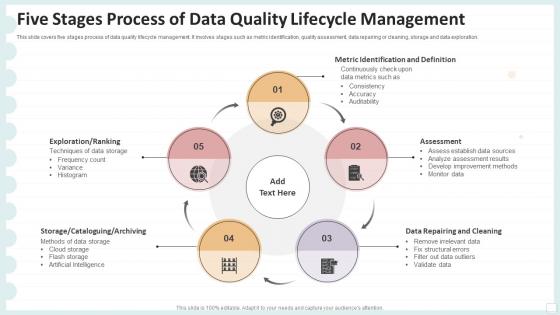
Five Stages Process Of Data Quality Lifecycle Management




Try Before you Buy Download Free Sample Product
 Impress Your
 Audience
 100%
100% Editable
 Save Hours
 of Time


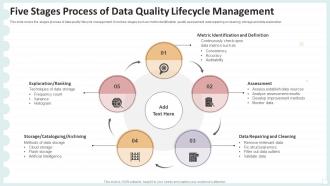
This slide covers five stages process of data quality lifecycle management. It involves stages such as metric identification, quality assessment, data repairing or cleaning, storage and data exploration.
People who downloaded this PowerPoint presentation also viewed the following :
Five Stages Process Of Data Quality Lifecycle Management with all 6 slides:
Use our Five Stages Process Of Data Quality Lifecycle Management to effectively help you save your valuable time. They are readymade to fit into any presentation structure.





FAQs for Five Stages Process Of Data
So there are six stages in the Data Quality Lifecycle: Define (figure out your quality standards), Measure (see where you're at now), Analyze (find what's causing problems), Improve (fix stuff), Control (keep monitoring), and Sustain (make it stick long-term). Honestly? Getting everyone to agree on what "quality" actually means during Define is usually the biggest headache. Once that's sorted though, everything else flows pretty smoothly. My advice - just pick one dataset that really matters and walk through these steps. You'll get the hang of it way faster than trying to understand it all theoretically first.
Honestly, data profiling is like getting a reality check on your dataset before you do anything else. You'll find weird patterns, missing chunks, and data types that make zero sense - there's always something funky lurking in there. Without knowing what mess you're dealing with first, you can't really fix it properly. Sample a bit of your data before going all-in on the full analysis. It helps you figure out which problems to tackle first and how much time you'll actually need. Saves you from those "oh crap" moments later.
So first thing I'd do is profile your data - look for weird outliers, missing stuff, patterns that seem off. Cross-check it against sources you trust, basically fact-checking but for datasets. Run some statistical analysis to catch distributions that don't make sense. Automated tools are honestly a lifesaver here, they'll spot things you'd totally miss doing it by hand. Oh and definitely set up validation rules and monitoring dashboards. Trust me, catching problems early beats dealing with messy data issues later when everything's already broken.
So most places do a combo of automated stuff plus manual checking. They'll set up rules to catch the obvious junk - duplicates, missing data, wonky formatting. That part's easy enough. Where it gets messy is deciding between two customer records that both look legit (ugh, hate those). You need someone actually owning these decisions though, like a proper data steward role. Oh and don't try to fix everything at once - that's a nightmare. Just focus on your most important data fields first and work from there.
So data enrichment is basically filling in missing pieces to make your data actually useful. You take what you have - like a customer's name and email - then add demographic info, location data, company details, whatever. Suddenly you've got a full profile instead of just fragments. Third-party sources can give you behavioral patterns and preferences you'd never capture otherwise. Short sentences work here. The trick is picking enrichment that matches your actual business goals, not just throwing random data at everything. Otherwise you're making your dataset messier, which honestly defeats the whole point.
Honestly, automated tools are a lifesaver for this stuff. You can set them up to run all those tedious validation checks - pattern matching, outlier detection, the works. No more babysitting data all day. They'll monitor your streams continuously and catch problems way faster than you ever could manually. The best part? Real-time alerts when something goes wrong. I'd start with your most critical data sources first - no point automating everything at once. Oh, and make sure those alerts actually work because there's nothing worse than finding out about issues three days later.
Think of metadata as your data's backstory - where it came from, how it got messed with, what it actually means. When stuff breaks (and it will), you'll need that trail to figure out what went wrong. Debugging without it is like... well, debugging without comments. Absolute nightmare. The trick is baking this into your pipelines from the start, not scrambling to add it later when everything's on fire. Document your lineage and business rules now. Trust me, you'll be so grateful you did when you're troubleshooting at 2am wondering why the numbers don't match.
Honestly, start by figuring out who actually owns what data - like assign real people to be responsible for specific stuff. Automated monitoring is a lifesaver because manually checking everything is brutal. You'll want standard processes for collecting and updating data, but here's the thing - it has to fit into people's normal work or they'll just ignore it. I've seen too many "governance initiatives" die that way. Set up alerts for when things go wrong (trust me on this one), do periodic check-ups, and maybe start with your most important datasets first. Don't try to boil the ocean right away.
So definitely track completeness, accuracy, consistency, and timeliness - those are your big four. Completeness is just missing data percentages. Accuracy shows if your data actually matches reality. Consistency catches contradictions between systems, and timeliness tells you how fresh everything is. Also worth looking at duplicate rates and schema compliance, though that really depends on your specific situation. The whole point is measuring these consistently so you can spot trends early - trust me, catching problems before they blow up is way better than dealing with the aftermath. Set up automated dashboards with alert thresholds because manually checking this stuff constantly will drive you insane.
User feedback and audits are basically your GPS for finding what's broken. People complaining about wonky data? That's gold - they're spotting real problems you'd probably miss sitting at your desk. Audits back this up and catch the sneaky systematic stuff too. Some patterns will genuinely surprise you, not gonna lie. Use both to figure out what needs fixing first, then update your rules and alerts accordingly. The trick is actually following through though - document everything, make changes, then double-check it worked. Otherwise you're just collecting complaints for no reason.
Ugh, you're gonna deal with data coming from everywhere and nobody knows who owns what. Requirements change constantly too - drives me crazy. The worst part? People think data quality is someone else's job, so good luck getting help. Then there's the nightmare of connecting systems that hate each other. Oh, and your project will definitely get pushed aside for "more important" stuff. Start with just one data source that really matters. Set up some basic rules early on. Show leadership numbers they care about - revenue impact, whatever gets their attention.
You definitely need your stakeholders involved - this stuff just doesn't work without them. Business users know what good data actually looks like and they're dealing with the headaches when it's garbage, so they're motivated to fix it. Get them defining your quality standards and giving feedback on rules. The technical team might miss context that seems obvious to someone who uses the data daily. Honestly, if you don't get buy-in from stakeholders, it'll just be another IT project that solves nothing. Find your key data users first and bring them in early - trust me on this one.
Bad data just screws everything up, honestly. You're basically making decisions with garbage info - like trying to navigate with a broken GPS. Your strategies go sideways, you miss obvious opportunities, and money gets wasted on random stuff. I watched one team chase completely bogus metrics for three months straight (painful to witness). Once people stop trusting your numbers, they'll just wing it instead. Figure out which business decisions actually matter most, then work backwards to see what feeds those. Oh, and incomplete data is almost worse than no data sometimes.
Honestly, data profiling first is non-negotiable - you need to know what mess you're dealing with. Set validation checkpoints throughout the whole migration and test on smaller chunks before going all-in. Map out your transformations clearly so when stuff breaks (and it will), you can actually figure out where. Oh and rollback plans are a lifesaver. Keep logs of everything too, even the boring stuff. Once you're done, validate against your source system because silent corruption is the worst kind of surprise.
Honestly, stop treating data quality like just an IT thing. Train your people so they actually get why clean data makes their jobs easier - nobody wants to deal with messy spreadsheets all day. Pick specific people to own different data areas and give them real power to fix stuff. We had amazing results when we started celebrating teams who caught problems early, made them feel like heroes. Regular check-ins help too where everyone can complain about data issues without getting blamed. The trick is building it into performance reviews so people actually care. Otherwise it just becomes another forgotten project gathering dust.
-
I was confident and well prepared for my presentation for the first time ever. With SlideTeam’s templates, I could deliver one of my best presentations. Will be coming back for more!
-
Great product with effective design. Helped a lot in our corporate presentations. Easy to edit and stunning visuals.