


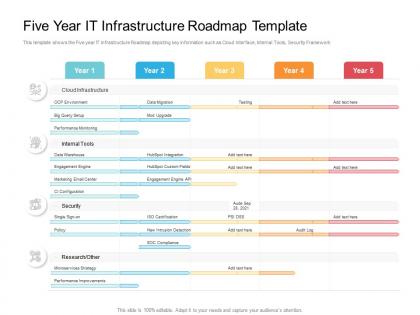
Five year it infrastructure roadmap timeline powerpoint template




Try Before you Buy Download Free Sample Product
 Impress Your
 Audience
 100%
100% Editable
 Save Hours
 of Time


Our Five Year IT Infrastructure Roadmap Timeline Powerpoint Template are topically designed to provide an attractive backdrop to any subject. Use them to look like a presentation pro.
People who downloaded this PowerPoint presentation also viewed the following :
Five year it infrastructure roadmap timeline powerpoint template with all 2 slides:
Use our Five Year IT Infrastructure Roadmap Timeline Powerpoint Template to effectively help you save your valuable time. They are readymade to fit into any presentation structure.
FAQs for Five year it infrastructure roadmap
Start by figuring out what you've got right now - can't go anywhere without knowing where you are. Then map out where you want to end up and what's missing in between. Build a timeline with realistic milestones and budget estimates. Security stuff is non-negotiable, trust me on this one. Don't skip the boring parts like capacity planning and how everything connects to your current systems. Make sure it actually matches your business goals, and honestly? Keep it flexible because priorities change constantly. Also factor in when you'll need to refresh hardware - that always sneaks up on people.
Look, your IT roadmap has to match what the business actually wants to achieve. Want to expand globally? Focus on cloud infrastructure that can scale. Going digital-first? Automation becomes your priority. I always think of it like renovating - you wouldn't just start knocking down walls without knowing what you're building, right? Same deal here. Map every tech project back to a real business goal, otherwise you're just throwing money at random stuff that won't actually help. Trust me, I've seen too many companies waste budget on "cool" tech that doesn't move them forward.
First thing - document literally everything you've got. Hardware, software, network stuff, all of it. Even the obvious things because trust me, you'll forget something important later. Check your performance metrics and figure out where the bottlenecks are hiding. Map out how different components depend on each other (this is where it gets really messy). Talk to your actual users too - they'll tell you what's broken that you didn't even know about. Be honest about what's actually working vs what you *think* is working. That baseline helps you figure out what needs fixing now versus what can wait.
Honestly, don't try moving everything at once - I've seen that blow up spectacularly. Pick your least critical stuff first, like dev environments or apps you won't cry over if they break. Map out maybe 12-18 months and go in phases. Training your team costs more than you think, so budget for that. Most places end up hybrid anyway, so plan for keeping some stuff on-premise. Security requirements will probably surprise you too. Start with one pilot project to test your approach. Oh, and prioritize based on what'll actually save money or help the business - not just what seems easiest to move.
Dude, security isn't something you slap on at the end anymore - it drives literally everything in IT planning now. Every cloud move, network upgrade, whatever... you've gotta think security first. I learned this the hard way at my last job, honestly. Build your timeline around fixing your biggest vulnerabilities while still hitting business goals. Regular assessments are non-negotiable. Budget for tools that actually play nice with what you already have instead of creating more headaches. The "we'll deal with security later" mentality will bite you in the ass every single time.
Start with what's actually broken vs what would just be nice to fix. Security stuff has to come first - trust me, you don't want to deal with a breach. Map everything by business impact and how urgent it really is. Score each project 1-5 on value, risk, and how much work it'll take. Dependencies matter too - some things have to happen before others can start. Build a visual timeline showing quick wins alongside your bigger projects. Makes it way easier when you're talking to stakeholders since they can actually see what's happening when.
Track uptime first - that's what everyone notices when it breaks. Then add performance benchmarks and how often security stuff goes wrong. Business-wise, look at cost per user and deployment speed. User satisfaction scores matter too since people get really vocal when things suck. Oh, and measure how fast you can scale resources - that one's huge for planning. Honestly though, pick like 3-4 metrics max to start. I tried tracking everything once and it was a nightmare to manage.
Look, don't just chase whatever tech is trending on LinkedIn right now. Pick stuff that actually makes sense for your business goals. I'd start with small pilots - maybe test some AI tools or cloud-native solutions, whatever fits your situation. Honestly, most "emerging" tech is still pretty half-baked anyway. Budget these experiments into your 3-5 year plan with realistic timelines. Don't forget you'll probably need infrastructure upgrades too (that always gets overlooked). Test small first. If it works, then scale up. Most pilots fail anyway, so don't bet the farm.
Honestly, most people mess up by being way too optimistic about timelines - I've seen so many teams crash and burn on this. Don't leave stakeholders out of early planning either. Your roadmap can't be super rigid because tech moves crazy fast. Budget reality checks are huge too (trust me on that one). Also, I get that new tech is exciting, but you've got to think about how it actually works with what you already have. Map out your dependencies first and get the key teams on board before you lock anything down. Way easier than backtracking later.
Honestly? Check it every quarter, then do the big overhaul once a year. Tech changes so damn fast - like, remember when everyone thought the metaverse was gonna be huge? Quarterly reviews help you spot when priorities shift or budgets get slashed before you're completely off track. The yearly deep dive is for rethinking your whole 3-5 year game plan. I'd start scheduling those quarterly meetings with your team now. Way better than playing catch-up when everything's already gone sideways.
Honestly, start with what makes you money or keeps the lights on - those projects get funded first. Security and compliance are boring but you can't skip them, trust me on that one. Technical debt is sneaky too; putting off system upgrades always comes back to haunt you later. Map everything to actual business results, then look at your team's bandwidth and skills for timing. I'd throw in some cushion for random stuff that'll definitely pop up mid-year. Revenue growth and critical operations should drive most decisions, but don't ignore the unsexy infrastructure work.
Look, you really can't skip stakeholder engagement when building your IT roadmap. Otherwise you'll build stuff nobody wants or needs. Get them involved early so you actually understand their pain points and what's coming down the pipeline business-wise. Here's the thing - engaged stakeholders become your biggest cheerleaders instead of constantly pushing back later. They'll help you get budget approved, set realistic timelines, and you'll look way more credible when presenting to the C-suite. Honestly, I'd start by figuring out who your key people are and then set up regular check-ins with them throughout the whole process.
TOGAF's solid for enterprise architecture - gives you structure but isn't crazy rigid. If you're more into service management stuff, ITIL's the way to go. Most teams I've seen just cherry-pick from different frameworks anyway, which honestly makes sense. Lean portfolio management is worth checking out too, especially if you're doing agile. Main thing is matching whatever you pick to how mature your org actually is. Don't go overboard right away - start simple and build up the process as you learn what works. I've seen too many teams get bogged down trying to implement some perfect framework from day one.
Look, your IT setup is what makes or breaks how fast you can adapt when things change. Got modern, flexible infrastructure? You'll scale quickly and roll out new apps without wanting to pull your hair out. Stuck with legacy systems? Good luck moving faster than molasses. It's honestly like comparing a sports car to some beat-up old pickup truck. Cloud-native stuff and automation give your team room to actually respond to opportunities instead of getting stuck waiting on tech issues. I'd definitely map out where your current setup is creating those annoying bottlenecks first.
First thing - map out what you've actually got right now. Can't plan anything without knowing the mess you're starting with. Prioritize by what'll hurt the business most if it breaks, plus tackle the worst technical debt. Don't try fixing everything at once though, that's a recipe for disaster. Quick wins first to show progress. Cloud migration and APIs are clutch here, containerization too. Run old and new systems side by side during switches - trust me on this one. Also document like crazy and get your team up to speed early. Otherwise you'll be the only one who knows how anything works.
-
Enough space for editing and adding your own content.
-
Awesome use of colors and designs in product templates.
-
Visually stunning presentation, love the content.
-
Easily Editable.
-
Best Representation of topics, really appreciable.
-
Best way of representation of the topic.
-
Editable templates with innovative design and color combination.