


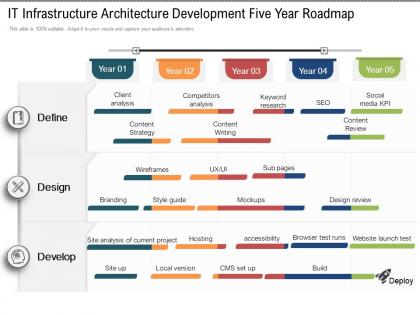
It infrastructure architecture development five year roadmap




Try Before you Buy Download Free Sample Product
 Impress Your
 Audience
 100%
100% Editable
 Save Hours
 of Time


Visualize your work plan and communicate your ideas impactfully with our pre designed IT Infrastructure Architecture Development Five Year Roadmap. Showcase the detailed overview of the project, the key deliverables, and the milestones to be achieved with the help of our fully customizable PowerPoint layout. You can easily emphasize on the project goals and discuss all the activities involved in an easy to comprehend manner by utilizing our professionally designed PPT theme. This roadmap PowerPoint layout is a perfect strategic planning tool that can help in keeping the project on track. With our attractive PowerPoint theme, you can articulate the workflow, track the work progress, and have a clear vision of the goal to be achieved. Download this versatile IT Infrastructure Architecture Development Five Year Roadmap and save your hours of work.
People who downloaded this PowerPoint presentation also viewed the following :
It infrastructure architecture development five year roadmap with all 2 slides:
Use our IT Infrastructure Architecture Development Five Year Roadmap to effectively help you save your valuable time. They are readymade to fit into any presentation structure.
FAQs for It infrastructure architecture development
So you'll need the basics first - servers or cloud stuff, storage, and networking. Security layers are obviously huge too. Monitoring and backups saved my butt more times than I can count, so don't skip those. Load balancing and identity management matter way more than people think. Honestly, networking is where most setups fall apart because it touches literally everything performance-wise. I'd map what you've got now, figure out the biggest gaps, then tackle whatever's causing you the most headaches first. Budget's probably gonna dictate the timeline anyway.
Start with frameworks like ITIL or COBIT to do a proper infrastructure assessment. Map out what you actually have - not what you think you have, because those are always different lol. Benchmark against industry reports too. Honestly, most companies skip this baseline step and it bites them later. Document everything from network setup to security controls. Then spot the biggest gaps between your current state and best practices. Oh, and prioritize by business impact, not whatever shiny tech sounds fun. That's usually where people mess up.
Honestly, cloud computing has become pretty much essential for most businesses these days. You get instant scalability and only pay for what you actually use - way better than buying a bunch of servers upfront. The flexibility is huge too, especially when you need to test new stuff or handle traffic spikes. I mean, nobody really wants to babysit physical hardware anymore, right? A lot of companies go hybrid - keep their sensitive data on-site but use cloud for everything else. My advice? Start with your dev and testing environments first. They're usually the easiest to move and you'll see benefits right away.
Honestly, the best IT roadmaps are built for change from day one. Think modular systems instead of those massive, rigid setups that break if you look at them wrong. Cloud-native stuff, APIs, microservices - they let teams work independently without stepping on each other's toes. I've watched companies completely stall out because their infrastructure couldn't adapt fast enough when priorities shifted. Build in room for experimenting and quick deployments. Oh, and start by figuring out what's currently your biggest pain point - then work backwards from there using modern patterns to fix it.
So you gotta plan for both vertical and horizontal scaling right from the start. Vertical is just throwing more CPU/RAM at your existing servers. Horizontal means adding more machines to spread the load around. Honestly, plan for at least 3x what you think you'll need - I've seen too many people get burned by underestimating this. Your bandwidth, storage, compute resources, all of it. Also worth looking into containers and cloud stuff early on since they make everything way more flexible down the road. Build things modular so you can grow piece by piece instead of rebuilding everything. Oh, and document your capacity limits now so you actually know when to scale.
Build security right into your system from the start - trust me, retrofitting it later is a nightmare. Go with zero-trust (verify everything basically) and set up proper access controls plus network segmentation. Don't skip the regular audits and compliance checks... I've watched companies get absolutely wrecked because they thought they could handle it later. Document everything as you go for compliance stuff. Keep your security frameworks fresh since threats change constantly. Oh and treat this as ongoing work, not something you check off once and forget about.
You'll want to cover all your bases - network, servers, and apps. PRTG or SolarWinds handle network stuff really well. For servers, Nagios and Zabbix are solid, though I'm personally loving Datadog lately. Log management is huge too - ELK stack or Splunk will save your butt. AppDynamics catches app issues before users start complaining, which is clutch. Honestly, the specific tools don't matter as much as making sure you're not missing blind spots. Set up decent alerting thresholds and start with whatever's most critical. You can always expand later once you get the basics dialed in.
Honestly, don't try to move everything at once - that's a recipe for disaster. Map out what you've got on-prem first, then pick some low-stakes workloads to test with. New apps or non-critical stuff usually work best for pilots. Your network setup is gonna be the real pain point though, making sure everything talks to each other properly between environments. Data governance gets messy too since you'll have sensitive stuff scattered across multiple locations. I'd set up checkpoints every few months to see how costs and performance are actually looking. You can always pivot your strategy once you figure out what's working and what isn't.
Honestly, the worst thing you can do is plan too far out - I've watched companies spend months on 5-year roadmaps that were trash within 18 months. Talk to actual users first, don't just sit in a room making assumptions. Migration is always messier than you think it'll be. Oh, and budgets matter more than perfect tech specs (learned that one the hard way). Focus on what's actually broken right now. Plan maybe 12-18 months max, then reassess. Build stuff that's flexible so you're not completely screwed when priorities shift.
Dude, AI and IoT totally flip how you think about infrastructure. Your edge computing needs to get way beefier because all those IoT devices dump insane amounts of data - can't send it all back to your main data center without killing performance. GPU requirements for AI are no joke, honestly way more demanding than traditional workloads. Network bandwidth? Plan for triple what you have now, maybe more. You'll need real-time processing scattered throughout your setup too. Oh and start by checking what edge capabilities you actually have right now - figure out where you need distributed processing first.
Start with monitoring tools to see what you're actually using - most people just guess and waste money. Containerization helps squeeze more out of your servers too. Cloud scaling is honestly a game changer since it adjusts automatically without you babysitting it. Get your baseline metrics first though, that's crucial. Then work from your most expensive stuff down. I'd set up alerts for when things hit certain thresholds so you catch problems early. The whole "optimize based on real data" thing sounds boring but it actually saves you tons of headaches later.
Look, you gotta map everything back to what the business actually wants first. Sit down with stakeholders regularly - find out if they're pushing for faster launches, cutting costs, whatever. This gets ignored so much and then IT just becomes this weird separate thing nobody understands. Figure out which infrastructure stuff directly helps hit those goals, then prioritize based on impact and how urgent it really is. Oh and review quarterly because priorities change like crazy. I learned this the hard way when we built this whole system nobody ended up needing.
Dude, start with something simple like automated backups - don't try to automate everything at once. You'll save tons of time on the boring stuff like provisioning and patching, plus your team can actually work on interesting projects instead of firefighting all day. The best part? No more "oh crap, I forgot to update that server" mistakes since everything runs the same way each time. Honestly, I was skeptical at first, but the consistency alone makes it worth learning. Once you get comfortable with basic monitoring alerts, you can expand from there. It's pretty addictive actually.
Honestly, you gotta build disaster recovery right into your setup from the start - can't just slap it on later and hope it works. First thing: figure out your RPO and RTO requirements. Most people totally skip this part and kick themselves later. Design redundancy across multiple zones, set up automated backups, and build failover systems for anything critical. Oh, and don't forget data replication strategies. Here's the thing though - you absolutely have to test your DR plan regularly. Untested recovery is basically just expensive storage sitting there doing nothing. I'd start with your most business-critical stuff first, then expand from there.
Uptime is your bread and butter - shoot for 99.9% or whatever your SLA says. Track response times, throughput, and how hard you're hitting CPU/memory/storage. Security incidents matter too (nobody wants to be the breach team, yikes). Cost per service keeps the finance folks happy during budget season, which honestly saved my butt last year. User satisfaction through surveys or ticket volume tells you if people actually like what you're building. Oh, and resource utilization - forgot that one. Start with these basics, then add weird edge-case metrics when you find specific problems.
No Reviews