


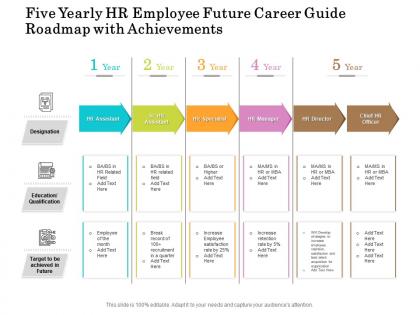
Five yearly hr employee future career guide roadmap with achievements




Try Before you Buy Download Free Sample Product
 Impress Your
 Audience
 100%
100% Editable
 Save Hours
 of Time


A well thought out action plan makes execution easier and increases the possibility of success significantly. Ensure hitting all the milestones within the deadlines by introducing our fully customizable Five Yearly HR Employee Future Career Guide Roadmap With Achievements. Streamline the work related information, budget, timeframe, key deliverable, landmarks, and major steps involved, all in one place to give an organized overview of the project by utilizing our PowerPoint theme. Minimize time lag and increase work efficiency by providing insight into the process with our comprehensively researched roadmap PowerPoint layout. Color coding helps in highlighting the process and grabs the attention of the audience. Download our handy Five Yearly HR Employee Future Career Guide Roadmap With Achievements to identify the possible problem areas in a much shorter time and propose solutions. Have a productive brainstorming session with your workforce by utilizing our action plan visualization tool.
People who downloaded this PowerPoint presentation also viewed the following :
Five yearly hr employee future career guide roadmap with achievements with all 2 slides:
Use our Five Yearly HR Employee Future Career Guide Roadmap With Achievements to effectively help you save your valuable time. They are readymade to fit into any presentation structure.
FAQs for Five yearly hr employee future career guide
Critical HR skills include communication, data analysis, employment law knowledge, conflict resolution, and strategic planning. These competencies enable HR professionals to streamline recruitment processes, enhance employee engagement, and deliver measurable business outcomes, with many organizations finding that skilled HR teams significantly reduce turnover costs while improving workplace productivity and compliance.
HR professionals can transition to management by developing strategic thinking, mastering data analytics, building cross-functional relationships, and gaining experience in talent development and organizational change initiatives. This progression typically involves taking on project leadership roles, pursuing HR certifications, and demonstrating measurable impact through improved retention rates and employee engagement, ultimately positioning themselves as strategic business partners.
Valuable HR certifications include PHR (Professional in Human Resources), SHRM-CP (Society for Human Resource Management Certified Professional), SPHR (Senior Professional in Human Resources), HRCI credentials, and specialized certifications in compensation or talent management. These certifications enhance credibility, demonstrate expertise across core HR functions, and enable career advancement, with many organizations prioritizing certified professionals for leadership roles, ultimately delivering higher salaries and strategic opportunities.
Networking is crucial in HR, as the field relies heavily on relationships, referrals, and industry insights to advance careers and stay current with best practices. HR professionals can build strong networks by actively participating in SHRM events, joining local HR chapters, engaging on LinkedIn, attending industry conferences, and seeking mentorship opportunities, while many find that consistently sharing knowledge and supporting colleagues' initiatives ultimately delivers reciprocal career opportunities and strategic partnerships.
Technology revolutionizes HR careers by automating administrative tasks, enhancing data analytics capabilities, enabling remote workforce management, and personalizing employee experiences through AI-driven platforms. These technological advances streamline recruitment processes, improve decision-making through predictive analytics, and create strategic HR roles focused on employee engagement, with many organizations finding that tech-savvy HR professionals deliver significantly enhanced organizational efficiency.
HR professionals can stay updated through industry publications, professional associations like SHRM, webinars, conferences, and HR certification programs that offer continuing education credits. These resources enable practitioners to track emerging trends in remote work policies, AI-driven recruitment, and employee wellness initiatives, with many organizations finding that continuously educated HR teams deliver more strategic workforce solutions and enhanced competitive advantage.
HR practices vary significantly across industries, with technology companies emphasizing agile performance management and flexible benefits, while healthcare organizations prioritize compliance-heavy recruitment and strict regulatory training protocols. Manufacturing sectors focus on safety-oriented onboarding and union relations, whereas financial services emphasize risk management training and stringent background verification, ultimately requiring HR professionals to adapt their strategic approach based on industry-specific regulatory requirements, workforce demographics, and operational priorities.
HR professionals develop effective leadership qualities through strategic communication, emotional intelligence, data-driven decision making, cross-functional collaboration, and continuous learning initiatives. These competencies enable leaders to navigate organizational change, build high-performing teams, and drive employee engagement, with many HR executives finding that combining people-focused skills with business acumen ultimately delivers measurable results and competitive advantage.
Strategies include flexible work arrangements, professional development opportunities, recognition programs, transparent communication channels, and wellness initiatives. These approaches streamline retention by creating meaningful career paths, fostering collaborative cultures, and addressing work-life balance, with many organizations finding that engaged employees deliver higher productivity, reduced turnover costs, and enhanced customer experiences.
Mentorship accelerates HR career development by providing industry insights, strategic guidance, and networking opportunities that enhance professional growth. HR professionals can find mentors through industry associations, internal leadership programs, professional conferences, and LinkedIn networking, with many finding that strategic mentor relationships deliver faster skill development, clearer career direction, and enhanced leadership capabilities.
HR professionals must navigate ethical considerations including employee privacy and confidentiality, fair hiring and promotion practices, workplace discrimination prevention, conflict of interest management, and transparent communication during organizational changes. These ethical foundations enable HR teams to build trust, ensure legal compliance, and create inclusive workplace cultures, with many organizations finding that strong ethical standards ultimately enhance employee retention, organizational reputation, and competitive advantage in talent acquisition.
HR professionals should approach career goals by defining specific milestones, identifying required competencies, and creating actionable development plans with clear timelines. This strategic combination enables professionals to enhance expertise in areas like talent acquisition, employee relations, and organizational development, while building networks across industries like healthcare, technology, and finance, ultimately delivering accelerated career progression and increased organizational impact.
Data analytics transforms HR practices by enabling evidence-based recruitment, predictive workforce planning, performance trend analysis, and strategic talent retention strategies. Through advanced analytics platforms, organizations streamline hiring processes, identify skill gaps, and enhance employee engagement initiatives, with many companies finding that data-driven HR decisions ultimately deliver improved productivity, reduced turnover costs, and stronger competitive advantage in talent management.
HR professionals leverage soft skills like emotional intelligence, active listening, conflict resolution, and empathy to enhance team collaboration, reduce workplace tensions, and foster inclusive environments. These competencies enable HR leaders to navigate complex interpersonal challenges, mediate disputes more effectively, and build trust across departments, ultimately delivering improved employee satisfaction, reduced turnover, and stronger organizational culture in increasingly diverse workplaces.
HR professionals face challenges including cultural miscommunication, unconscious bias in hiring and promotions, varying work styles, and ensuring equitable policy implementation across diverse employee groups. Through comprehensive diversity training, structured inclusive recruitment processes, and adaptive management approaches, organizations streamline cross-cultural collaboration, enhance employee engagement, and minimize workplace conflicts, ultimately delivering stronger team performance and competitive advantage in increasingly global markets.
No Reviews