

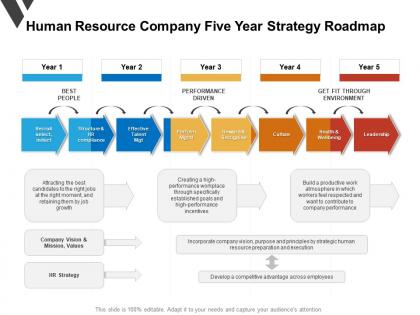
Human resource company five year strategy roadmap




Try Before you Buy Download Free Sample Product
 Impress Your
 Audience
 100%
100% Editable
 Save Hours
 of Time


A well thought out action plan makes execution easier and increases the possibility of success significantly. Ensure hitting all the milestones within the deadlines by introducing our fully customizable Human Resource Company Five Year Strategy Roadmap. Streamline the work related information, budget, timeframe, key deliverable, landmarks, and major steps involved, all in one place to give an organized overview of the project by utilizing our PowerPoint theme. Minimize time lag and increase work efficiency by providing insight into the process with our comprehensively researched roadmap PowerPoint layout. Color coding helps in highlighting the process and grabs the attention of the audience. Download our handy Human Resource Company Five Year Strategy Roadmap to identify the possible problem areas in a much shorter time and propose solutions. Have a productive brainstorming session with your workforce by utilizing our action plan visualization tool.
People who downloaded this PowerPoint presentation also viewed the following :
Human resource company five year strategy roadmap with all 2 slides:
Use our Human Resource Company Five Year Strategy Roadmap to effectively help you save your valuable time. They are readymade to fit into any presentation structure.
FAQs for Human resource company five
You need four main things: hiring and keeping good people, managing performance, training/development, and pay strategy. Most companies screw this up by keeping everything separate instead of connecting the dots. Add succession planning and keeping employees engaged too. Oh, and everything has to match your business goals - like if you're growing fast, hiring and training better support that. Companies that ignore this connection usually regret it later. I'd start by looking at what you have now. Figure out which gaps are actually killing your performance, then fix those first.
Honestly, first figure out what your company's actually trying to do - scaling up, breaking into new markets, cutting costs, whatever. Then make sure your HR stuff directly supports that. So if they're all about innovation, go hunt for creative types and build programs that let people experiment. I know it sounds super basic, but most HR teams just do their own thing without connecting to the bigger picture! Have regular chats with leadership about what matters most to them right now. Then translate that into your people strategy. Every program you run should tie back to some real business goal - otherwise what's the point?
Dude, HR without tech is like... why would you even do that to yourself? Start with an ATS if you don't have one - seriously game-changing for recruiting. Analytics platforms track engagement stuff automatically, plus AI helps predict workforce planning (though sometimes it's weirdly specific about random metrics). Resume screening, performance tracking, all that repetitive work just runs itself now. The compensation and retention insights you get are actually useful too. I'd just look at what you're still doing manually and see what tech could handle it instead. Oh, and the skill gap identification thing is clutch - catches problems before they blow up.
Okay so first thing - clean up those job descriptions and get rid of bias words. Train your hiring managers too because honestly, most people have no clue how biased they actually are during interviews. Source candidates from different places, not just the usual spots. Once people are hired, that's when the real work starts though. Set up mentorship programs and employee resource groups. Make promotion processes super transparent - like, people should know exactly what they need to advance. Oh and actually measure this stuff! Track your diversity numbers and do inclusion surveys. Most companies collect the data but then just... ignore it? Don't be those companies.
Honestly, start with the basics that actually matter to your bottom line. Turnover rates and time-to-fill are obvious ones, but don't sleep on employee engagement scores from surveys. Revenue per employee is probably my favorite metric - shows if your HR investments are paying off or just burning cash. Retention data gets me fired up because replacing people costs a fortune. Track training ROI, internal promotions, and sick day patterns too. Here's the thing though - pick like 5-7 max. More than that and you'll drown in spreadsheets. Check these quarterly and you'll start seeing real patterns emerge.
Honestly, you've got to stay on top of labor trends or you'll get burned. Low unemployment means people have options - so beef up retention and hire faster. Remote work exploded after 2020 and companies scrambling to catch up looked pretty foolish. Demographics matter too. Gen Z wants different stuff than boomers, and an aging workforce changes everything. Benefits, training, company culture - it all needs tweaking based on who's actually working for you. The trick is anticipating these shifts instead of panicking when your best people start jumping ship to competitors who already figured it out.
Honestly, it's such a headache dealing with all the different labor laws - like something totally normal in the US could land you in legal trouble in Germany. Cultural stuff trips people up too. Your performance reviews might work great here but completely bomb in other regions. Time zones make everything worse when you're trying to coordinate with teams who interpret your policies in totally different ways. Oh and compensation expectations are all over the place. I'd definitely start small, maybe pick 2-3 regions max. Find local HR people who actually know what they're doing in each country. Build in flexibility from the start because you'll need it.
Look, the biggest thing is actually having managers who give a damn about their people growing. Survey your employees first to see what's making them leave - don't just guess. Then focus on real career paths and feedback that isn't just once a year (annual reviews are basically useless at this point). Recognition programs work, but they've gotta be consistent. Flexible work and decent pay are expected now, not perks. Oh, and work-life balance isn't just a buzzword anymore - people will literally quit over it. Target whatever's actually broken instead of doing generic "engagement" stuff.
Remote work flipped HR on its head, honestly. Now you can hire from anywhere, but good luck competing with every company for the same talent pool. Digital tools become everything - onboarding, communication, tracking actual results instead of butts in seats. Culture gets tricky when everyone's spread out. Performance reviews? Totally different game since you can't just peek over cubicles anymore. The whole focus shifts to what people actually accomplish rather than how many hours they log. Oh, and keeping remote teams engaged takes way more effort than I expected. It's basically rebuilding your playbook from scratch.
Start with a gap analysis - figure out what skills you actually have versus what you'll need down the road. Most companies totally skip this step and pay for it later. Map out your strategic goals, then work backwards to see what roles and competencies that'll require. Don't forget about retirements either, those sneak up fast. Make it data-driven instead of just guessing. I'd build a few different scenarios based on growth possibilities. Audit your current talent first, then create a realistic timeline for filling gaps through hiring or training people up.
Honestly, your leadership team makes or breaks any HR strategy. Period. If they're not genuinely on board, you're just creating fancy documents that'll collect dust. Think about it - they control the budget, set the cultural tone, and employees watch how they actually behave vs. what they say. I've watched solid strategies crash because executives talked a good game but didn't follow through. You need them communicating the why behind changes, not just mandating them. Oh, and they can't just delegate this stuff - active involvement is non-negotiable. Get them aligned first or save yourself the headache.
Honestly, you gotta bake legal reviews right into your regular HR stuff instead of scrambling when things change. I'd set up quarterly calls with employment lawyers or get one of those HR update services that actually explains what new laws mean for you day-to-day. Can't tell you how many companies I've watched get wrecked by surprise leave policy changes or wage stuff they missed. Someone needs to own tracking compliance deadlines - maybe a simple spreadsheet works? And your employee handbook should get looked at every year, not just when people start griping. Oh, and definitely audit what you're doing now against whatever's changed in your state recently.
Honestly, the best training programs are the ones tied directly to what your business actually needs. Start by figuring out your skill gaps in critical roles first. Mix it up - formal training, mentoring, cross-functional projects, real on-the-job stuff. I swear by the 70-20-10 model (70% hands-on experience, 20% learning from others, 10% classroom). It just works better than sitting through endless PowerPoints. Track performance improvements, not just who showed up. Oh, and don't forget to measure ROI - you'll want proof this stuff is actually moving the needle when budget reviews come around.
Honestly, just ask your teams what they actually want instead of guessing based on age. Boomers usually like face-to-face stuff and formal feedback. Gen Z? They're all about instant messages and constant check-ins. Millennials want meaningful work that feels purposeful. Gen X just wants you to leave them alone and respect their work-life balance (can't blame them). The trick is being flexible with everything - benefits, training, career stuff, how you give feedback. One approach definitely won't work for everyone, and I learned that the hard way at my last job.
Honestly, I'd start with flexible work stuff - remote days, four-day weeks, unlimited PTO. That's what people actually want right now. Drop the degree requirements too and focus on skills instead, you'll get way better candidates. Your current employees probably know awesome people, so beef up that referral program with real incentives (not just pizza parties lol). Put salary ranges in your job posts - candidates hate guessing games. Maybe throw in some development money or quirky perks that match your vibe. Don't try everything at once though, pick like two things and nail them first.
-
Design layout is very impressive.
-
Nice and innovative design.
-
Unique research projects to present in meeting.