


Food Products And Beverages Industrys Strategic Group Mapping




Try Before you Buy Download Free Sample Product
 Impress Your
 Audience
 100%
100% Editable
 Save Hours
 of Time


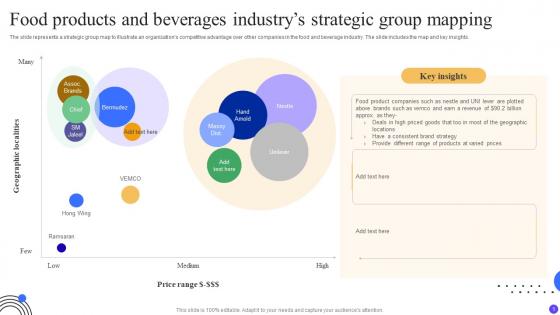
The slide represents a strategic group map to illustrate an organizations competitive advantage over other companies in the food and beverage industry.The slide includes the map and key insights.
People who downloaded this PowerPoint presentation also viewed the following :
Food Products And Beverages Industrys Strategic Group Mapping with all 6 slides:
Use our Food Products And Beverages Industrys Strategic Group Mapping to effectively help you save your valuable time. They are readymade to fit into any presentation structure.





FAQs for Food Products And Beverages Industrys
So you basically need two strategic dimensions for your axes - think price vs quality or maybe geographic reach vs product variety. Plot your competitors based on where they land on those two things. Honestly, the hardest part is choosing dimensions that actually drive competitive advantage, not just random stuff that sounds good. Use different circle sizes to show how big each competitor group is. Oh, and once you've got everything mapped out, hunt for empty spaces where nobody's competing - that's probably where your best positioning opportunities are hiding. Makes sense?
So strategic group mapping basically plots companies by things like price, distribution, features - whatever matters most. Companies that cluster together? Those are your real competitors, not every random business in your industry. Way more focused than making some giant list of everyone. I actually think it's super useful because you can spot gaps where nobody's positioned yet - hello, opportunity. Plus you see which groups are actually threatening your market share versus just existing nearby. Honestly saves you from analyzing companies that don't even compete with you directly.
Pick 2-3 dimensions that actually show how companies compete differently - stuff like product range, geography, pricing, or distribution channels. Don't overthink it though. I've seen people get way too fancy with this and create maps that are just confusing noise. What matters is finding variables that create real clusters. Like, why are some competitors more similar than others? Start with brainstorming everything, then cut it down to what actually explains competitive dynamics and customer decisions. The whole point is telling a clear story about your market, not impressing anyone with complex metrics.
So differentiating factors are basically what split companies into clusters on your map - think price point, product quality, distribution channels, that kind of stuff. Companies making similar choices end up grouped together since they're playing the same competitive game. Here's the thing though: don't pick generic factors like "customer service" because honestly, that won't tell you much. You want 2-3 factors where companies actually make different strategic trade-offs. Like, real differences that matter in your industry. Once you nail those factors, the patterns become super obvious and you'll see clear groups form naturally.
Yeah, strategic group mapping is perfect for this! Plot your competitors by things like pricing, distribution, R&D spend - you'll see where they cluster up. Those gaps between clusters? That's where your barriers live. Could be economies of scale, brand loyalty, whatever. Super helpful for avoiding expensive mistakes honestly. I mean, why dump money into a market segment where you need $50M just to get started, right? The visual makes it obvious which spots have lower barriers or where you can actually meet the requirements without going broke.
So basically, strategic group maps plot out where all your competitors are based on pricing and features. Super helpful for spotting gaps in the market - like maybe everyone's going mid-range but there's zero budget options? That's your opening. You can see exactly who you're up against too, which honestly beats guessing what matters for your positioning. I'd use it to find those underserved spots and price to dominate them. It's like getting the whole competitive picture laid out visually instead of trying to keep track of everything in your head.
Honestly, consumer behavior is everything when you're figuring out strategic groups. You can't just lump companies together by size or whatever anymore - people's buying decisions are way more complicated than that. Take Netflix vs Disney+, right? Totally different audiences even though they're both streaming. I'd start by really digging into how your customers actually make choices, then group your competitors based on that. The whole point is understanding who's really fighting for the same eyeballs. Surface-level similarities between business models? Pretty much useless if customers don't see them as real alternatives.
Do it yearly at minimum, but honestly? Don't wait that long if stuff starts getting crazy. Major competitor shakeups, new tech dropping, regulation changes - any of that means it's time to update your map. I've seen too many teams using maps from like 2019 and wondering why their strategy feels off. Market shifts can create whole new competitive groups or move players around completely. Set that annual reminder for sure, but trust your gut - if things feel different, they probably are. Better to refresh it too often than get caught with stale intel.
Honestly, strategic group maps oversimplify things way too much. You're cramming all these complex competitive dynamics into just two dimensions, so you miss a ton of important stuff about how companies actually compete. They're also basically snapshots - markets move fast, and your fancy map is probably outdated before you even finish it. The group boundaries aren't as clear-cut as they look either. Companies jump between "groups" all the time. I'd treat them more like a rough starting point for your analysis rather than gospel truth about where you stand competitively.
So digital transformation totally scrambles how companies compete - it's wild. Netflix is the perfect example, right? They went from mailing DVDs to streaming and basically created a whole new playing field. Traditional industry boundaries just disappear when tech becomes the main advantage. Companies that never competed before suddenly find themselves head-to-head, while others get completely sidelined. The barriers that used to matter - like having good distribution - don't mean much anymore. Now it's all about data and digital platforms. Honestly, if you're using a strategic group map from even three years ago, you might as well throw it out.
Honestly, Excel or Google Sheets are your best bet for this - just throw your competitors on a scatter chart with whatever dimensions you picked. Lucidchart's pretty solid too if you want nicer visuals, plus your team can all jump in and mess with it together. I've watched people waste way too much time hunting for the "perfect" tool when a basic spreadsheet works fine. Short sentences work. If you're drowning in data points, maybe look at Tableau or StrategyBlocks, but that's probably overkill unless you're at a huge company. Start with whatever you've already got access to.
Honestly, strategic group maps change so much between industries because you're tracking totally different stuff. Tech companies? You'd probably look at R&D spending vs how far their market reach goes. Retail is more about price point and service level. Manufacturing gets into cost structure and product differentiation - which makes sense when you think about it. Each industry has those 2-3 factors that actually matter for competition. The trick is figuring out what separates the companies crushing it from everyone else. I'd start by thinking about what customers in your space really value, then what gives companies lasting advantages there.
So strategic group mapping is actually pretty useful for finding alliance partners. It shows you which companies have similar positions or market approaches. You can spot firms with complementary strengths - like maybe one's great at R&D while another kills it in distribution. The visual aspect makes everything way clearer, honestly. Companies facing the same competitive pressures often want to team up too. Look for firms in nearby groups or ones with overlapping strategies. When you're doing your next map, mark potential partners and just reach out. Worth exploring those connections.
First thing - figure out where you actually stand compared to everyone else. Which groups are winning right now? Tech usually breaks down those old barriers pretty fast (like how budget software can suddenly do what only premium stuff used to). You've got three moves: dig in where you are, jump to a better group, or honestly just create something totally new. Don't wait until you're scrambling though. Map out what it'll cost and how long repositioning takes - executives always underestimate the timeline on this stuff. Moving strategic position is way messier than it looks on paper.
Honestly, digital transformation is turning everything upside down - companies are jumping between strategic groups like crazy. Netflix is the perfect example, going from mailing DVDs to streaming to making their own shows. Environmental stuff is becoming huge too. Your sustainability practices can literally shift you into a completely different competitive space now. Data analytics is creating new ways to compete that we couldn't even track before - it's wild how fast this is all happening. You should probably map your industry every 6 months instead of yearly at this point. Things change that quickly now.
-
“Excellent service from the customer support team when I wanted a slide that was a bit different from those on their standard menu. Super helpful.”
-
“Immediate response, professional support, and effective solutions that were customized and immediately provided. Well done- Thank you!”