

Strategic Group Mapping For The Airline Industry




Try Before you Buy Download Free Sample Product
 Impress Your
 Audience
 100%
100% Editable
 Save Hours
 of Time


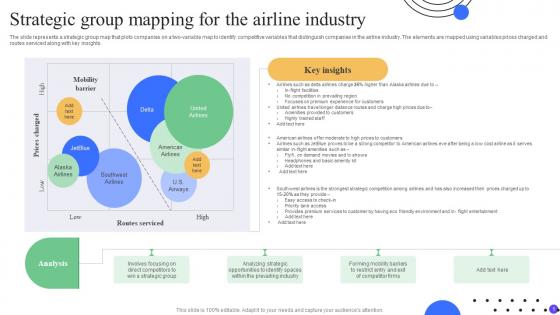
The slide represents a strategic group map that plots companies on a two variable map to identify competitive variables that distinguish companies in the airline industry.The elements are mapped using variables prices charged and routes serviced along with key insights.
People who downloaded this PowerPoint presentation also viewed the following :
Strategic Group Mapping For The Airline Industry with all 6 slides:
Use our Strategic Group Mapping For The Airline Industry to effectively help you save your valuable time. They are readymade to fit into any presentation structure.





FAQs for Strategic Group Mapping For
Okay so strategic group mapping is where you plot competitors on a chart using two dimensions - like price vs quality or market reach vs product range. Way better than those old-school competitor lists honestly. You can actually see the competitive landscape instead of just staring at boring spreadsheets. The cool part? You spot which companies are battling in the same space (your strategic group) and find gaps where nobody's competing yet. I swear it's a game-changer for spotting opportunities. Definitely try mapping your industry soon - it'll totally shift how you think about positioning.
So basically, you plot competitors on a map based on stuff like pricing and quality. Shows you where everyone's clustered together. The cool part? You'll see empty spots where nobody's competing - those gaps can be pure gold if you're smart about it. Think of it like looking down at a game board, you know? Plus you start noticing why certain companies in the same group crush it while others don't. Honestly, those blank areas on your map are where the magic happens. Worth spending time on this exercise.
Pick dimensions where companies actually compete differently - like price range, how many markets they're in, product variety, or distribution methods. Don't go with vague stuff like "quality" because literally everyone says they're high-quality. Look for strategic choices that create real separation between competitors. Price vs. geographic reach works well in a lot of industries, honestly. Map out how firms differentiate themselves first, then grab the two that split your competition into the clearest groups. You want variables where companies can't just flip a switch and copy each other tomorrow.
Strategic group mapping is honestly pretty clever for finding market gaps. Grab your top 5-7 competitors and plot them on two axes that actually matter to customers - like price vs. features. Look for empty spaces where nobody's playing yet, or super crowded spots you'll want to avoid. Those gaps? That's where you can position differently without fighting everyone for the same customers. The visual makes it way easier to see which messaging will set you apart. Plus you'll spot underserved segments you might've missed otherwise. It's like scoping out the best corner at a party before everyone else gets there.
So strategic group mapping is basically plotting your competitors on a chart using two key factors that matter in your industry - like price vs quality or local vs national reach. Way better than some boring competitor list. You can spot gaps where nobody's playing, see which companies are trapped in certain positions, and figure out who's vulnerable. The cool part? You start predicting what moves they'll make next. I'd pick dimensions that actually drive strategy in your space - distribution and product range work well for most industries. Makes the whole competitive landscape way clearer.
So basically you plot competitors on a map using things like price vs features or geographic reach. Look for the empty spots - that's where new companies might jump in. I always think the coffee shop analogy is perfect here! You're scanning the neighborhood for corners without cafes. Those white spaces on your map? They're opportunities waiting to happen. Focus on whatever dimensions actually matter in your industry. Also keep watching which competitor groups have weak barriers or good margins - makes them targets too.
Don't pick dimensions just because they're easy to measure - company size is the classic trap everyone falls into. You want stuff that actually affects how companies compete. Perfect data is overrated tbh, rough estimates work fine when you're starting out. Avoid making your groups super tiny or throwing wildly different competitors into the same bucket. That defeats the whole point. I'd start with maybe 2-3 dimensions that seem strategic, see what patterns pop up, then tweak from there. The goal is groups that feel distinct and meaningful, not mathematically perfect.
Strategic group mapping is actually really useful for this - basically you plot competitors on a chart using two key factors like price range and distribution channels. I'd pick dimensions that actually separate companies in your industry. Once you map everyone out, you'll see these clusters form and it becomes super obvious who your real competition is. The visual makes it way easier to spot gaps in the market too. Plus you can see which companies might jump into your space later - though honestly, predicting pivots is always tricky. It shows you those barriers between different competitive groups and helps identify direct threats.
You really don't need anything fancy - Excel or Google Sheets work perfectly fine. Just make scatter plots and customize your axes for whatever you're comparing. PowerPoint has decent chart tools if you need something prettier for presentations. People overthink this way too much honestly. I've watched colleagues spend hours researching software when they could've finished the whole analysis in Excel already. Tableau's nice if you're dealing with a million competitors, but start simple first. Plot your main competitors on two dimensions, see what jumps out at you. You can always upgrade later if needed.
So strategic group mapping is clutch for finding gaps where you can actually compete. Plot your competitors on two axes - like price vs quality or features vs ease of use. Then look for empty spots or crazy crowded areas. Kind of like musical chairs but for business positioning, honestly. Empty spaces might be goldmines nobody's thought of yet. Overcrowded spots? Maybe avoid those unless you've got something really different. Map out your top 5-7 competitors this week and you'll probably spot some obvious moves you hadn't considered.
Update those maps when the competitive game changes - like when digital skills suddenly matter more than price wars. Companies jump between groups all the time after mergers or big strategy shifts. I've watched entire groups just vanish when tech disrupts everything (RIP Blockbuster, honestly). Check your maps yearly or whenever something major hits the industry. Question whether your current axes actually show what separates winners from losers anymore. If price and quality don't explain performance differences, you're probably tracking the wrong stuff. The whole point is catching when your dimensions become irrelevant.
So Netflix is actually a perfect example of this - they mapped out competitors by how they delivered content and their pricing, which showed them the streaming gap that cable companies totally missed. Southwest did the same thing in airlines, plotting service level against costs. That's how they found the sweet spot for cheap, basic flights. Both companies didn't just copy everyone else though. They used their maps to find those empty spaces where nobody was competing. That's honestly where you'll find the best opportunities - look for the gaps everyone's ignoring.
Honestly, I'd do strategic group mapping before jumping into SWOT. Map out where competitors sit - like price vs quality or whatever matters in your industry. You'll spot market gaps (opportunities) and see where it's getting crowded (threats). Way clearer than just guessing. Plus you can figure out if your strengths actually matter against what competitors are doing. I learned this the hard way on a project last year - doing SWOT first meant I missed some obvious competitive moves. The mapping gives you that external view, then SWOT makes way more sense.
Yeah, you can definitely use strategic group mapping across different industries. Pick two dimensions your customers actually care about—could be quality vs price, innovation vs efficiency, whatever fits your market. Plot out 8-10 competitors and you'll start seeing patterns you missed before. What's cool is spotting those gaps or super crowded areas that probably mirror stuff happening in your own industry. I mean, competition dynamics are weirdly similar once you strip away the surface-level differences. The whole exercise just gives you a fresh lens to view your competitive landscape through.
Start with the basics - revenue, profit margins, market share. Then grab operational stuff like product range and where they sell. Pricing data is huge though, and honestly most people half-ass this part by not looking at actual transaction numbers. Customer segments matter too. For competitive intel, check their R&D spending and how they position themselves. Annual reports are gold for this - way better than guessing. Oh, and don't try to track everything. Pick maybe 2-3 things that actually separate the competitors in ways that matter for what you're analyzing.
-
Thank you for offering such fantastic custom design services. The team is really helpful and innovative. In a very short time, I received my personalized template.
-
Very well designed and informative templates.