

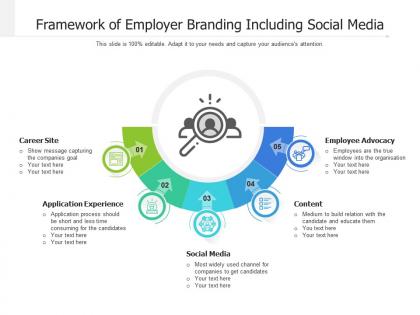
Framework of employer branding including social media




Try Before you Buy Download Free Sample Product
 Impress Your
 Audience
 100%
100% Editable
 Save Hours
 of Time


Our Framework Of Employer Branding Including Social Media are topically designed to provide an attractive backdrop to any subject. Use them to look like a presentation pro.
People who downloaded this PowerPoint presentation also viewed the following :
Framework of employer branding including social media with all 2 slides:
Use our Framework Of Employer Branding Including Social Media to effectively help you save your valuable time. They are readymade to fit into any presentation structure.
FAQs for Framework of employer branding
Key components include employee value proposition development, authentic culture messaging, candidate experience optimization, employee advocacy programs, and digital presence management. These elements work together by aligning internal culture with external perception, leveraging current employees as brand ambassadors, and creating consistent touchpoints across recruitment channels, ultimately attracting top talent while reducing hiring costs.
Employer branding significantly influences retention and engagement by creating authentic workplace identity, competitive compensation packages, clear career advancement paths, and strong company culture alignment. Through strategic branding initiatives, organizations enhance employee satisfaction, reduce turnover costs, and improve internal advocacy, with many companies finding that strong employer brands deliver higher engagement scores and ultimately create sustainable competitive advantage in talent retention.
Company culture serves as the foundation of employer brand by defining workplace values, behaviors, and employee experiences that attract and retain talent. A strong culture creates authentic storytelling opportunities, enhances employee advocacy, and differentiates organizations in competitive talent markets, with companies like Google and Salesforce leveraging their cultures to build compelling employer brands that deliver lower recruitment costs and higher employee engagement.
Organizations can measure employer branding effectiveness through recruitment metrics like time-to-fill and quality of candidates, employee engagement scores, retention rates, and brand perception surveys. These measurements help companies track their progress across talent acquisition, workforce satisfaction, and market reputation, with many organizations finding that strong employer brands deliver 50% more qualified candidates and significantly reduce hiring costs.
**INPUT**: What strategies can be implemented to align employer branding with corporate values? **OUTPUT**: Employer branding alignment strategies include authentic storytelling across recruitment materials, consistent messaging in employee communications, leadership advocacy programs, values-based hiring practices, and regular culture audits. These approaches streamline talent acquisition by ensuring candidates understand organizational culture, enhancing employee retention through clear expectations, and ultimately delivering stronger workforce engagement, with many organizations finding that authentic alignment reduces turnover costs while attracting top-tier talent. [Word count: 60 words]
Candidate experience directly shapes employer branding by influencing perceptions through every touchpoint, from application processes to interview feedback and onboarding communications. Poor experiences create negative reviews on platforms like Glassdoor, while streamlined, respectful interactions enhance reputation, ultimately helping organizations attract top talent and reduce recruitment costs in competitive markets.
Best practices for leveraging social media in employer branding include showcasing authentic employee experiences, sharing behind-the-scenes content, highlighting company culture and values, posting career development opportunities, and engaging directly with potential candidates. These strategies enhance organizational visibility by building genuine connections, demonstrating workplace transparency, and creating compelling narratives, with many companies finding that consistent, employee-driven content ultimately delivers stronger talent attraction and competitive recruiting advantage.
Storytelling enhances employer brand by creating emotional connections through authentic employee experiences, showcasing company culture, and highlighting career development journeys. These narratives humanize the organization while demonstrating values in action, with companies like Salesforce and Google using employee success stories, behind-the-scenes content, and mission-driven messaging to attract top talent and build lasting engagement.
Organizations should track metrics including employee Net Promoter Score, Glassdoor ratings, application-to-offer ratios, employee retention rates, and social media sentiment analysis. These measurements enable companies to assess brand reputation, candidate attraction effectiveness, and workforce satisfaction levels, with many HR departments finding that comprehensive tracking ultimately delivers improved talent acquisition outcomes and enhanced competitive positioning in increasingly tight labor markets.
Employee advocacy strengthens employer brand by transforming workers into authentic brand ambassadors who share genuine experiences, participate in recruitment efforts, and create organic social media content. Through structured advocacy programs, companies enhance credibility, expand reach, and attract top talent more effectively, with organizations like Microsoft and Adobe finding that employee-generated content delivers significantly higher engagement and trust than traditional corporate messaging.
Companies face challenges including unclear value proposition definition, inconsistent messaging across departments, limited budget allocation, measuring ROI effectiveness, and aligning internal culture with external brand promises. These obstacles often stem from lack of cross-functional collaboration and inadequate employee feedback systems, with many organizations finding that successful frameworks require dedicated resources, executive buy-in, and ongoing refinement to authentically represent their workplace culture while attracting top talent.
Recruitment marketing strategies integrate into employer branding through targeted content creation, social media engagement, employee advocacy programs, candidate experience optimization, and data-driven messaging consistency. These approaches enhance brand visibility by showcasing company culture, streamlining application processes, and leveraging employee testimonials, with many organizations finding that strategic integration significantly reduces hiring costs while attracting higher-quality candidates.
Diversity and inclusion significantly enhance employer branding by attracting top talent, improving company reputation, and expanding market reach across diverse customer bases. Organizations with strong D&I initiatives experience higher employee engagement, reduced turnover costs, and enhanced innovation, with many companies finding that inclusive cultures deliver competitive advantage in talent acquisition and retention.
Employer branding helps companies attract top talent by showcasing unique culture, career development opportunities, competitive compensation, and meaningful work experiences that differentiate them from competitors. Strong employer brands enable organizations in sectors like technology, healthcare, and finance to reduce recruitment costs, decrease time-to-hire, and ultimately secure higher-quality candidates who align with company values and drive long-term business success.
Leadership drives employer branding through authentic communication, consistent culture modeling, and strategic internal-external alignment across all organizational touchpoints. Through transparent leadership practices, executives in companies like Microsoft and Salesforce demonstrate core values, influence employee advocacy, and enhance recruitment outcomes, ultimately delivering stronger talent retention and competitive positioning in increasingly competitive talent markets.
-
Graphics are very appealing to eyes.
-
Awesomely designed templates, Easy to understand.
-
Perfect template with attractive color combination.
-
Amazing product with appealing content and design.
-
Attractive design and informative presentation.