


Fundamentals Of Supervised Machine Learning Training Ppt




Try Before you Buy Download Free Sample Product
 Impress Your
 Audience
 100%
100% Editable
 Save Hours
 of Time


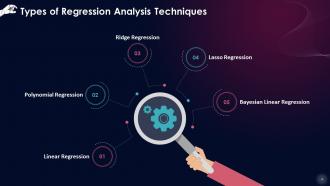
This set of slides gives an overview of supervised learning, one of the most basic types of Machine Learning. Supervised learning can be divided into four categories regression analysis, decision tree, random forest, and classification KNN, trees, logistic regression, Naive-Bayes, and SVM. Regression Analysis techniques include linear regression, polynomial regression, ridge regression, lasso regression, and Bayesian linear regression.
People who downloaded this PowerPoint presentation also viewed the following :
Content of this Powerpoint Presentation
Slide 1
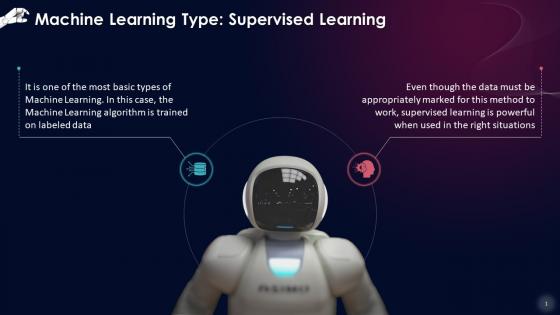
This slide gives an overview of supervised learning which is one of the most basic types of Machine Learning. In this case, the Machine Learning algorithm is trained on labeled data. Even though the data must be appropriately marked for this method to work, supervised learning is powerful when utilized in the right situations.
Slide 2
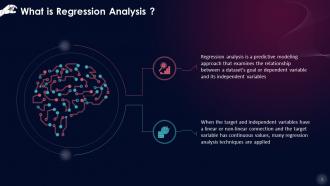
This slide demonstrates that regression analysis is the fundamental approach used in Machine Learning to address regression issues, using data modeling. It entails establishing the best fit line, which goes through all data points while minimizing the distance between the bar and each data point. The regression approach is mainly used to identify predictor strength, forecast trend, time series, and in the event of a cause and effect relationship.
Slide 3
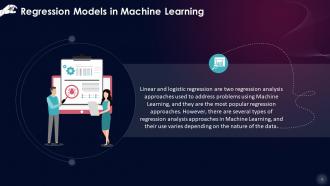
This slide describes that linear and logistic regression are two regression analysis approaches used to address problems using Machine Learning; these are the most popular regression approaches. However, there are many types of regression analysis approaches in Machine Learning, and their use varies depending on the nature of the data.
Slide 4
This slide states that regression analysis have many types, and the application of each approach is dependent on the number of components. These variables include the kind of target variable, the form of the regression line, and the number of independent variables.
Slide 5
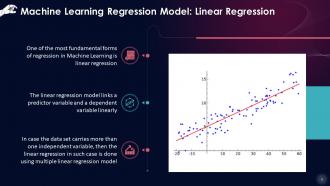
This slide describes that linear regression is one of the most fundamental forms of regression in Machine Learning. The linear regression model links a predictor variable and a dependent variable linearly.
Slide 6
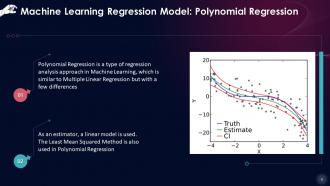
This slide states that Polynomial Regression is a type of regression analysis approach in Machine Learning. It is similar to Multiple Linear Regression but with a few differences. As an estimator, a linear model is used. The Least Mean Squared Method is also used in Polynomial Regression.
Slide 7
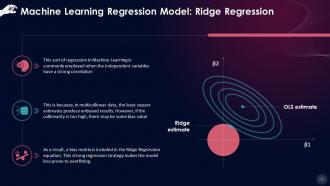
This slide states that this sort of regression in Machine Learning is employed when the independent variables have a strong correlation. This is because, in multicollinear data, the least square estimates produce unbiased results. However, if the collinearity is too high, there may be some bias value.
Slide 8
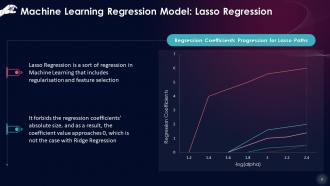
This slide lists that lasso regression is a sort of regression in Machine Learning that includes regularisation and feature selection. It forbids the regression coefficients’ absolute size; and as a result, the coefficient value approaches 0, which is not the case with Ridge Regression.
Slide 9
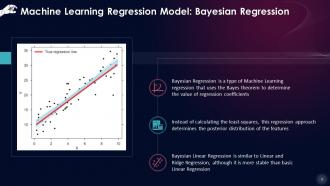
This slide showcases that Bayesian Regression is a type of Machine Learning regression that uses the Bayes Theorem to determine the value of regression coefficients. Instead of calculating the least-squares, this regression approach determines the posterior distribution of the features.
Slide 10
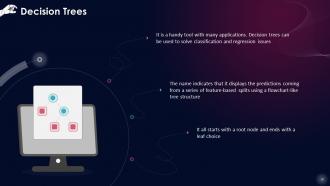
This slide states that decision trees are a handy tool and has many applications. Decision trees can be used to solve classification and regression issues. The name indicates that it displays the predictions coming from a series of feature-based splits using a flowchart-like tree structure. It all starts with a root node and ends with a leaf choice.
Slide 11
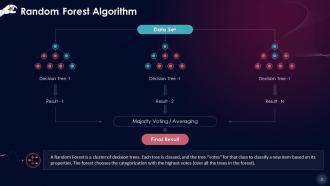
This slide gives an overview of random forest algorithm. A Random Forest is a cluster of decision trees. Each tree is classed, and the tree "votes" for that class to classify a new item based on its properties. The forest chooses the categorization with the highest number of votes (over all the trees in the forest).
Slide 12
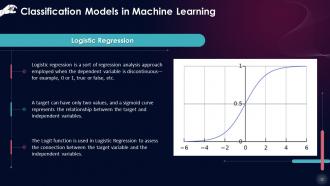
This slide gives an overview of logistic regression which is a sort of regression analysis approach employed when the dependent variable is discontinuous: For example, 0 or 1, true or false, and so on. The Logit function is used in Logistic Regression to assess the connection between the target variable and the independent variables.
Slide 13
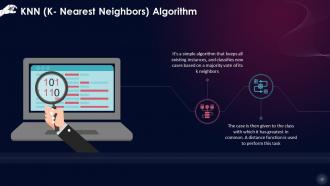
This slide demonstrates that KNN is a simple algorithm that keeps all existing instances, and classifies new cases based on a majority vote of its k neighbors.
Instructor’s Notes:
KNN may be understood with an analogy from real life. For example, if you want to learn more about someone, chat with their friends and coworkers.
Consider the following before settling on the K Nearest Neighbors Algorithm:
- KNN is costly to compute & arrive at
- Variables should be normalized, or greater range variables will cause the algorithm to be biased
- Data must still be pre-processed
Slide 14
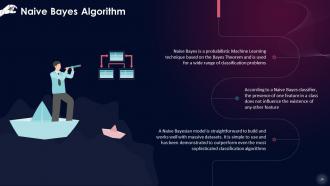
This slide states that Naive Bayes is a probabilistic Machine Learning technique based on the Bayes Theorem and is used for a wide range of classification problems. A Naive Bayesian model is straightforward to build and works well with massive datasets. It is simple to use and outperforms even the most sophisticated classification algorithms.
Slide 15
This slide showcases that the SVM algorithm is a classification process in which raw data is shown as points in an n-dimensional space (n being the number of features you have). The value of each characteristic is then assigned to a specific location, making it simple to categorize the data. Classifier lines can divide data and plot it on a graph.
Fundamentals Of Supervised Machine Learning Training Ppt with all 31 slides:
Use our Fundamentals Of Supervised Machine Learning Training Ppt to effectively help you save your valuable time. They are readymade to fit into any presentation structure.















FAQs for Fundamentals Of Supervised Machine
So supervised learning is basically when you give your model a bunch of examples with the correct answers already labeled - like showing it thousands of emails marked "spam" or "not spam." Then it learns to predict new stuff. Unsupervised is the opposite. No labels at all. The algorithm just digs through data trying to find patterns you didn't even know existed. Way harder honestly, since there's no "right answer" to check against. I'd definitely start with supervised learning if you're just getting into this - at least you can tell when your model is being terrible! Plus most real-world problems I've seen are supervised anyway.
So you'll want to gather your data first and clean it up - that part's always messier than you think it'll be. Split everything into training and test sets, pick an algorithm, then train away. Don't get too excited if your first results look amazing though, you still need to properly validate with that test set. Tune your hyperparameters if things aren't quite right. Once you deploy it, keep an eye on how it performs in the real world because things can get weird. Oh and seriously, start simple with a baseline model before you go crazy with the fancy stuff!
So first thing - figure out what kind of problem you're actually solving. Classification? Go with logistic regression or random forests. Regression stuff works better with linear regression or decision trees. Your dataset size is huge here though - neural networks are data hungry beasts, but simpler models don't need much. Start with something basic like random forest (honestly my go-to most of the time). Then see how it performs. Also think about whether your boss needs to understand what's happening under the hood. Some models are total black boxes. Oh, and messy data? That changes everything too.
Look, your data quality is literally everything. Messy data will torpedo your model before you even start - missing values, weird outliers, inconsistent formatting all confuse the hell out of algorithms. They're just learning patterns from whatever you throw at them, right? Spend time cleaning first: handle those missing values, scale your features, encode categorical stuff properly. I know it's boring compared to the actual modeling part, but preprocessing directly affects how well your model works on new data. Trust me, explore your dataset thoroughly before you get excited about fancy algorithms. Clean data beats clever models every time.
For classification, you'll mostly use accuracy, precision, recall, and F1-score. Regression? MSE and MAE are your go-to metrics. Accuracy sounds great but honestly it's trash with imbalanced data - I've been burned by that before. Precision shows how many positive predictions were actually correct. Recall tells you what percentage of true positives you managed to catch. F1-score finds the sweet spot between them. MSE hits big errors way harder than MAE does. Just pick whatever metric matches what you actually care about - like if missing cancer cases would be terrible, focus on recall.
Oh man, class imbalance is annoying but totally fixable! SMOTE works great for oversampling your minority class, or you could just undersample the majority one. Most algorithms let you adjust class weights too - that's probably your easiest bet to start with. Don't stress if it's just a slight imbalance though, I see people freak out over nothing sometimes lol. But yeah, if you're doing fraud detection or something where it's like 99% normal cases, definitely fix that. Also ditch accuracy as your main metric - precision, recall, and F1-score will actually tell you what's happening. Class weights first, then try the other stuff!
So overfitting is basically when your model gets too obsessed with the training data - like cramming for a test by memorizing answers but then bombing when the actual questions are slightly different. It nails training but crashes on new stuff. Underfitting is when your model's too dumb to pick up on anything meaningful, so it sucks at everything. You'll spot overfitting when training accuracy is great but validation tanks. Fix it with regularization, more data, or dial back complexity. For underfitting, beef up your model or get better features. Honestly, finding that sweet spot takes some trial and error.
So many ways to tackle this! Correlation analysis and chi-square tests are solid starting points for feature selection. You could also try recursive feature elimination if you want something more sophisticated. PCA is probably your best friend for dimensionality reduction - I use it constantly. LDA works great when you're dealing with classification stuff. Autoencoders are pretty cool too but might be overkill depending on what you're working with. Honestly? I'd just run correlation analysis first, then throw PCA at it and see what shakes out. You can always get more creative later if the simple stuff isn't cutting it.
Healthcare and finance are perfect for supervised learning - they've got mountains of labeled data just sitting there. Doctors can train models on patient records to spot disease risks or catch cancer in scans. Finance uses it for credit scores, fraud detection, trading algorithms. Both industries have clear "right answers" baked into their historical data, which is honestly what makes this stuff work so well. You just need to figure out what you're trying to predict first. Then look at what examples you already have. The patterns are usually already there waiting to be found.
Okay so model interpretability matters because you need to know why your model's making decisions. Like if someone gets denied a loan, you can't just shrug and say "the algorithm did it." Deep neural networks are crazy powerful but they're total black boxes - linear regression is way easier to understand but might miss stuff. There's always this annoying trade-off between accuracy and being able to explain what's happening. I'd start with simple, interpretable models first. Then if you need something fancier, tools like SHAP or LIME can help explain the more complex ones. Healthcare and finance especially - those domains don't mess around with unexplainable decisions.
So cross-validation basically rotates through different train/test splits instead of just doing it once. Every data point gets used for both training and testing, which is way better at catching overfitting. I learned this the hard way when a model looked amazing but completely failed in production - super frustrating. You end up with multiple performance scores that you can average together, plus you get confidence intervals around how well your model actually works. K-fold is usually my go-to approach. Trust me, it'll save you so much pain down the road when you're trying to figure out why everything broke.
Oh man, data drift is gonna be your worst enemy - your model basically gets dumber as the real world changes around it. Latency can kill you too if you need fast predictions. Monitoring is such a pain but you can't skip it, gotta watch everything from model health to how your features are behaving. Traffic spikes will mess with your infrastructure when you least expect it. Honestly? The actual deployment part is way easier than keeping the damn thing running smoothly. Set up good monitoring and auto-retraining from the start - trust me on this one, you'll save yourself so many headaches later.
So basically deep learning is just supervised learning but with way more layers - you're still using labeled data to train everything. Instead of decision trees or whatever, you've got these massive neural networks finding crazy complex patterns. The workflow's pretty much identical: prep your labeled datasets, train, validate, rinse and repeat. But now you can actually tackle the hard stuff like image recognition and NLP. Honestly, I'd start simple though. Don't jump straight into the super deep architectures or you'll just confuse yourself. It's like supervised learning but on serious steroids.
So you basically need two different datasets when building ML models. Training data is where your algorithm learns all the patterns and relationships. Test data? That's how you figure out if it actually works in practice. It's kinda like studying with practice problems then taking the real exam - you can't use the same questions for both or you'll think you're way smarter than you are lol. The test set has to stay completely separate until the very end. No cheating and checking it early! Otherwise your performance scores will be totally misleading and you'll be in for a rude awakening later.
Bias is probably your biggest headache - if your training data sucks or has old-school prejudices, your model will too. Test it across different groups early on. Privacy's another nightmare these days, so handle personal data carefully and get consent. Oh, and if you're making decisions that actually impact people's lives? Like loans or whatever. You need to explain how your model works. I swear the whole field's gotten so complicated lately! But yeah, start by auditing where your data comes from and checking if certain demographics get screwed over.
-
A beautiful, professional design paired with high-quality images and content that is sure to impress. It is a must-use PPT template in my opinion.
-
You guys are life-saver when it comes to presentations. Honestly I cannot do much without your services. Thank you!!!