


Importance Of Machine Learning Training Ppt




Try Before you Buy Download Free Sample Product
 Impress Your
 Audience
 100%
100% Editable
 Save Hours
 of Time


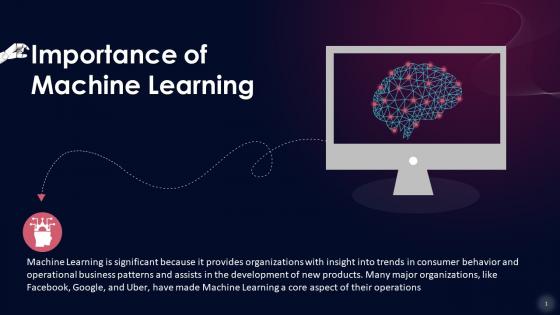
This slide describes the importance of Machine Learning as it provides organizations with insight into trends in consumer behavior and operational business patterns and assists in the development of new products. Many major organizations, like Facebook, Google, and Uber, have made Machine Learning a core aspect of their operations.
People who downloaded this PowerPoint presentation also viewed the following :
Importance Of Machine Learning Training Ppt with all 17 slides:
Use our Importance Of Machine Learning Training Ppt to effectively help you save your valuable time. They are readymade to fit into any presentation structure.







FAQs for Importance Of Machine
So there's basically three types: supervised, unsupervised, and reinforcement learning. Supervised uses labeled data - like spam filters where you train it on emails already marked as spam or not. Pretty straightforward stuff. Unsupervised finds patterns without labels, think customer groups or spotting weird data. Reinforcement learning is where it gets interesting - algorithms learning through trial and error, like those game AIs that crush humans at chess. Honestly though? Most real business problems are just supervised learning. I'd say start there for your first project since it's way easier to wrap your head around and actually validate if it's working.
Honestly, your data quality is what'll make or break everything. Garbage in, garbage out - sounds cliche but it's so true. I've watched entire teams waste months obsessing over fancy algorithms when their real problem was just terrible data from the start. Messy, biased stuff? Your model learns all that and spits it right back out in production. Clean data that actually represents what you're trying to solve - that's where the magic happens. Worth spending way more time upfront cleaning and auditing than you think. Trust me on this one.
Honestly, feature engineering is huge for model performance - probably the biggest impact you can have. You're basically giving your algorithm better ingredients to work with when you transform raw data into useful features. Like making ratios from existing columns, dealing with categorical stuff properly, extracting parts from dates. I've watched okay models turn awesome just from clever feature work! Domain knowledge is everything here - you need to understand what patterns actually matter. Oh, and definitely explore your data relationships first before getting creative with transformations that make sense for the business.
Honestly there's no magic number here. Plot some learning curves - train with different dataset sizes and watch your validation accuracy. Performance usually plateaus somewhere, that's your target. Problem complexity matters though - simple stuff might work fine with thousands of samples, but deep learning? Yeah you're probably looking at millions. I'd just start with whatever you've got and keep adding data until the improvements get pretty marginal. Not worth the extra training costs at that point. Features and classes definitely play into it too.
Oh man, overfitting is the worst! I'd start with dropout - super easy to add and usually works pretty well. Cross-validation and L1/L2 regularization are solid too. Early stopping is clutch though, just watch your validation loss and bail when it starts going up. More data helps if you can swing it, or try cutting some features/layers to simplify things. I always get paranoid about that gap between training and validation performance - that's your red flag right there. Don't throw everything at it at once, test one thing first then see what happens.
So basically cross-validation tests your model on different data chunks instead of just one train/test split. Think of it like giving your model multiple quizzes with different question sets. Really helps catch overfitting - you know when a model looks incredible on your test data but totally fails in real life? That's the worst. K-fold CV shows you how your model actually performs across various scenarios, not just one lucky split. I always use it during development because honestly, one test split can be super misleading. You'll get a much better sense of whether your model will actually work when people start using it.
Totally depends what you're trying to solve, honestly. Classification problems? Start with accuracy but precision/recall/F1 will tell you way more about what's actually happening. ROC-AUC works great for binary stuff too. Regression's different - I usually just go with RMSE since it hits big errors harder, though MAE and R-squared are solid options. Oh, and this should go without saying but test everything on data your model hasn't seen before. Can't tell you how many people skip that step and wonder why their "amazing" model falls apart in production.
Think of hyperparameter tuning like adjusting the settings on your car before a road trip. Learning rate, batch size, network architecture - these control how your model actually learns. Get them wrong and you'll sit there for hours watching terrible results. There's no magic formula either, which is annoying. I usually start with whatever worked for similar problems, then tweak from there. The difference between good and bad hyperparameters is huge - can make or break your training speed and final performance.
Basically it's garbage in, garbage out - biased training data means your model will just amplify those same biases. Super problematic in stuff like hiring or healthcare where you can actually hurt people. I've seen models perform way worse on minorities because the training data was mostly one demographic, which is honestly pretty messed up. You want to audit your data first, look for gaps in representation. Data augmentation can help fill those holes. Oh, and fairness constraints during training - that's clutch for catching bias before it spirals. Better to deal with it upfront than try fixing a discriminatory model later.
Honestly, it's all about what kind of data you're working with. Classification problems? Just go with logistic regression or random forests first - they work way better than people expect and you can actually understand what's happening. Everyone's obsessed with neural networks these days but they're total overkill for most stuff. Text and images are different though, you'll probably need deep learning for those. Start basic, get your baseline numbers, then mess around with fancier models if you really need them. Don't overthink it at first.
First thing - split your data into train/test sets before you touch anything else. Trust me on this one, data leakage is a nightmare to debug later. Clean up the messy stuff next: missing values, duplicates, obvious errors. Then you'll need to get everything on the same scale - normalization or standardization, whatever works. Neural networks especially hate it when features are wildly different ranges. Categorical variables need encoding too, and if you see chances for feature engineering, go for it. Oh, and definitely build this into a pipeline so you can reuse it on new data without going insane.
So basically you're combining multiple models instead of relying on just one - kind of like asking several friends for advice before making a big decision. Different models catch different patterns in your data, which cuts down on overfitting. Random forests are actually a type of ensemble method and they're super beginner-friendly. You can also do boosting or bagging, then average the predictions or use voting. The trick is making sure your models are actually diverse from each other (otherwise what's the point?). I'd probably start with random forest since it usually works well right away without much tweaking.
Honestly, just nail three things: compute, data pipeline, and experiment tracking. Cloud GPUs are your best bet unless you want the headache of managing hardware - AWS or GCP both work fine. PyTorch or TensorFlow for the actual training part. Here's where I learned the hard way: get MLflow or Weights & Biases set up early because trust me, you'll forget which hyperparameters actually worked after like your third experiment. Docker keeps things from breaking when you move between environments. Start simple with cloud GPUs and basic tracking. Scale up later when things get messy.
Dude, transfer learning is basically cheating but in the best way. You grab a pre-trained model like ResNet that already figured out edges and shapes from millions of images. Then you just tweak the final layers for whatever you're doing. Way better than starting from zero - I learned this the hard way on my first project lol. The model already did the grunt work recognizing basic patterns. You're just teaching it your specific stuff. Honestly, try Hugging Face or torchvision first. You'll get decent results with like 200 examples, which still blows my mind.
Biggest things to watch out for? Biased training data will mess you up - if your dataset isn't diverse or has historical biases baked in, your model just amplifies that garbage at scale. Privacy's huge too, you need real consent for personal data. Oh and transparency matters way more than people think, especially when decisions actually affect lives. I'd honestly do an ethics check before starting any project. Ask yourself: am I accidentally screwing someone over or making existing problems worse? It's not just about the tech working, it's about it working fairly.
-
I never had to worry about creating a business presentation from scratch. SlideTeam offered me professional, ready-made, and editable presentations that would have taken ages to design.
-
My team has been relying on SlideTeam’s professional PPT designs for a while now. It has greatly sped up quality work at my organization. So thanks!