Classification Models In Machine Learning Training Ppt
Try Before you Buy Download Free Sample Product
Audience
Editable
of Time
These slides discuss various classification models of Machine Learning. These include Logistic Regression, K-Nearest Neighbors KNN Algorithm, Naive Bayes Algorithm, and Support Vector Machine SVM Algorithm.
People who downloaded this PowerPoint presentation also viewed the following :
Content of this Powerpoint Presentation
Slide 1
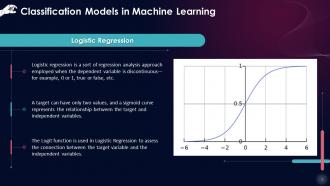
This slide gives an overview of logistic regression which is a sort of regression analysis approach employed when the dependent variable is discontinuous: For example, 0 or 1, true or false, and so on. The Logit function is used in Logistic Regression to assess the connection between the target variable and the independent variables.
Slide 2
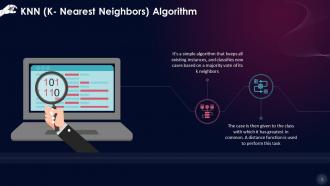
This slide demonstrates that KNN is a simple algorithm that keeps all existing instances, and classifies new cases based on a majority vote of its k neighbors.
Instructor’s Notes:
KNN may be understood with an analogy from real life. For example, if you want to learn more about someone, chat with their friends and coworkers.
Consider the following before settling on the K Nearest Neighbors Algorithm:
- KNN is costly to compute & arrive at
- Variables should be normalized, or greater range variables will cause the algorithm to be biased
- Data must still be pre-processed
Slide 3
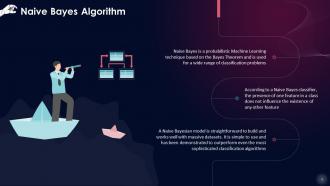
This slide states that Naive Bayes is a probabilistic Machine Learning technique based on the Bayes Theorem and is used for a wide range of classification problems. A Naive Bayesian model is straightforward to build and works well with massive datasets. It is simple to use and outperforms even the most sophisticated classification algorithms.
Slide 4
This slide showcases that the SVM algorithm is a classification process in which raw data is shown as points in an n-dimensional space (n being the number of features you have). The value of each characteristic is then assigned to a specific location, making it simple to categorize the data. Classifier lines can divide data and plot it on a graph.
Classification Models In Machine Learning Training Ppt with all 20 slides:
Use our Classification Models In Machine Learning Training Ppt to effectively help you save your valuable time. They are readymade to fit into any presentation structure.
FAQs for Classification Models In Machine
So basically, supervised learning has labels - you're showing the computer "this email = spam, this one = not spam" and it figures out the pattern. Unsupervised doesn't have any labels at all. You just dump data on it and say "find me some groups or patterns." Like if you wanted to segment customers but had no clue what those segments should be. Honestly, supervised is way easier to wrap your head around. If you know what you want to predict, go supervised. If you're just poking around trying to discover stuff in your data, that's when unsupervised makes sense.
So decision trees basically test every feature and threshold to find the best split. They use stuff like Gini impurity or information gain - sounds fancy but it's just measuring how "pure" each group gets after the split. Like, did you successfully separate your classes or is everything still mixed up? The goal is maximizing differences between groups while keeping each individual group as uniform as possible. Pretty neat how automated it all is. Oh and they're always hunting for that split that creates the least confusion within each pile of data.
So SVMs are solid for smaller datasets where you want good accuracy. They handle high-dimensional stuff really well - like when you've got way more features than samples. Pretty resistant to overfitting too. But honestly? They're painfully slow on big datasets. Also, you don't get direct probability outputs which can be annoying, and tuning those hyperparameters (especially picking kernels) is kind of a nightmare. I'd go with them for smaller classification problems where you care more about getting it right than getting it fast. Skip 'em if you're working with huge data or need quick predictions though.
Dude, go with logistic regression when you need to actually explain what your model's doing - like to your boss or some compliance team. Limited data? Perfect, because fancy models will just overfit anyway. Training and deployment are lightning fast too, which saves your butt when deadlines are tight. I swear, half the data scientists I know immediately jump to deep learning for everything when basic logistic regression would totally work. Seriously, start there first. If it performs well enough and you can explain it easily, why make life harder?

So Random Forests basically train a bunch of decision trees on different chunks of your data and features. Each tree makes slightly different mistakes, but when you average all their predictions together, those errors kind of cancel out. Pretty clever, right? You end up with way better accuracy than just using one tree, plus it handles noisy data much better. I always thought the "hundreds of doctors giving opinions" comparison was a bit cheesy, but honestly it's not wrong. Try it on your next project - the performance jump from a single tree to RF is usually pretty obvious.
So feature selection is actually massive for getting good results. Your model gets way better at spotting real patterns when you dump the useless features that just add noise. Overfitting becomes less of an issue too - I've seen models go from terrible to decent just from this. Training runs faster with fewer features, which is nice when you're iterating a bunch. Honestly, start simple with correlation analysis or recursive feature elimination. They'll show you which features are actually doing work vs just taking up space. Makes everything cleaner and your results more reliable.
Oh man, imbalanced data is such a pain. SMOTE works pretty well for oversampling your minority class, or you could undersample if you've got tons of data. Class weighting is honestly your easiest fix though - just tell your model to care more about getting the rare class right. Random Forest and SVM both let you do this super easily. Also, don't trust accuracy at all with this stuff. It'll lie to your face. Stick with F1-score, precision, recall - the metrics that actually matter. Ensemble methods are solid too but I'd start with the class weights thing first since it's like a 2-minute change.
Honestly, start with the classics - accuracy, precision, recall, and F1-score. Accuracy's just your overall "how often was I right" number. Precision tells you when you said something was positive, how often you were actually correct. Recall catches how many of the real positives you actually found. F1-score is clutch because it balances precision and recall, especially when your data's all wonky and imbalanced (which mine always seems to be). Don't sleep on confusion matrices either - they'll show you exactly where your model's getting tripped up. Pick what matters most for your specific situation.
So overfitting is basically when your model just memorizes everything instead of actually learning patterns - kinda like how I used to cram for exams without understanding anything lol. It'll crush your training data but completely fail on new stuff. You can fix it with regularization (L1/L2 penalties), cross-validation to spot it happening, or just getting more data if possible. Random forests work well too since they don't overfit as easily. Honestly, it's all about finding that balance between too simple and too complex through testing on validation sets.
Honestly, k-NN is pretty finicky about a few key things. Your k value matters huge - too small and you'll get fooled by noisy data points, too big and everything gets mushy. I usually start with odd numbers around the square root of my dataset size (avoids those annoying ties). Distance metrics are another big one. Euclidean's fine for most stuff, but sometimes Manhattan or custom ones work way better depending on your data. Also, this algorithm completely falls apart in high dimensions - distances just stop making sense up there. Oh, and definitely scale your features first or you'll hate yourself later.
Honestly, preprocessing is what separates models that actually work from complete garbage. Missing values will destroy your accuracy if you just ignore them or fill them randomly. SVM and neural networks especially hate when your features are on totally different scales - learned that the hard way once. Outliers mess everything up too, though sometimes they're actually the most interesting data points. Class imbalance is another nightmare - your model just predicts the majority class and calls it a day. Spend the extra time cleaning your data upfront. Trust me, it beats trying to figure out why your "amazing" model can't predict anything correctly.
Honestly, neural networks are like having a super smart pattern detector that finds stuff traditional models completely miss. Your basic logistic regression needs you to hand-feed it features and assumes everything's linear - neural networks just figure out crazy complex relationships themselves through all those layers. They absolutely crush it with images and text data. More data = better performance too, which is nice. Traditional models are way easier to explain to your boss though, so if you need that interpretability factor, maybe start simple first. Really depends what you're building.
So hyperparameter tuning is basically what separates decent models from actually good ones. Default settings usually suck - your model either won't learn enough or it'll memorize everything perfectly but fail on new data. It's kinda like adjusting camera settings instead of just using auto mode all the time. Grid search works well to start, or you could try random search if you're feeling lazy. Cross-validation helps you find that sweet spot where accuracy is actually decent. Honestly took me forever to realize how much this stuff matters when I started out.
Look at your confusion matrix first - shows you exactly where things go wrong. Are you missing positives or getting flooded with false alarms? Feature importance tells you what actually drives predictions (honestly this part's pretty cool). ROC curves help pick thresholds based on what mistakes cost you more. The real breakthrough comes from digging into your wrong predictions. What patterns did the model miss? Sometimes it's obvious stuff you overlooked. Use all this to either grab better features for retraining or just work around what your model's naturally good at.
So real-time is for when people are literally waiting - fraud detection, chatbots, recommendation stuff where there's a human staring at their screen. Batch works when you can wait around. Like spam filtering emails overnight or doing customer analysis once a month. Real-time costs way more though, obviously. Honestly, most people think they need real-time when they don't. Just ask yourself: does someone actually need an answer right now, or can this wait till tomorrow? Map out your timeline first - that'll tell you everything. Don't overthink it.
-
Awesome use of colors and designs in product templates.
-
“The presentation template I got from you was a very useful one.My presentation went very well and the comments were positive.Thank you for the support. Kudos to the team!”