


Machine Learning For Speech Recognition Training Ppt




Try Before you Buy Download Free Sample Product
 Impress Your
 Audience
 100%
100% Editable
 Save Hours
 of Time


These slides discuss the fundamentals of speech recognition. It is a feature that allows computer software to convert human speech into text. They discuss the key features of a speech recognition system, algorithms, and a real-world use case.
People who downloaded this PowerPoint presentation also viewed the following :
Content of this Powerpoint Presentation
Slide 1
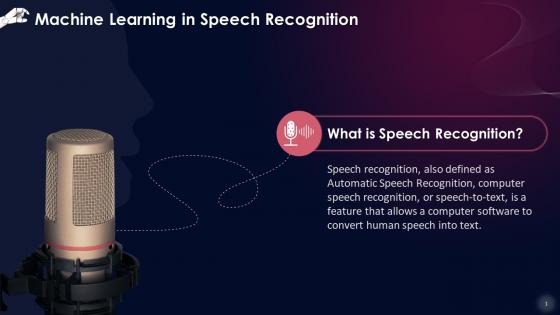
This slide introduces Speech Recognition as an application of Machine Learning. It is a feature that allows a computer software to convert human speech into text.
Slide 2
This slide depicts the working of a speech recognition system. The three-step process includes signal level, acoustic level, and language level which converts an analog signal into transcription.
Slide 3
This slide lists the key features of an effective and efficient speech recognition system. These features include language weighting, acoustics training, speaker labeling, and profanity filtering.
Instructor’s Notes:
- Language Weighting: It can improve precision by weighting specific words that are frequently used, such as product names
- Acoustics Training: These ML driven systems pay attention to the acoustic part of the business. It trains the system to adjust to speaking styles (like voice pitch, volume, and pace) and acoustic environments (such as those seen in call centers)
- Speaker Labeling: These systems can create a transcription of a multi-participant conversation that references or tags each speaker's contributions
- Profanity Filtering: Filters can be used to identify specific words or phrases and cleanse the audio output
Slide 4
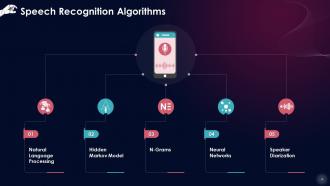
This slide depicts types of speech recognition algorithms. These include natural language processing, Hidden Markov Model, N-grams, neural networks, and speaker diarization.
Instructor’s Notes:
- Natural Language Processing: While Natural Language Processing (NLP) isn't strictly a specific method for speech recognition, it is a branch of Artificial Intelligence that focuses on human-machine interaction through languages, such as speech and text. Many mobile devices have speech recognition built in to conduct voice searches (e.g., Siri) or to improve messaging accessibility
- Hidden Markov Model: Hidden Markov Models allow us to add hidden events into a probabilistic model, such as part-of-speech tags. They are used as sequence models in speech recognition, assigning labels to each item in the sequence, such as words, syllables, phrases, etc. These labels create a mapping with the available input, allowing it to identify the most relevant label sequence
- N-Grams: This is the most basic language model, in which sentences or phrases are assigned probability. An N-gram is a collection of N words. For example, "Order the pizza" is a 3-gram phrase, while "please order the pizza" is a 4-gram phrase. Grammar and the probability of particular word sequences are used to increase recognition and accuracy
- Neural Networks: Training data is processed using neural networks, which use layers of nodes to replicate the interconnection of the human brain. Inputs, weights, a bias, and an output make up each node. If the output value reaches a certain threshold, the node is activated, and data is passed to the next tier of the network. Through supervised learning, neural networks learn this mapping function and then alter it using gradient descent based on the loss function
- Speaker Diarization: Speaker diarization algorithms recognize and segment speech based on the speaker's identity. This enables programs to discern between people in a discussion and is commonly used in contact centers to distinguish between customers and customer care executives
Slide 5
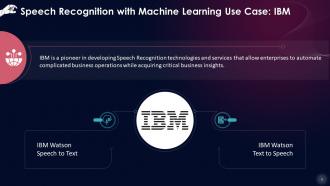
This slide showcases the IBM use case of Speech recognition driven by Machine Learning. Speech Recognition technologies and services allow IBM to automate complicated business operations while acquiring critical business insights.
Instructor’s Notes:
- IBM Watson Speech to Text: IBM Watson Speech to Text is a cloud-based solution that applies information about grammar, linguistic structure, and audio/voice signal composition to generate customized speech recognition for effective text transcription
- IBM Watson Text to Speech: IBM Watson Text to Speech delivers human-like audio from written text, expanding accessibility across languages and interaction modes and increasing customer engagement and happiness
Machine Learning For Speech Recognition Training Ppt with all 21 slides:
Use our Machine Learning For Speech Recognition Training Ppt to effectively help you save your valuable time. They are readymade to fit into any presentation structure.










FAQs for Machine Learning For Speech
So there's HMMs which were huge for like decades but feel super outdated now. Then you've got neural networks - RNNs, LSTMs, that whole family. CNNs pop up too for pulling features from spectrograms. But honestly? Transformers are where it's at these days. They're absolutely demolishing every benchmark out there. Attention mechanisms handle the audio-to-text mapping way better than the old stuff. If I were you starting something new, I'd skip straight to pre-trained transformer models. You can fine-tune them for whatever you need and save yourself months of headache.
Yeah, accents absolutely wreck speech recognition - like you'll see accuracy drop from 95% down to 70% or even worse. The models just don't know what to do when sounds don't match their training. Regional stuff, non-native speakers, even talking too fast can mess things up. Honestly it's probably the most annoying problem you'll hit in real applications. Best fix is getting way more diverse training data with different accents, or if you know your specific users, train on their patterns. Oh and slower speech usually helps too.
So feature extraction is how you turn messy audio waves into data your ML model can actually understand. You're pulling out the important bits - frequency patterns, MFCCs, spectral stuff. Without it? Your model's basically trying to find patterns in random noise, which sucks. It's kinda like highlighting key parts of a text before you summarize it. Different feature sets work better for different projects, so you'll want to experiment around. The whole thing reminds me of when I first started with audio ML - spent way too much time on this step but it's honestly worth getting right.
Oh yeah, definitely works! These days you can either train one model on multiple languages or detect the language first, then route it. The single model approach is honestly pretty slick - handles when people switch languages mid-conversation too. Google and Microsoft are already doing this stuff in production. I'd probably start with something like Whisper since it's pre-trained on tons of languages, then fine-tune it for whatever you're building. Way easier than starting from scratch, trust me.
Honestly, the biggest pain points are gonna be data quality and compute power. Clean, diverse audio with good labels is crucial - bad transcriptions will absolutely wreck your results. Real-world speech is such a mess compared to clean datasets too. Accents, background noise, different speakers... it's chaos. Memory becomes a huge bottleneck, especially with transformers (learned that one the hard way). Oh and if you're dealing with multiple languages or specialized vocab? Good luck. My advice: nail your preprocessing pipeline first and don't cheap out on compute resources. Trust me on this.
Yeah, bigger datasets usually help a ton with speech recognition. Your model gets way better at handling different accents and background noise when it has more diverse audio to learn from. Quality beats quantity though - I'd rather have 10,000 hours of varied, clean recordings than 50,000 hours of the same boring stuff. You'll see huge jumps going from tiny datasets (under 100 hours) to medium ones (1,000+). Honestly, focus on getting speakers with different backgrounds and recording conditions first. Raw volume is nice but diversity is what actually moves the needle.
Neural networks totally revolutionized speech recognition - they're way better at picking up complex audio patterns than the old statistical approaches. RNNs and LSTMs were game-changers for handling sequential data. Then transformers came along and basically dominated everything (same story as with text processing). These days you've got wav2vec doing cool self-supervised learning from unlabeled audio, plus end-to-end systems that skip all those messy pipeline steps. Honestly, if I were you I'd focus on transformer architectures first - that's where all the action is right now.
Yeah, noise totally screws with speech recognition - accuracy can tank from like 95% down to 60% in loud places. The algorithms get confused trying to figure out what's actual speech vs background junk. Coffee shop chatter, traffic, even AC hums can mess things up since most models are trained on perfect clean audio. You can help by using noise reduction preprocessing or better mics. Oh, and definitely test your system where people will actually use it - learned that one the hard way. Models trained specifically on noisy data work way better too.
Oh man, real-time processing is huge for speech recognition. Users expect instant responses - like when you talk to Siri or use dictation, any lag just kills the whole experience. You're basically processing audio as it streams in, not waiting for them to stop talking. Super tricky to balance though. Fast models vs accurate ones, you know? I always shoot for under 100ms latency because that's where conversations start feeling natural. Honestly the hardest part of the whole speech recognition thing - finding that sweet spot between complexity and speed without your accuracy going to hell.
So you'll need to keep retraining your models with new data that has all the latest slang and terms. Online learning algorithms work well since they adapt without full retraining - though honestly they're a pain to tune right. Set up feedback loops so user corrections get added back to your training data. Transfer learning is your friend here, lets you adapt existing models way faster. Oh and definitely automate data collection monthly or whatever works for your pipeline. Language changes so damn fast these days, especially online speech patterns.
Okay so privacy is probably your biggest headache - these systems are basically eavesdropping on people's conversations. Where's all that audio data going? Bias is another mess though, honestly the hardest one to fix. Most models work terribly for certain accents or speech patterns, which totally shuts out whole groups of users. Also make sure people actually know they're being recorded - consent can't be buried in fine print somewhere. Oh and definitely test across different demographics before you launch anything. Be upfront about how you handle data too.
Honestly, both work well but here's the deal - TensorFlow's got better speech tools out of the box and Google's money behind it, so production stuff is easier. PyTorch is way more flexible though, especially if you're doing research or building weird custom models. Debugging in PyTorch doesn't make you want to pull your hair out either. For production apps? Go TensorFlow. Experimenting with architectures? PyTorch all the way. Though really, just pick whatever your team already knows - learning a new framework while tackling speech recognition is like... why make life harder?
It's literally everywhere now. Siri, Alexa - obvious ones. But call centers use it for customer service, doctors dictate notes in real-time, cars have hands-free controls. Banking uses voice authentication when you call. Legal firms transcribe depositions automatically, which honestly seems like it would save lawyers tons of time. Smart homes too - you can control lights, temperature, whatever. Language learning apps give pronunciation feedback. If you want to try implementing it somewhere, I'd start with basic transcription. That's usually the easiest place to begin and see if it actually works for your situation.
Use models like Wav2Vec2 or Whisper that are already trained - way better than starting from nothing. These have learned speech patterns from huge datasets, so you're basically getting a head start. Then just fine-tune the last layers for your specific stuff (accent, vocab, whatever). It's honestly pretty wild how well they work even when you switch domains. Takes way less time and computing power too. Even if you don't have much labeled data, you'll still get decent accuracy. Oh, and pick whichever pre-trained model seems closest to what you're trying to do.
Honestly, the multilingual stuff is getting insane - you can translate conversations in real time now. Your phone's gonna handle speech recognition way better offline thanks to edge computing improvements. They're finally nailing accents and background noise too, which was about time. The coolest part? These systems actually learn how YOU talk over time. Personal vocabulary, speech patterns, all that. Oh and they're mixing it with visual AI now, so it understands context from what you're looking at too. Definitely mess around with the newer APIs if you get a chance.
-
Wonderful templates design to use in business meetings.
-
What an exhaustive collection of templates you guys have there in slideteam. Impressive!!!