

Future state improvement plan powerpoint slide design templates





Try Before you Buy Download Free Sample Product
 Impress Your
 Audience
 100%
100% Editable
 Save Hours
 of Time


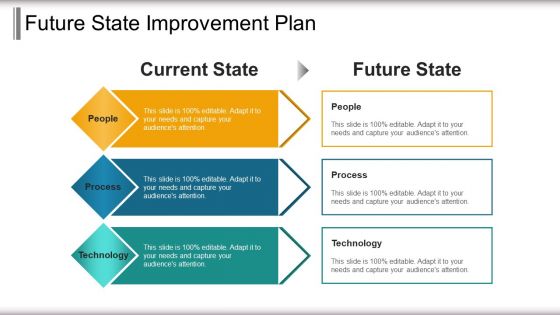
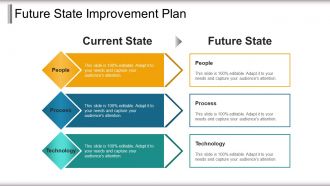
SlideTeam presents current state and future state PowerPoint slide design. The presentation graphic helps you define and evaluate the current and future state of your business. With this PPT template, you can communicate the details effectively about current state to future state as highlighted in the presentation visual with aspects such as people, process and technology. Current state is the plan as how the business is delivering services through systems, processes, policies, people and more and how the transformation can be done to improve the service delivery experience whereas future state is about what services are you planning to offer in the future, what customers are expecting and how are you going to deliver them. Our PowerPoint layout assist you to share the current state and future state structure related to business development, sales and marketing management and many more. So what are you waiting for, just download current state future state PPT design, add it in your presentation and let it share the message in an effective manner. Pull your presentations up to the next level. Future State Improvement Plan Powerpoint Slide Design Templates are easy to use.
People who downloaded this PowerPoint presentation also viewed the following :
Future state improvement plan powerpoint slide design templates with all 5 slides:
Encourage a joyful exchange of ideas with our Future State Improvement Plan Powerpoint Slide Design Templates. Indulge in good hearted banter.
FAQs for Future state improvement plan powerpoint
So you'll want clear objectives first - what are you actually trying to fix? Then map out where you're at now vs where you want to be. Action items with deadlines and owners are crucial. Don't forget success metrics! Honestly, most people totally skip the risk planning part and then wonder why everything falls apart later. Resource needs, communication plans, regular check-ins - all that stuff matters too. Oh, and make your template flexible because things will definitely change. Start simple though. You can always add more complexity once your team gets the hang of it.
Honestly, visuals are a game-changer for future state presentations. People need to *see* what you're proposing, not wade through endless bullet points. Before/after comparisons work great. So do process flows and timeline charts. I swear, nothing kills a room faster than wall-to-wall text slides – learned that the hard way once. Charts and infographics break down your complex ideas into stuff people actually get. Different audiences too, which is huge. Pick one strong visual per improvement area and tell your story around those. Keeps everyone awake and on the same page.
Think of stakeholder analysis as figuring out who you need to keep happy (or at least neutral) when rolling out changes. Map out everyone who'll be affected or has any power to help/hurt your plan. Some people have tons of influence but won't really care - others might be super invested but can't actually block you. The trick is knowing the difference so you don't waste time on the wrong people. I learned this the hard way on a project last year! Focus your energy on high-influence folks first, figure out what motivates them, and craft your approach accordingly. Saves you from nasty surprises later.
Honestly, I'd set up quarterly check-ins right from the beginning - saves you so much headache later. Your plan needs to be modular, like building blocks you can swap around when life happens. And trust me, life will happen. Set clear triggers for when you pivot - budget cuts, market changes, whatever applies to your situation. The whole thing should feel flexible, not rigid. Oh, and here's something I wish someone told me earlier: always start each review asking what's actually different now. Sounds obvious but you'd be surprised how easy it is to just go through the motions.
Honestly, the biggest trap is overcomplicating things. I made this mistake once - created a template with like 40 fields that everyone just ignored. Keep it simple and flexible so different teams can actually use it. Also, don't just focus on the final deadline. Map out those smaller milestones too, because they matter more than you'd think. Your template should get people thinking about what could go wrong early on - dependencies, budget issues, all that fun stuff. Way better than scrambling halfway through a project. Start basic, then add bells and whistles only if you need them.
Okay so future state improvement plans are way more specific than regular strategic plans. Strategic plans are those big 3-5 year vision things that honestly just collect dust half the time. Future state plans? They're laser-focused on transforming your current mess into something that actually works - usually in 6-18 months. You get real milestones, actual owners, stuff you can measure. It's less "here's our destination" and more "here's exactly how we're getting there step by step." Pro tip though - map out where you are now first. Can't build a decent improvement plan if you don't know your starting point.
Track the hard numbers first - cycle times, costs, error rates, throughput. That's your bread and butter. But honestly, the soft metrics matter just as much. Are employees actually happy with the changes? What's customer feedback looking like? Don't forget adoption rates either - best process in the world means nothing if nobody uses it. I'd throw in milestone tracking and budget stuff to keep the project from going sideways. Pick maybe 5-6 metrics that actually connect to your original problem and check monthly. More than that gets overwhelming fast.
Honestly, automation tools are a lifesaver for this stuff. Miro and Lucidchart have these drag-and-drop templates that you can reuse - total game changer when you're cranking these out constantly. AI can actually draft the initial version if you feed it your current state analysis. Then just tweak it. The collaborative platforms are where it's at though - your whole team jumps in at once instead of those brutal email threads that go nowhere. I'd start by just digitizing whatever clunky manual process you're stuck with now. Build up from there and you'll be flying through these.
Honestly, bring stakeholders in super early - like embarrassingly early when you barely have anything. Don't polish it first. Set up regular check-ins where they can actually influence things, not just nod at your finished work. I've watched so many good plans crash because people felt like they were being "informed" instead of heard. Ask them specific stuff about what's driving them crazy and what success looks like. Then actually use their input in the next draft - visibly. Skip the corporate speak and focus on results they give a damn about. Oh, and make sure everyone has a clear piece to own, otherwise it'll just sit there gathering dust.
Honestly, I'd look at three main things when ranking these scenarios. First - which ones will actually make a real difference to your key metrics? Business impact matters most. Feasibility comes next, and yeah, the "perfect world" option almost never wins (learned that the hard way). Resource mapping is huge too - figure out what people, budget, and time you'd actually need for each. I always make a simple scoring matrix to compare everything. Sounds nerdy but it saves your ass when stakeholders start questioning your choices later. Trust me on that one.
Toyota's Production System is the classic example everyone talks about - they mapped out their ideal manufacturing flow and basically revolutionized how factories work. Amazon did something similar with their warehouses before rolling out changes. But honestly? Healthcare cases hit different since people's lives are at stake. Virginia Mason Medical Center cut patient wait times by 85% and slashed medication errors using future state planning. Pretty incredible results. You'd probably get the most value looking at case studies in your specific field though. The core ideas work everywhere, but industry details really matter when you're trying to apply this stuff.
Honestly? Don't try to create this thing alone and then convince people later - that never works. Get everyone in a room (virtual counts) and build it together from scratch. Have each person share what they're actually envisioning first, because I guarantee you'll find out people are thinking totally different things. Visual stuff helps a ton - draw out the process or map the journey so you're all looking at the same thing. Write down the decisions as you make them too. The whole point is making them feel ownership over it. Otherwise you're just that person trying to sell your pet project, you know?
Honestly, just start with whatever you already have - even PowerPoint works if you set up swim lanes. Visio's solid if your company has it, or Lucidchart for something web-based. My team's obsessed with Miro lately for the collaborative whiteboard thing. First thing though? Map out all your current pain points before you touch any fancy tools. Value stream mapping is where you'll actually see the bottlenecks and wasted time hiding. I know it sounds boring but it's game-changing. You can literally build your current workflow next to your ideal future state and spot the gaps. Don't overthink the tool choice - I've seen people create brilliant process maps in PowerPoint that put expensive software to shame.
Dude, culture is everything when you're planning this stuff. Your org loves getting everyone's buy-in? Plan for way more meetings and longer timelines. Risk-averse places need like a million pilot tests before anything happens - honestly kind of exhausting but whatever. Innovative teams? You can probably move faster and shake things up more. Don't forget communication styles vary wildly too. Some people want everything documented, others just want a quick heads up. Bottom line: figure out how your people actually operate first, then build your plan around that reality instead of some perfect world scenario.
Honestly, get your leadership team on the same page first - nothing tanks a rollout faster than executives contradicting each other. Use town halls for the big vision stuff, then break it down in team meetings. Email updates help too, but here's what most people miss: your middle managers need to actually understand WHY you're changing things, not just what's changing. I've watched so many initiatives crash because managers couldn't answer basic questions. Set up ways for people to give feedback (they want to feel heard), and definitely celebrate wins when they happen. Oh, and keep your core message consistent everywhere - just adjust it for different roles.
-
Commendable slides with attractive designs. Extremely pleased with the fact that they are easy to modify. Great work!
-
Innovative and attractive designs.