


Healthcare Quality Assessment Plan To Improve Patient Experience




Try Before you Buy Download Free Sample Product
 Impress Your
 Audience
 100%
100% Editable
 Save Hours
 of Time


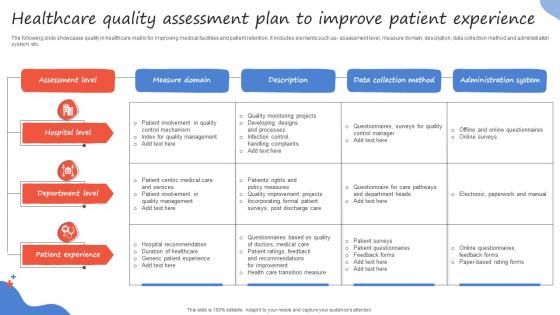
The following slide showcases quality in healthcare matrix for improving medical facilities and patient retention. It includes elements such as assessment level, measure domain, description, data collection method and administration system etc.
People who downloaded this PowerPoint presentation also viewed the following :
Healthcare Quality Assessment Plan To Improve Patient Experience with all 6 slides:
Use our Healthcare Quality Assessment Plan To Improve Patient Experience to effectively help you save your valuable time. They are readymade to fit into any presentation structure.





FAQs for Healthcare Quality Assessment Plan To
So you'll mainly see patient safety stuff like infection rates and med errors. Clinical outcomes matter too - mortality, readmissions, all that. HCAHPS patient satisfaction scores are big. Process measures like vaccination rates and following guidelines are everywhere now. Staffing ratios and tech adoption count as structural quality metrics. Honestly, the annoying part is every accrediting body weights these differently. I'd figure out what matters most for your specific unit first - saves you from drowning in data that doesn't actually move the needle for your patients.
Patient satisfaction surveys have to be real quality metrics, not just something you do because you're supposed to. I've watched too many hospitals collect this stuff and then... nothing happens with it. Track those scores next to your clinical outcomes. Use them in staff evaluations. Pick maybe 3-4 key satisfaction metrics and actually review them every month with your other quality data. Make sure the survey questions match what you're trying to achieve quality-wise. And here's the thing - when patients complain about something, you've got to circle back with them. Otherwise they'll think you don't care.
Honestly, tech makes healthcare quality assessments so much better. EHR analytics can automatically track patient outcomes instead of doing it by hand. AI spots patterns you'd totally miss otherwise. Real-time dashboards show you quality metrics instantly - no waiting around. Predictive analytics are actually pretty neat because they catch problems before they blow up. The data standardization thing is huge too since you're not dealing with messy, inconsistent info anymore. I'd start by figuring out which manual processes you can automate first. Way less room for human error that way.
So basically these accreditation groups all have different ideas about what makes healthcare "good." Joint Commission is all about safety and operations. NCQA? They're more into preventive stuff and patient outcomes - totally different vibe. Then you've got AAAHC doing their ambulatory thing, plus CMS with their payment-tied measures. It's honestly kind of a mess because facilities end up chasing whatever standards their specific accreditor wants. Pro tip though - if you're checking out a facility, see who accredits them. That'll tell you exactly what they're prioritizing, which is pretty useful info to have.
Honestly, it's pretty messy because those standard metrics weren't really built with everyone in mind. Cultural differences totally change what quality care even means - like, someone's family might expect to be super involved in decisions while another person wants full autonomy. Language barriers make everything harder too. A lot of measurement tools were basically designed for certain demographics, so they completely miss problems that hit underserved communities the worst. Health literacy levels vary so much between groups. I'd probably try multiple ways to measure things and actually talk to the communities you're looking at - otherwise you're gonna miss half the story.
So you know all that healthcare data just sitting around? Analytics turns it into stuff you can actually act on. Pretty neat how you can spot which treatments work best and catch problems early instead of just winging it. The predictive parts are honestly where it gets interesting - forecasting readmissions, figuring out staffing needs ahead of time. You'll see patterns you'd never notice otherwise. My advice? Don't try to boil the ocean right away. Pick one specific quality thing you want to fix and focus your analytics there first. Way less overwhelming that way.
So here's the thing about evidence-based practices - they're your best friend for quality assessments because there's actual research backing them up. You can look at clinical studies and know what works instead of just guessing or going with "we've always done it this way" (which honestly drives me crazy). They give you solid benchmarks to compare against and help spot where care is falling short. My advice? Always dig into what evidence supports the metrics you're evaluating. Focus on interventions that have proven they actually work - it'll make your recommendations way more convincing.
Honestly, don't just slash budgets blindly - focus on what actually matters for patient outcomes first. Look at your quality metrics and figure out which ones really make a difference (spoiler: not all the fancy-looking ones do). Hunt for waste that doesn't hurt care quality. Administrative stuff is usually a goldmine here, plus all those duplicate tests nobody really needs. The magic happens when you find changes that save money AND improve outcomes at the same time. Track cost-per-quality-adjusted outcome instead of raw spending. Set your quality red lines upfront, then get creative with costs within those limits.
Honestly, training your staff is huge for patient care - probably the biggest thing you can do. Better training means fewer mistakes, happier patients, and way better outcomes overall. I've actually seen some places completely turn around just from solid education programs. Your team starts communicating better with patients too, plus they spot problems before they get serious. The money side makes sense when you think about it - less liability, better reputation. Oh, and definitely start by figuring out where your biggest training gaps are. Focus on the safety stuff first since that's where you'll see the most impact.
Get your leadership on board first - without them, you're dead in the water. Don't dump everything on quality control though. Everyone needs skin in the game. Track metrics that actually impact patients, not just whatever's convenient to measure. The PDSA thing really does work (even if it sounds corporate). Small tests, see what happens, then expand. Your frontline people? They're gold mines for spotting real problems since they live it daily. Oh, and definitely celebrate the wins loudly - makes people want to keep going. When stuff fails, just learn from it instead of pointing fingers. Start small with one department first.
So basically you're dealing with three big things: patient privacy, getting proper consent, and not screwing anyone over in the process. Any patient data has to be de-identified - that's non-negotiable. People need to know their info might get used for quality stuff too. Here's what really gets me though - so many assessment methods accidentally make care harder for certain groups. Totally defeats the purpose, right? Always loop in your ethics committee before you start anything. Oh, and build in check-ins to catch problems you didn't see coming. Trust me, there'll be some.
Honestly, telemedicine is making healthcare quality metrics a total headache right now. We're scrambling to figure out new ways to measure things - like how well patients can actually use the tech, internet connection quality, whether people stick to remote monitoring. Traditional in-person metrics just don't work anymore. The good news? You can get real-time data from connected devices and instant feedback after virtual visits. My colleague was just telling me how messy the standardization process is. But here's the thing - you've got to track both clinical results AND the digital experience. Miss either one and you're basically flying blind.
So PROMs are patient-reported outcome measures - they track what people actually feel about their health after treatment. Pain levels, how well they can move around, overall quality of life, that stuff. Here's the thing though - you can have perfect test results but if someone's miserable, your "success" isn't really successful, you know? That's where PROMs shine. They catch what lab work misses about the real patient experience. You'll want standardized tools so you can compare data between different providers. Makes tracking improvements way easier. Oh, and don't go crazy at first - pick one condition and start there.
When different healthcare people actually talk to each other, patients do way better. Your pharmacist catches drug interactions the doc might miss. Nurses spot changes in condition faster. Honestly, the whole "working in silos" thing is so outdated - you miss tons of stuff that way. Teams that communicate well see fewer readmissions and shorter hospital stays. SBAR communication and regular team meetings help a lot. I'd start small though - pick one area where departments overlap and fix how they hand things off first. It's crazy how much better outcomes get when everyone's on the same page.
There's some pretty exciting stuff happening right now. Real-time feedback platforms can analyze patient comments automatically using text analytics. AI clinical decision tools help spot quality issues before they blow up. Predictive models dig through EHR data to find at-risk patients early - which honestly seems like magic sometimes. Digital monitoring is huge too, tracking things like hand hygiene or med errors without anyone having to manually check. Patient-reported outcome measures are becoming standard in most workflows now. Oh, and the AI space moves ridiculously fast so half this stuff will probably be outdated next year! I'd start small though - pick one feedback tool and test it in your busiest department first.
-
Great quality product.
-
The design is very attractive, informative, and eye-catching, with bold colors that stand out against all the basic presentation templates.