


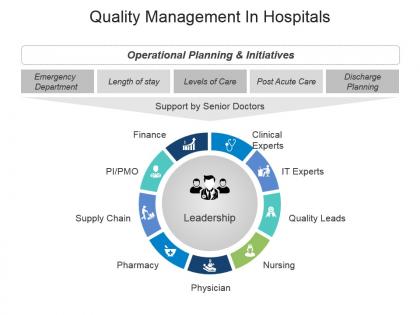
Quality management in hospitals powerpoint slide presentation examples




Try Before you Buy Download Free Sample Product
 Impress Your
 Audience
 100%
100% Editable
 Save Hours
 of Time


Dish out the intelligence with our Quality Management In Hospitals Powerpoint Slide Presentation Examples. Elaborate on your assessment of the competition.
People who downloaded this PowerPoint presentation also viewed the following :
Quality management in hospitals powerpoint slide presentation examples with all 5 slides:
Extend your domain with our Quality Management In Hospitals Powerpoint Slide Presentation Examples. They help broaden your customer base.



FAQs for Quality management in hospitals powerpoint
Look, start with the boring stuff that actually works - standardized checklists and protocols. Your staff needs to feel safe reporting mistakes without getting their heads chopped off, otherwise you'll never know what's really happening. Training and simulation exercises are huge too. Electronic health records cut down on those stupid transcription errors (though honestly, some systems are still a nightmare to use). Don't make this just the quality team's problem - everyone should own safety. Pick one area first and see how it goes before trying to fix everything at once.
Focus on patient safety first, not just saving money. Six Sigma's perfect for cutting down medication errors - use DMAIC for things like infection control or discharge processes. Lean's honestly a no-brainer since hospitals waste so much time and resources already. Map out your patient care pathways to spot bottlenecks and cut the useless steps. Here's the thing though - clinical staff will only buy in if you show them it actually helps patients, not just makes spreadsheets look better. Pick one department to test it out first. Trust me on this one.
Patient feedback is seriously your best tool for figuring out what's actually broken. Surveys, complaints, focus groups - they'll tell you stuff your reports never will. Like, patients notice when nurses seem rushed or when nobody explains what's happening. Wait times that seem "reasonable" to staff? Patients hate them. The complaints especially - those usually point to your biggest problems. You need multiple ways for people to speak up though. And here's the thing that drives me crazy - so many places collect all this feedback then just... sit on it. Actually use it to fix things! That's literally the whole point.
So you'll need to watch both the clinical stuff and operational side. Start with patient safety metrics - infection rates, readmissions, med errors, that kind of thing. Patient satisfaction scores are obviously huge too. Then look at your process improvements: wait times dropping? Staff actually following protocols? Meeting your targets? Here's the thing though - you absolutely have to get baseline numbers before changing anything, otherwise you're just guessing. Keep monitoring consistently after that. And honestly, don't just hoard data like some people do. Actually dig into the trends and pivot your strategy when the numbers aren't working.
Start with the big three patient safety ones - infection rates, med errors, and falls. Those are non-negotiable. Then add readmission rates and patient satisfaction scores. Honestly, you'll go crazy if you try tracking everything at once (learned that the hard way). Staff turnover and ED wait times are huge too since they mess with everything else. Oh, and length of stay - that one's sneaky important. Pick maybe 5-6 that actually matter for your units first. You can always add more once you're not drowning in data.
So you want better interdisciplinary teams? Start by actually getting everyone in the same room - doctors, nurses, pharmacists, social workers, the whole crew. Each person brings something different to the table. SBAR communication helps, but honestly the real game-changer is when people drop their egos and actually listen to each other instead of protecting their turf. Joint training sessions work great too. Don't try to overhaul everything at once though - pick one unit, nail it there, then spread what works to the rest of the hospital.
Ugh, honestly? Every department thinks they're running their own show with totally different priorities. Surgery wants speed and precision. Pharmacy obsesses over accuracy above all else. Nursing's drowning in patient care AND paperwork - I don't know how they do it. Then you've got communication disasters where what works in radiology bombs completely in the ER. Staff turnover makes it worse since you're always training someone new on quality stuff. My advice? Set up standard quality metrics that everyone has to follow, then do regular cross-department meetings so people actually talk to each other about shared goals.
Honestly, your staff training makes or breaks everything. Yeah, you can write perfect procedures, but if your team doesn't actually get how to follow them? Total disaster waiting to happen. Healthcare changes so fast too - new regulations pop up constantly, tech updates, all that stuff. I've literally watched hospitals crash and burn because they skipped proper training and ended up with major compliance nightmares. Don't just do the basic orientation thing either. You need regular check-ins and refresher sessions to keep people sharp.
EHRs have honestly been a lifesaver for quality stuff - way less human error and you get data instantly. We can actually track patient outcomes now and spot weird patterns before they become big problems. The audit trails are solid too, so you know who touched what record and when. My old hospital still had some paper charts mixed in (nightmare!). Main thing is getting your team to actually USE the system properly, not just dump info in there. I'd say pick one quality metric first and really nail that down before expanding.
Honestly, quality management is one of those things that pays off big time for patient satisfaction. Patients can tell when you've got your act together - fewer errors, better coordination, all that stuff. They'll actually recommend you to friends instead of just complaining on Yelp. Your rankings go up, insurance companies take you seriously, and it snowballs from there. Makes hiring easier too since people want to work at respected places. I'd definitely start tracking your satisfaction scores next to whatever quality stuff you're already doing. You'll see the connection pretty quick, and it's kind of satisfying to watch those numbers climb together.
Start by mapping what you're already doing against the regs - that's your foundation. Build compliance right into your workflows instead of slapping it on later. Seriously, I've watched hospitals try the "add it afterward" approach and it's a total mess to manage. Create standard processes where regulatory stuff just happens naturally as part of everyone's day. Automate the monitoring pieces you can. Train people so it becomes routine, not extra busywork they hate doing. Oh, and definitely pilot this in just one department first - work out all the weird issues before you go hospital-wide.
Honestly, hospitals are getting pretty smart about this stuff - they're using real-time analytics and AI to spot problems before they blow up. Predictive algorithms can flag which patients might have complications coming. Mobile dashboards let staff check quality metrics anywhere, which is super handy. Some places are even making it competitive with leaderboards for things like hand washing (kinda weird but apparently it works?). The rapid-cycle testing thing is brilliant though - teams can test small changes weekly instead of waiting forever for results. If you're thinking about upgrading, I'd definitely start with something that gives you real-time visibility into what's actually happening.
Honestly, the biggest thing is getting everyone bought in, not just your quality team. When executives actually show up to rounds instead of just talking about it, people notice. Train your staff on quality basics and - this is huge - make sure they can flag problems without getting thrown under the bus. I've seen places do this really well by celebrating wins publicly, like posting patient thank-you notes or shout-outs for teams who catch near-misses. Your frontline people need to see how their daily stuff actually impacts patients. Oh, and when someone brings up a concern? Act fast. Otherwise they'll stop telling you things.
Get your team together fast - like within 2-3 days max. Make sure you've got the actual people who were there, not just their bosses looking over their shoulders. Fishbone diagrams and the "5 Whys" are your friends here. Don't stop digging when you hit "human error" - that's usually just scratching the surface. The real problems are almost always process breakdowns or communication gaps. Write everything down (I know, boring but necessary), assign specific people to fix stuff with actual deadlines. Then circle back in a month or two to see if anything actually changed.
Don't treat CQI like some separate thing you bolt onto everything else - weave it right into what people already do. Train your frontline folks on PDSA cycles and root cause analysis since they're spotting issues before anyone else anyway. Regular team huddles work great for talking through what's broken and what's actually helping patients. Honestly, quality can't just be the quality department's problem anymore. Everyone needs skin in the game. Set up simple metrics that staff can see - visual tracking boards are clutch for this. And yeah, celebrate the small stuff or people burn out fast.
-
The content is very helpful from business point of view.
-
Illustrative design with editable content. Exceptional value for money. Highly pleased with the product.