

Highlighting The Employee Satisfaction Survey Results Developing Staff Retention Strategies




Try Before you Buy Download Free Sample Product
 Impress Your
 Audience
 100%
100% Editable
 Save Hours
 of Time


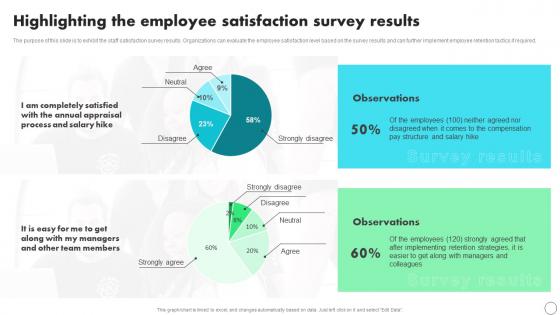
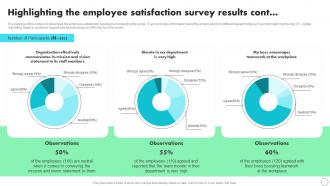
The purpose of this slide is to showcase the employee satisfaction results post conducting the survey. It also provides information about the employees from different departments such as Information technology IT, digital marketing, finance, customer support and human resource HR who took the survey.
People who downloaded this PowerPoint presentation also viewed the following :
Highlighting The Employee Satisfaction Survey Results Developing Staff Retention Strategies with all 8 slides:
Use our Highlighting The Employee Satisfaction Survey Results Developing Staff Retention Strategies to effectively help you save your valuable time. They are readymade to fit into any presentation structure.






FAQs for Highlighting The Employee Satisfaction Survey Results Developing
Key factors influencing employee satisfaction include work-life balance, career development opportunities, compensation and benefits, management quality, and workplace culture. These elements work together to create comprehensive employee experiences, with many organizations finding that companies addressing multiple factors simultaneously see significantly higher retention rates, increased productivity, and enhanced competitive advantage in talent acquisition.
These survey results demonstrate competitive performance against industry standards, with employee engagement scores typically ranging from 65-75% across sectors, while retention metrics and satisfaction ratings vary significantly by company size, industry type, and organizational culture. Through strategic comparison analysis, organizations can identify improvement opportunities, benchmark compensation structures, and enhance workplace policies, ultimately delivering targeted interventions that boost employee morale and reduce turnover costs.
**INPUT**: Which departments or teams showed the highest and lowest satisfaction scores, and what insights can be drawn from this? **OUTPUT**: Employee satisfaction surveys typically reveal significant variations across departments, with customer service, sales, and IT often showing lower scores due to high-pressure environments, while HR, marketing, and executive teams frequently score higher. These patterns enable organizations to identify specific operational challenges, resource allocation gaps, and management effectiveness issues, ultimately delivering targeted improvement strategies that enhance retention, productivity, and competitive advantage across underperforming divisions.
Employee feedback typically highlights areas like communication transparency, career development opportunities, work-life balance policies, recognition programs, and management effectiveness. These insights enable organizations to prioritize strategic improvements, with many companies finding that addressing communication gaps and professional growth pathways delivers enhanced retention, productivity, and overall workplace satisfaction.
Demographic factors reveal distinct satisfaction patterns, with younger employees typically showing higher engagement scores, longer-tenured staff expressing stronger loyalty but lower adaptability satisfaction, and managerial roles reporting different priorities than individual contributors. These correlations enable organizations to tailor retention strategies, customize development programs, and address role-specific concerns, ultimately delivering more targeted employee experiences and improved overall workplace satisfaction across diverse workforce segments.
Company culture significantly influences employee satisfaction by shaping workplace values, communication patterns, recognition practices, and overall work environment quality. Strong cultures that prioritize transparency, collaboration, and employee development consistently demonstrate higher satisfaction scores across engagement metrics, with organizations finding that cultural alignment directly correlates with retention rates, productivity levels, and ultimately competitive advantage in talent acquisition.
The feedback collection channels achieved strong representational reach by combining digital surveys, focus groups, anonymous suggestion systems, and direct manager consultations across all departments and tenure levels. This multi-channel approach enabled comprehensive participation from remote workers, on-site teams, and various demographic segments, ultimately delivering broader insights and higher response rates than single-method approaches.
Strategies include enhancing communication channels, implementing flexible work arrangements, providing targeted professional development, improving recognition programs, and addressing compensation concerns through market analysis. These approaches streamline employee engagement by fostering transparency, supporting work-life balance, and creating growth opportunities, with many organizations finding that strategic combinations of these initiatives ultimately deliver improved retention and enhanced workplace satisfaction.
Management can communicate survey results through company-wide meetings, detailed reports highlighting both strengths and improvement areas, regular progress updates, and transparent action plans with specific timelines. This approach demonstrates accountability while building trust, with many organizations finding that honest communication about challenges alongside successes ultimately enhances employee engagement and organizational credibility.
**Follow-up actions should prioritize addressing compensation concerns, enhancing management training programs, improving work-life balance policies, expanding professional development opportunities, and strengthening internal communication channels.** **These strategic initiatives streamline organizational effectiveness by reducing turnover costs, boosting productivity levels, and enhancing employee engagement, with many companies finding that targeted action plans ultimately deliver measurable improvements in retention rates and workplace satisfaction.** *[Word count: 56 words]*
Employee recognition and rewards programs significantly enhance satisfaction scores by boosting morale, increasing engagement, and fostering loyalty among team members. These strategic initiatives streamline retention efforts while reducing turnover costs, with many organizations finding that personalized recognition approaches, performance-based incentives, and peer acknowledgment systems ultimately deliver improved productivity and stronger workplace culture across all departments.
Looking at employee satisfaction survey results, common training needs that emerge include leadership development programs, technical skills enhancement, communication workshops, project management certification, and mentoring initiatives. These developmental opportunities address skill gaps identified through feedback, with many organizations finding that strategic investment in targeted training programs significantly improves employee engagement, retention rates, and overall workplace productivity.
Ongoing employee feedback mechanisms include pulse surveys, regular one-on-ones, anonymous suggestion systems, exit interviews, and digital feedback platforms. These approaches enable organizations to track satisfaction trends by collecting continuous data, identifying emerging concerns early, and measuring progress on improvement initiatives, with many companies finding that consistent feedback loops ultimately enhance retention and workplace culture.
Work-life balance serves as a critical driver of employee satisfaction, directly influencing retention rates, productivity levels, engagement scores, and overall workplace morale. Survey results consistently show that organizations prioritizing flexible schedules, remote work options, and reasonable workloads experience significantly higher satisfaction ratings, with employees reporting reduced burnout, improved performance, and greater loyalty to companies that respect personal boundaries.
Technology enhances employee engagement by automating feedback collection, providing real-time analytics, and enabling personalized development paths through AI-driven insights. Through digital platforms, organizations streamline communication, deliver targeted training programs, and create interactive recognition systems, while mobile apps facilitate continuous pulse surveys, ultimately improving retention rates and workplace satisfaction across diverse teams.
-
“Superb. What a great finding. Thankful for SlideTeam. We were paying people to make slides which went all in vain. We are so happy to have found you.”
-
Easily Understandable slides.