


History And Evolution Of Scientific Digital Forensics




Try Before you Buy Download Free Sample Product
 Impress Your
 Audience
 100%
100% Editable
 Save Hours
 of Time


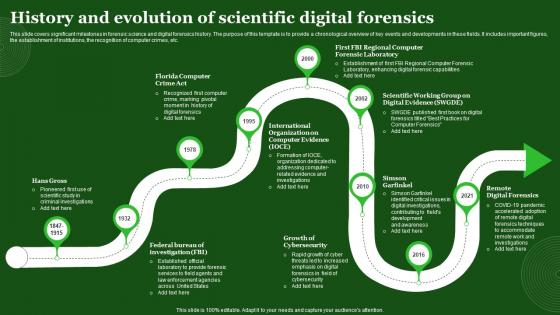
This slide covers significant milestones in forensic science and digital forensics history. The purpose of this template is to provide a chronological overview of key events and developments in these fields. It includes important figures, the establishment of institutions, the recognition of computer crimes, etc.
People who downloaded this PowerPoint presentation also viewed the following :
History And Evolution Of Scientific Digital Forensics with all 9 slides:
Use our History And Evolution Of Scientific Digital Forensics to effectively help you save your valuable time. They are readymade to fit into any presentation structure.








FAQs for History And Evolution Of
So the main thing is protecting evidence integrity - you gotta maintain chain of custody and document literally everything. Never work on originals! Make bit-for-bit copies first using write blockers. Hash everything to verify it hasn't changed. I can't stress this enough - keep crazy detailed logs of every single step because you'll probably end up explaining it all in court later. Follow standard procedures too, obviously. People screw this up way more than you'd think, honestly. The whole point is making sure your findings hold up legally.
So basically you're working with stuff that can just vanish if you breathe on it wrong, unlike regular forensics where fingerprints don't delete themselves. Digital evidence is ridiculously fragile - I've seen cases where people accidentally wiped critical data just by booting up a device. You'll need special tools to make exact copies before touching anything. The tricky part? Evidence gets spread across phones, laptops, cloud accounts, everywhere. Plus you're racing against encryption and remote wipes. Always image first, work from copies later. Trust me on this one.
So the big players are EnCase and FTK - basically everyone uses them for drive imaging and analysis. Cellebrite's the go-to for mobile stuff, and yeah, watching them crack locked phones is kinda scary tbh. Autopsy's solid if you want something free and open-source. Wireshark's your friend for network traffic. Oh, and don't overlook simple stuff like dd for imaging or basic hex editors - sometimes the old tools just work better. I'd honestly start with Autopsy since it won't overwhelm you. The Sleuth Kit's there too if you like command-line work.
Dude, chain of custody will make or break your case. Document literally everyone who touches the evidence - who, when, what they did, storage conditions, all of it. Defense lawyers are like bloodhounds sniffing for any gap in your paperwork. Miss one handoff? Judge might throw everything out. You gotta start logging from the second you grab a device. Nobody handles anything without proper documentation - I learned that the hard way on a case last year. It's tedious as hell but covers your ass legally.
Dude, you absolutely need to get good at data recovery - it's like the bread and butter of digital forensics. Suspects love trying to wipe their drives clean, or you'll get some busted hard drive that died at the perfect moment (classic). Recovery tools let you pull deleted files, grab stuff from formatted drives, even extract data from physically trashed hardware. The tricky part is keeping everything court-ready while you're doing it. Honestly, I'd say learn this stuff early because you're gonna use it on basically every single case. Oh, and invest in good tools - the cheap ones will make you want to cry.
First thing - airplane mode or throw it in a Faraday bag so nobody can wipe it remotely. Create a forensic image before you touch anything else. Cellebrite UFED or Oxygen Detective Suite are solid choices. Physical extraction gets you way more data, but logical works if the device is locked down. Honestly, encryption is becoming a nightmare with how much manufacturers are ramping up security. Document everything for chain of custody - that's what'll save you in court. Oh, and start simple with extraction methods first. You can always escalate later if it doesn't work.
Look, privacy and consent are huge here - you're messing with people's personal stuff. Don't go on fishing expeditions through random data just because it's there, that's asking for trouble. Stick to your investigation's actual scope and document literally everything you do. Chain of custody can't have any gaps or your whole case falls apart. Only grab what you actually need for the investigation. Also, your org probably has policies about this stuff so follow those and whatever legal guidelines apply. Honestly, it's better to be overly cautious than sorry later.
Cloud forensics is honestly a mess. Data gets scattered across tons of servers in different countries, so you're juggling various laws and regulations. Service providers? They move at their own pace during investigations - super frustrating. Data disappears constantly too - automatic deletions, caching, overwrites. You can't control any of it. Shared infrastructure makes things worse since you might mess up evidence or miss important logs buried with other users' stuff. My advice? Set up response agreements with providers beforehand and figure out their forensic tools now, not when everything's on fire.
Yeah crypto definitely throws a wrench into digital investigations. The blockchain's public but good luck connecting wallets to actual people - it's like everyone's wearing masks. Privacy coins are a nightmare since they hide everything. But honestly? Most criminals mess up at exchanges or when cashing out. You can still track patterns through IP logs and wallet clustering stuff. Focus on where crypto meets regular banking - that's usually where they get sloppy and leave breadcrumbs.
First thing - make a bit-for-bit copy right away and never touch the original again. Write-blocking tools are a must so you don't accidentally mess anything up. Work only from your forensic images after that. Document literally everything. Chain of custody, timestamps, which hashing algorithms you used - all of it. MD5 and SHA-256 hashes will save your butt later when you need to prove nothing got changed. Keep everything locked up somewhere climate-controlled. Honestly, I treat originals like they're radioactive or something. Better safe than sorry when your case depends on it.
So digital forensics is basically detective work for cyberattacks. You're digging through computers, phones, networks - all that digital stuff - to piece together what went down. First thing? Don't touch anything until you've made forensic copies of everything. Then you can start hunting through deleted files, network logs, timestamps, all those breadcrumbs attackers leave behind. It shows you how they broke in, what they grabbed, maybe even who did it (though figuring out attribution is honestly a pain). The whole point is building evidence for court cases or just understanding how you got pwned so it doesn't happen again.
Dude, metadata analysis is where the magic happens in digital forensics. You're basically finding all the secret info hiding behind files - timestamps, GPS coords, device details, user activity. Most people have no clue this stuff even exists. It'll show you timelines, prove someone was somewhere specific, reveal when files got created or messed with. Sometimes deleted info is still buried in there too, which is wild. My advice? Grab that metadata first thing in your investigation. Honestly, it's usually way more useful than whatever's actually in the file itself.
Ugh, encryption and privacy laws are such a pain in digital forensics. You might get a warrant but still can't crack the device because of strong encryption - super frustrating. GDPR and similar regulations limit what data you can even touch during investigations. Short sentences suck sometimes, but you'll constantly be working with legal teams on warrant requirements and data protocols. Document everything you do though, because one slip in your methodology can make evidence inadmissible in court. Honestly the legal side takes up way more time than the actual tech work these days.
Honestly, everything's shifting toward AI and machine learning right now - they can crunch through terabytes of data way faster than we ever could manually. Cloud forensics is becoming essential since everyone's using AWS and Azure these days. The IoT thing is kinda crazy though - like, your smart thermostat could literally be evidence in a case. Mobile forensics keeps getting trickier with all the new encryption stuff. Oh, and quantum computing might break all our current crypto methods eventually. You should probably start learning AI tools and cloud platforms now because just knowing how to image drives isn't gonna be enough anymore.
Honestly, you've got to set up data retention policies and incident response stuff *before* anything goes wrong. Map out your IT infrastructure and get chain of custody protocols down pat. Train everyone on evidence preservation because - and I can't stress this enough - people always screw up by trying to "fix" things immediately. Keep detailed logs of system activity and user access. Have forensic imaging ready to roll, and your legal team should already have external forensic experts on speed dial. The whole point is planning ahead so you're not totally lost when something actually happens.
-
Graphics are very appealing to eyes.
-
I was confident and well prepared for my presentation for the first time ever. With SlideTeam’s templates, I could deliver one of my best presentations. Will be coming back for more!