

Honda Company Profile Board Of Directors Ppt Show Graphics Tutorials CP SS




Try Before you Buy Download Free Sample Product
 Impress Your
 Audience
 100%
100% Editable
 Save Hours
 of Time


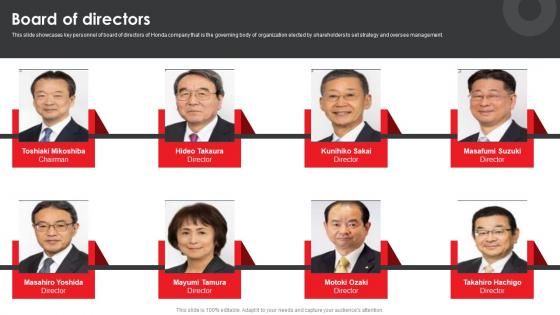
This slide showcases key personnel of board of directors of Honda company that is the governing body of organization elected by shareholders to set strategy and oversee management.
People who downloaded this PowerPoint presentation also viewed the following :
Honda Company Profile Board Of Directors Ppt Show Graphics Tutorials CP SS with all 9 slides:
Use our Honda Company Profile Board Of Directors Ppt Show Graphics Tutorials CP SS to effectively help you save your valuable time. They are readymade to fit into any presentation structure.








FAQs for Honda Company Profile Board Of Directors Ppt Show Graphics
Honda was founded in 1948 by Soichiro Honda, initially focusing on motorized bicycles before expanding into motorcycles and automobiles. The company achieved its first significant milestone in 1959 by becoming the world's largest motorcycle manufacturer, with this rapid growth enabling Honda to establish global manufacturing operations and ultimately deliver innovative transportation solutions across automotive, motorcycle, and power equipment sectors.
Honda's innovation commitment drives its product development through advanced research facilities, cross-industry technology transfer, and continuous improvement methodologies like kaizen. This approach enables Honda to pioneer breakthrough technologies across automotive, motorcycle, and power equipment sectors, with innovations in hybrid systems, robotics, and fuel efficiency ultimately delivering competitive advantages, enhanced customer experiences, and sustained market leadership in an increasingly technology-driven landscape.
Honda's automotive division emphasizes hybrid technology, advanced driver assistance systems, fuel efficiency innovations, and family-oriented safety features, while its motorcycle division focuses on engine performance optimization, lightweight materials, racing technology, and recreational mobility solutions. The automotive segment targets mainstream consumers seeking reliability and environmental consciousness, whereas motorcycles serve diverse markets from commuter efficiency to high-performance enthusiasts, with both divisions leveraging Honda's engineering expertise to deliver competitive advantages in their respective global markets.
Honda's sustainability approach has evolved from basic fuel efficiency improvements in the 1970s to comprehensive environmental initiatives including hybrid technology development, carbon neutrality commitments, and sustainable manufacturing processes. The company now integrates renewable energy across operations, advances electric vehicle platforms, and implements circular economy principles, with many automotive manufacturers finding that Honda's early environmental investments deliver competitive advantages in increasingly regulated global markets.
Honda has leveraged robotics and AI through automated assembly lines, predictive maintenance systems, quality control algorithms, collaborative robots for precision tasks, and intelligent supply chain management. These technologies streamline production by reducing human error, accelerating manufacturing cycles, and optimizing resource allocation, with many automotive manufacturers finding that strategic AI integration ultimately delivers enhanced operational efficiency and competitive manufacturing advantage.
Honda's most popular models feature renowned reliability, fuel efficiency, advanced safety systems like Honda Sensing, spacious interiors, and strong resale values. While competitors like Toyota match reliability and Hyundai offers longer warranties, Honda distinguishes itself through superior driving dynamics, innovative engineering solutions, and consistent performance across diverse segments, with many consumers finding that Honda's balanced approach to practicality and engagement delivers exceptional long-term value.
Honda's corporate culture emphasizes respect for individuals, continuous improvement, and innovation, directly shaping collaborative decision-making processes, employee empowerment initiatives, and long-term strategic planning. This philosophy enables cross-functional teamwork, accelerates product development cycles, and enhances workforce retention, with many automotive organizations finding that such people-centered approaches ultimately deliver stronger operational efficiency and sustainable competitive advantage.
Honda serves as a major Tier 1 manufacturer and strategic partner in the global automotive supply chain, producing vehicles, engines, and components while collaborating with thousands of suppliers worldwide. The company enhances supply chain efficiency through its lean manufacturing principles, just-in-time delivery systems, and advanced logistics networks, ultimately delivering cost optimization and streamlined operations across automotive markets globally.
Honda invests heavily in research and development through advanced engineering centers, partnerships with technology companies, and dedicated innovation labs focused on electrification, autonomous driving, and sustainable materials. The company allocates significant resources to hybrid and electric vehicle development, AI-powered safety systems, and fuel cell technology, with these strategic investments enabling Honda to deliver cutting-edge vehicles while maintaining market leadership in an increasingly competitive automotive landscape.
Honda has introduced personalized vehicle customization programs, comprehensive warranty extensions, digital service scheduling platforms, loyalty reward systems, and enhanced after-sales support services. These customer-centric initiatives streamline ownership experiences by reducing service wait times, offering flexible financing options, and providing proactive maintenance alerts, with many automotive companies finding that such integrated approaches significantly boost customer retention and brand loyalty.
Honda's branding strategy has evolved from emphasizing reliability and fuel efficiency to incorporating sustainability, electrification, and smart mobility solutions in response to environmental consciousness and technological expectations. The company now positions itself as an innovative mobility leader rather than just an automaker, with campaigns showcasing electric vehicles, autonomous technologies, and connected services, ultimately delivering enhanced brand relevance while maintaining its core engineering heritage across global markets.
Honda has pursued strategic partnerships with GM on electric vehicle development, collaborated with Waymo on autonomous driving technology, partnered with SoftBank on AI-powered mobility solutions, and established alliances with major suppliers for battery innovation. These collaborations enhance Honda's technological capabilities by accelerating R&D timelines, sharing development costs, and accessing specialized expertise, ultimately delivering cutting-edge vehicles and mobility solutions.
Global economic fluctuations have created varied regional impacts for Honda, with supply chain disruptions, currency volatility, and shifting consumer preferences affecting sales differently across markets. While economic uncertainty in Europe and inflation pressures challenged traditional automotive demand, Honda's strategic diversification into hybrid technologies and emerging market expansion has enabled sustained growth, particularly in Southeast Asia and India, ultimately delivering competitive resilience.
Honda's vision for future mobility centers on achieving carbon neutrality by 2050 through electrification, autonomous driving technologies, and connected mobility solutions. The company is investing heavily in electric vehicle platforms, hydrogen fuel cell technology, and AI-driven autonomous systems, with many automotive manufacturers finding that this integrated approach to sustainable transportation, enhanced safety features, and seamless connectivity ultimately delivers competitive advantage in an increasingly digital automotive landscape.
Honda addresses regulatory compliance challenges through strategic localization, comprehensive regulatory monitoring systems, and dedicated compliance teams in each market. The company establishes regional manufacturing facilities, develops market-specific product variants, and maintains strong relationships with local regulatory bodies, ultimately enabling seamless operations across diverse international markets while minimizing compliance risks and accelerating market entry timelines.
-
Amazing product with appealing content and design.
-
I want to thank SlideTeam for the work that they do, especially their customer service.