

SWOT Analysis Hyundai Motors Company Profile CP SS




Try Before you Buy Download Free Sample Product
 Impress Your
 Audience
 100%
100% Editable
 Save Hours
 of Time


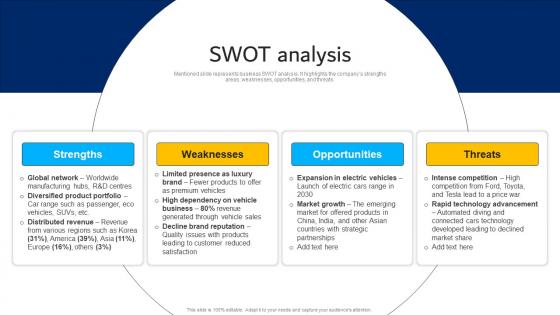
Mentioned slide represents business SWOT analysis. It highlights the companys strengths areas, weaknesses, opportunities, and threats.
People who downloaded this PowerPoint presentation also viewed the following :
SWOT Analysis Hyundai Motors Company Profile CP SS with all 9 slides:
Use our SWOT Analysis Hyundai Motors Company Profile CP SS to effectively help you save your valuable time. They are readymade to fit into any presentation structure.








FAQs for SWOT Analysis Hyundai Motors Company
Hyundai Motors' key strengths include comprehensive warranty programs, advanced manufacturing quality, strategic global market presence, competitive pricing structures, and rapid innovation in electric vehicle technology. These advantages enable the company to deliver reliable vehicles across diverse market segments, build strong customer loyalty through exceptional after-sales support, and maintain competitive positioning in both traditional automotive and emerging EV markets, ultimately delivering sustained growth and market differentiation.
Hyundai's sustainability commitment has significantly enhanced its market position by accelerating electric vehicle development, reducing manufacturing emissions, and establishing strategic partnerships with renewable energy providers. This approach enables the company to capture environmentally conscious consumers, meet stringent global regulations, and compete effectively with Tesla and other EV leaders, while many automotive manufacturers finding that early sustainability investments ultimately deliver competitive advantage in an increasingly eco-focused marketplace.
Hyundai Motors faces weaknesses including limited luxury brand perception compared to German competitors, heavy reliance on traditional combustion engines while transitioning to EVs, and regional market dependencies that create vulnerability. While the company has made significant strides in quality and design, these challenges present opportunities for strategic repositioning, with many automotive analysts finding that addressing brand perception and accelerating electrification could strengthen competitive positioning.
Hyundai has adapted its strategies by accelerating electric vehicle development, expanding SUV portfolios, integrating advanced connectivity features, emphasizing sustainability initiatives, and enhancing digital customer experiences. These strategic shifts enable the automaker to capture emerging market segments, meet evolving mobility demands, and strengthen competitive positioning, with many automotive manufacturers finding that consumer-centric adaptation ultimately delivers improved market share and brand loyalty.
Hyundai's global presence enhances competitive advantage by enabling market diversification, localized production, and economies of scale across manufacturing operations. Through strategic positioning in Asia, North America, and Europe, Hyundai leverages regional insights, reduces supply chain costs, and adapts quickly to local consumer preferences, ultimately delivering enhanced market responsiveness and operational efficiency.
Hyundai Motors faces significant opportunities in the electric vehicle market through expanding government incentives, growing consumer demand for sustainable transportation, strategic partnerships with battery manufacturers, and leveraging its existing global distribution network. The company can capitalize on emerging markets like India and Southeast Asia, while its IONIQ brand positioning and investment in charging infrastructure development ultimately deliver competitive advantage in an increasingly electrified automotive landscape.
Hyundai is responding to automation and technological advancement challenges by investing heavily in electric vehicles, autonomous driving technology, hydrogen fuel cells, and smart manufacturing systems. The company has established dedicated innovation centers, formed strategic partnerships with tech companies like Aptiv and Aurora, and committed billions to EV production, ultimately positioning itself as a mobility solutions provider rather than just a traditional automaker.
Innovation serves as Hyundai's cornerstone for developing electric vehicles, autonomous driving technologies, hydrogen fuel cells, and smart manufacturing processes that enhance operational efficiency and market competitiveness. Through strategic R&D investments and partnerships with tech companies, Hyundai accelerates product cycles, delivers cutting-edge features, and maintains competitive advantage in the rapidly evolving automotive landscape.
Hyundai's strong brand reputation significantly enhances customer loyalty through reliable quality, innovative technology, and comprehensive warranties that build trust and repeat purchases. This reputation translates directly into increased market share, with many automotive markets finding that Hyundai's improved perception attracts new buyers while retaining existing customers, ultimately delivering sustained competitive advantage in an increasingly crowded global marketplace.
Hyundai Motors faces intensifying threats from emerging market competitors like BYD, Geely, and Tata Motors, who leverage lower production costs, government subsidies, and aggressive pricing strategies to capture market share. These manufacturers increasingly challenge Hyundai's position by offering competitive electric vehicles, expanding globally through strategic partnerships, and delivering cost-effective alternatives, ultimately pressuring profit margins and market positioning.
The geopolitical landscape significantly impacts Hyundai's operations through trade tensions, tariff fluctuations, regulatory changes, and supply chain disruptions across its global manufacturing network. While geopolitical challenges present risks, they also drive Hyundai to diversify production facilities, strengthen local partnerships, and develop more resilient supply chains, ultimately enhancing operational flexibility and reducing dependency on single markets or suppliers.
Hyundai has formed strategic partnerships with technology companies like Aurora for autonomous driving, Aptiv for advanced mobility solutions, and Google for connected car services, while collaborating with suppliers like LG Chem for EV batteries. These alliances enable Hyundai to accelerate innovation, reduce development costs, and enhance vehicle connectivity, ultimately delivering cutting-edge features and maintaining competitive advantage in the rapidly evolving automotive landscape.
Hyundai positions its vehicles globally through localized manufacturing, region-specific model variants, and tailored pricing strategies that address distinct market preferences, regulatory requirements, and economic conditions. Through strategic partnerships and local production facilities, markets like India receive compact, fuel-efficient models while North America focuses on larger SUVs and luxury features, ultimately delivering enhanced market penetration and competitive advantage across diverse automotive landscapes.
Regulatory changes significantly impact Hyundai's business strategies by driving investments in electric vehicle technology, influencing manufacturing processes, and reshaping market entry approaches across different regions. These evolving standards compel automakers like Hyundai to accelerate sustainability initiatives, adapt supply chain operations, and develop region-specific product portfolios, ultimately delivering competitive advantages in increasingly regulated automotive markets.
Hyundai can leverage digital transformation through AI-powered personalization, connected vehicle technologies, mobile-first service platforms, virtual showrooms, and predictive maintenance systems. These technologies streamline customer interactions by delivering customized recommendations, seamless omnichannel experiences, and proactive service alerts, with many automotive companies finding that digital integration significantly enhances customer satisfaction and operational efficiency.
-
The pricing page of this website is very sorted. I felt no pain while buying the PPTs.
-
One word for SlideTeam–Versatile!
-
Placing an order on SlideTeam is very simple and convenient, saves you a lot of your time.
-
A library of engaging, customizable and content-ready templates.