


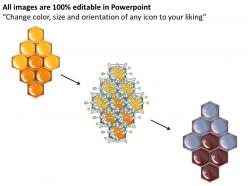
Honeycomb structure





Try Before you Buy Download Free Sample Product
 Impress Your
 Audience
 100%
100% Editable
 Save Hours
 of Time


Keep abreast with our Honeycomb Structure. They are constantly updated to the talk of the day.
People who downloaded this PowerPoint presentation also viewed the following :
Honeycomb structure with all 5 slides:
Keeping presentation presentations fresh and compelling can be a challenge. Our Honeycomb Structure are waiting to help update your look quickly every time.


FAQs for Honeycomb structure
Honeycomb structures feature exceptional strength-to-weight ratios, high stiffness, excellent energy absorption capabilities, and efficient material distribution through their hexagonal cell geometry. These properties enable widespread applications across aerospace, automotive, construction, and packaging industries, with manufacturers finding that honeycomb designs deliver superior structural performance while minimizing material costs and weight.
Honeycomb geometry maximizes strength-to-weight ratio through its hexagonal cell structure, which distributes loads efficiently across multiple walls while minimizing material usage. This configuration delivers exceptional compression resistance and structural integrity, with aerospace, automotive, and construction industries leveraging honeycomb designs to reduce weight by up to 80% while maintaining comparable strength to solid materials.
Honeycomb structures are widely used in aerospace, automotive, construction, packaging, and marine industries due to their exceptional strength-to-weight ratio, superior energy absorption, and cost-effective material efficiency. These lightweight architectures enable aircraft manufacturers to reduce fuel consumption, automotive companies to enhance crash safety while meeting weight regulations, and construction firms to create stronger building panels, ultimately delivering improved performance and competitive operational advantages.
Honeycomb manufacturing varies significantly across industries, with aerospace using advanced autoclave curing and precision layup techniques, automotive employing high-volume compression molding, and construction utilizing continuous production methods with different core densities. These specialized processes enable manufacturers to optimize strength-to-weight ratios, production speeds, and material properties for specific applications, ultimately delivering enhanced performance while reducing costs.
Honeycomb structures serve as lightweight core materials in aircraft panels, wing components, satellite structures, and spacecraft heat shields, delivering exceptional strength-to-weight ratios critical for fuel efficiency. These aerospace applications streamline manufacturing processes, minimize material costs, and enhance structural integrity, with many aviation companies finding that honeycomb composites ultimately reduce operational expenses while improving performance capabilities.
Honeycomb structures can be optimized for thermal insulation through material selection, cell size adjustment, wall thickness modification, and strategic orientation design. By incorporating low-conductivity materials like ceramics or specialized polymers, adjusting hexagonal cell dimensions, and controlling air gap spacing, manufacturers in aerospace, automotive, and construction industries achieve superior insulation performance while maintaining structural integrity, ultimately delivering enhanced energy efficiency.
Environmental impacts of producing honeycomb materials include energy consumption during manufacturing, raw material extraction effects, potential chemical emissions from synthetic cores, and transportation-related carbon footprints. However, these materials ultimately deliver significant environmental benefits by reducing overall weight in aerospace and automotive applications, decreasing fuel consumption and emissions, with many manufacturers finding that honeycomb structures' durability and recyclability create long-term sustainability advantages.
Honeycomb designs significantly outperform traditional solid materials by delivering superior strength-to-weight ratios, enhanced thermal insulation, and reduced material consumption while maintaining structural integrity. These lightweight structures enable aerospace manufacturers, automotive companies, and construction firms to achieve cost savings, improved fuel efficiency, and enhanced performance, with many industries finding that honeycomb applications reduce weight by up to 80% compared to solid alternatives.
Recent advancements in 3D printing honeycomb structures include multi-material printing capabilities, variable cell size control, optimized lattice geometries, and enhanced surface finishing techniques. These innovations enable aerospace manufacturers, automotive companies, and construction firms to produce lightweight components with superior strength-to-weight ratios, reduced material waste, and customized mechanical properties, ultimately delivering significant cost savings and performance advantages in structural applications.
Hexagonal honeycombs outperform rectangular ones in scenarios requiring maximum material efficiency, structural strength, and space optimization, such as aerospace manufacturing, packaging design, and architectural applications. Engineering firms and construction companies increasingly choose hexagonal patterns for lightweight panels, energy-absorbing materials, and building facades, as they deliver superior strength-to-weight ratios while minimizing material costs.
Variations in cell size and wall thickness significantly influence honeycomb structures' strength-to-weight ratio, energy absorption capacity, and thermal properties through optimized load distribution and material efficiency. Smaller cells with thicker walls enhance compressive strength for aerospace applications, while larger cells with thinner walls maximize weight reduction in automotive panels, ultimately delivering tailored performance characteristics that enable engineers to balance structural integrity with material optimization across diverse industrial applications.
Recycling honeycomb materials presents challenges including multi-material separation difficulties, adhesive contamination, structural degradation during processing, limited recycling infrastructure, and economic viability concerns. While aerospace and automotive industries increasingly recognize recycling importance, many organizations find that developing specialized separation techniques and investing in dedicated processing equipment delivers long-term sustainability benefits and regulatory compliance advantages.
Honeycomb structures enhance building energy efficiency by providing superior thermal insulation, reducing material weight while maintaining structural strength, and creating natural ventilation pathways. Through strategic integration in walls, roofing, and facade systems, architects achieve significant energy savings, lower heating costs, and improved indoor climate control, with many commercial buildings finding that honeycomb panels deliver up to 30% better thermal performance.
Computational modeling enables engineers to optimize honeycomb structures by simulating mechanical properties, predicting failure modes, and testing design variations without costly physical prototypes. Through finite element analysis and algorithmic optimization, aerospace manufacturers and automotive companies can enhance weight-to-strength ratios, minimize material usage, and accelerate product development cycles, ultimately delivering superior performance while reducing manufacturing costs.
Honeycomb structures exhibit exceptional performance under compression through energy absorption, load distribution, and progressive crushing that prevents catastrophic failure, while demonstrating controlled deformation characteristics under shear loads. These structural behaviors enable aerospace manufacturers, automotive engineers, and construction companies to leverage honeycomb materials for impact protection, lightweight panels, and energy-absorbing components, ultimately delivering enhanced safety performance and weight reduction advantages.
-
Thanks for all your great templates they have saved me lots of time and accelerate my presentations. Great product, keep them up!
-
Awesome presentation, really professional and easy to edit.