


Roles And Responsibilities Of Marketing Team Members Social Media Marketing Strategic




Try Before you Buy Download Free Sample Product
 Impress Your
 Audience
 100%
100% Editable
 Save Hours
 of Time


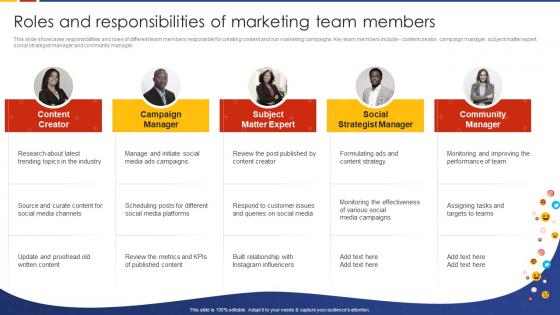
This slide showcases responsibilities and roles of different team members responsible for creating content and run marketing campaigns. Key team members include - content creator, campaign manager, subject matter expert, social strategist manager and community manager.
People who downloaded this PowerPoint presentation also viewed the following :
Roles And Responsibilities Of Marketing Team Members Social Media Marketing Strategic with all 6 slides:
Use our Roles And Responsibilities Of Marketing Team Members Social Media Marketing Strategic to effectively help you save your valuable time. They are readymade to fit into any presentation structure.





FAQs for Roles And Responsibilities Of Marketing Team Members Social
Okay so you're basically becoming the brand's voice everywhere online. Content calendars, writing posts, making graphics - that's your daily grind. Community management is probably the biggest part though, like answering comments and DMs. Crisis management too when things go sideways (and they definitely will). Analytics are crucial for tracking what's actually moving the needle. Platform algorithms change constantly so you'll be learning forever - honestly it's exhausting but kinda fun? I'd start by looking at what's already working on your current accounts before jumping into any new strategy stuff.
Honestly, most people get way too caught up in vanity metrics like likes and shares. Focus on what actually matters for your goals first - sales, leads, whatever you're after. Track your click-through rates and conversions, obviously. Reach and impressions are good for awareness campaigns. Before you launch anything though, set up your UTM codes and tracking pixels or you'll hate yourself later trying to figure out what worked. Compare everything against your baseline numbers and industry benchmarks. The analytics can get pretty addictive once you start seeing patterns, but don't lose sight of ROI.
Honestly, you're gonna need both creative and techy stuff. Writing's obviously huge - you're basically becoming the brand's voice. Video editing is pretty much mandatory now with everyone losing their minds over TikToks and Reels. Learn one platform really well first, then branch out once you get the hang of it. Analytics help you figure out what's actually working (not just what you think is cool). Oh, and project management skills since you'll be juggling like five campaigns at once. The algorithms change constantly though, so staying flexible is clutch. I'd pick Instagram or TikTok to start - they're where most brands want to be anyway.
Honestly, you've gotta actually *talk* to people instead of just posting stuff and hoping for the best. Reply to their comments like you mean it. Ask questions that'll get them chatting. I always think of it like hosting a party - you want everyone to feel included, you know? Jump into conversations that make sense for your brand. Use people's names when you respond (they love that). Oh, and create stuff they can participate in - polls work great, or ask them to share their own content. Block out time each day just for responding to people, not posting. That's where the real magic happens.
So basically a social media strategist figures out how your brand should "talk" online. They write up guidelines for tone and personality, then show your content people how to actually use it. Sounds kinda boring but it actually works - someone needs to make sure you don't sound corporate on TikTok, you know? Plus they watch how people respond and tweak things. What works on LinkedIn will definitely bomb on Instagram. Oh, and make sure whoever you hire gets your company vibe, not just some textbook approach. Otherwise you'll end up sounding like every other brand out there.
Okay so paid social is basically rocket fuel for your best organic content. Look at what's already crushing it organically - those post formats and topics your audience actually engages with. Then create paid campaigns around that stuff. Your organic content builds the authentic voice that makes ads feel less... gross and salesy, you know? I'd start by just boosting your top organic posts first to see what happens. The real magic is when paid drives conversions while organic keeps nurturing those relationships. It's like a one-two punch that actually works.
Honestly, ignore the vanity metrics - they're just ego boosts. What you really want are engagement rate, click-through rate, and conversion rate. Those tell you if people actually care about your stuff. I'd rather have 10K followers who engage than 100K ghost accounts, you know? Track reach and impressions too so you can see how far your content spreads. Oh, and if you can tie any leads or sales back to social, that's gold. But seriously, pick like 3-5 metrics max and stick with them. Don't get overwhelmed by every single number.
Okay so social listening is basically your cheat code for content creation. You can see exactly what your audience is talking about instead of just throwing stuff at the wall and hoping it sticks. Check out their conversations, what's bugging them, trending topics - all that good stuff. Honestly, it's way better than guessing what might work. You'll spot opportunities where your brand can actually help people out. Plus you can see what tone hits right in your space and catch trends before everyone else jumps on them. Just turn those insights into content that matches what people already care about.
So the main ones everyone uses are Hootsuite, Buffer, and Sprout Social. Buffer's free version is actually decent if you're just getting started. I've been really into Later recently - their visual calendar layout is so much cleaner than the others. Sprout Social costs more but it's totally worth it if you need the advanced analytics stuff. Oh, and the social listening features are pretty solid too. My biggest tip? Just grab free trials from like 2 or 3 of them and see which one doesn't make you want to throw your laptop out the window.
Honestly, micro and nano-influencers (like 1K-100K followers) are where all the money's going now. Their engagement rates are actually crazy good compared to the mega ones. Brands are doing way more long-term partnerships too - makes sense since one random post feels so fake these days. Video is everything right now, especially those short TikTok and Reel clips. User-generated content is blowing up too where regular customers make the content instead of influencers. My advice? Don't get caught up in follower counts. Put your budget toward smaller creators who actually talk to their audience - that's where you'll see results.
So here's the thing - social media and SEO are like best friends who help each other out. Yeah, your Instagram posts won't directly bump up your Google rankings, but they drive people to your website, which Google definitely notices. When your stuff gets shared around, you're getting more backlinks and people talking about your brand online. Both are huge for SEO. Plus social gives you intel on what your audience actually wants to read about (hello, keyword ideas). Oh and your social profiles usually show up when people search your business name anyway. I'd say use what you learn from one to improve the other - they're way more connected than most people think.
Honestly, just be upfront about sponsored stuff - the FTC will come for you if you're sneaky about it. Privacy's huge too, so don't be creepy with people's data. Fake reviews and bot engagement? Yeah, companies get destroyed for that. I saw this one brand get absolutely demolished on Twitter for buying followers lol. Also think about whether you're being inclusive or just pushing weird beauty standards. Short sentences work. Longer ones need to actually flow naturally when you read them out loud. Trust takes forever to build back once it's gone, so don't screw it up.
Honestly, social media is clutch for customer service these days. You can jump on complaints right away instead of waiting for emails or phone calls. When you fix someone's problem publicly, other people see you actually care - sometimes angry customers become your biggest fans afterward. Set up alerts for your company name (and definitely check common misspellings too, trust me on this). Keep an eye on what people are saying so you can catch issues early. If everyone's suddenly complaining about the same thing, you'll know before it becomes a total nightmare. Just stay consistent with how your brand sounds when responding.
Honestly, speed is everything here. Jump on it within hours even if you're still figuring things out. Don't be that company that goes radio silent - it looks sketchy. Move the messy stuff to DMs when you can, but seriously, don't delete comments unless someone's being a total jerk. That backfires every time. Stay calm and focus on fixing things instead of getting defensive (easier said than done, I know). Have some kind of game plan ready before drama hits. Oh, and whatever you promise publicly? Actually do it. People will definitely check.
Working with other teams is seriously where the magic happens. Sales gives you real intel on what customers actually care about, not just what we think they want. Customer service can spot content opportunities before anyone else does. Your reach explodes too - sales reps will share your stuff, support teams can pull from your responses. Monthly check-ins with like two other departments changed everything for us. Oh, and you won't have those cringe moments where you promise features that don't exist yet. Product teams hate that lol. Start small but definitely start somewhere.
-
I am glad to have come across Slideteam. I was searching for some unique presentations and templates for my business. There are a lot of alternatives available here.
-
The website is jam-packed with fantastic and creative templates for a variety of business concepts. They are easy to use and customize.