


Hypothesis bulb innovation five linked square




Try Before you Buy Download Free Sample Product
 Impress Your
 Audience
 100%
100% Editable
 Save Hours
 of Time


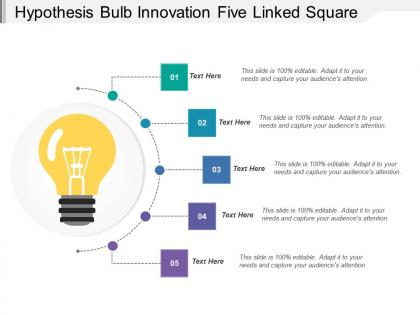
Consider actions to control inflation with our Hypothesis Bulb Innovation Five Linked Square. Deliberate on how to halt further growth.
People who downloaded this PowerPoint presentation also viewed the following :
Hypothesis bulb innovation five linked square with all 5 slides:
Highlight irrefutable facts with our Hypothesis Bulb Innovation Five Linked Square. Explain how the case is cut and dried.

FAQs for Hypothesis bulb innovation
Think of a hypothesis as your educated guess about what'll happen in your experiment. You write it before collecting any data - it's basically your "if this, then that" prediction based on what you already know. The trick is making it specific and testable so you can actually prove or disprove it. Honestly, the "falsifiable" part trips people up sometimes, but it just means there has to be a way to show you're wrong. Make yours clear and measurable. That way you'll know exactly what data to hunt for when you start experimenting.
So a hypothesis is your educated guess that you can actually test out. Theories though? Those are the heavy hitters - established explanations with mountains of evidence behind them. Like gravity or evolution, you know? When you make a hypothesis, you're predicting something specific that you can experiment with. Way more narrow than theories. Your hypothesis might end up supporting existing theories or maybe challenging them (which is honestly pretty cool). But yeah, start small with testable hypotheses first, then see how they connect to the bigger theoretical picture.
You need three key things for a good hypothesis. First, make it testable and super specific - not just "exercise affects mood" but "people walking 30 minutes daily will report higher happiness scores than non-walkers." That's way better. Also, it should predict how your variables connect. Honestly, I see so many people mess this up by being too vague. Figure out what you can actually measure first, or you'll be stuck later. Your hypothesis is basically your educated guess before diving in. Just identify your independent and dependent variables, then write a statement linking them with your predicted outcome.
So the null hypothesis is your boring default assumption - like "nothing's happening here." You're trying to knock it down with your data. Either you reject it (found something cool!) or you can't reject it (meh, no solid proof). Honestly, I think of it as giving your test a punching bag to aim at. Otherwise you're just wandering around your dataset hoping to stumble on something interesting. It also keeps you from seeing patterns that aren't really there. Always nail down what your null is first - makes everything else way easier to interpret.
So basically you need a solid experiment where you change one thing and measure what happens to something else. Keep everything else the same though - that's crucial. Write your hypothesis like "if X happens, then Y will result" so you know it's actually testable. Collect enough data to run stats on it, because honestly, gut feelings don't cut it in science. One weird result means nothing, so make sure you can repeat it. Oh and avoid vague predictions - they're impossible to prove or disprove properly.
So basically, your hypothesis is just an educated guess that you're gonna test out. You make observations first, then form a prediction about what's happening. Like when your code keeps crashing - you develop a theory about why, then test it (sorry, work mode lol). The whole point is designing experiments to see if you're actually right or totally off base. Here's the thing though: it has to be something you can actually prove wrong, otherwise you're just collecting random data with no direction. Start with a clear, specific prediction before diving into research. Makes everything way more focused.
Ugh, the worst thing you can do is make your hypothesis super vague or way too complicated. Like, avoid stuff like "this will improve user experience" - that tells us nothing! Keep it specific and testable. Also don't let your own assumptions creep in about what'll happen. I've seen so many people basically write their conclusion before they even test anything lol. Your hypothesis should show a real relationship between variables, not just state something obvious. Oh, and use that "If X, then Y" structure - it keeps you honest and makes everything clearer for whoever has to understand it later.
So basically, you need to be able to actually test your hypothesis somehow - like through an experiment or just observing stuff. Plus there has to be some result that could prove you totally wrong. Think about it this way: what evidence would you collect, and what outcome would make you go "well, that was completely off"? The swan thing is perfect here - "all swans are white" works because you can literally go check swans, and finding just one black swan destroys your whole theory. Can't answer those questions clearly? Your hypothesis probably sucks. If there's literally no way to prove it wrong, it's not really science.
Okay so basically you want your hypothesis to be super specific and something you can actually test. Like "students who eat breakfast score higher on math tests" works way better than just "breakfast is good for students" - that's way too vague. I honestly think this trips people up more than it should! Your hypothesis needs to show a clear relationship between two things so you know what data you're even looking for. Also avoid anything you can't measure - like obviously you can't test if ghosts mess with test scores lol. Just ask yourself if you could actually design an experiment around it.
Ok so hypothetical constructs are those abstract things you can't actually see or touch - like intelligence, anxiety, motivation, whatever. You can't just measure someone's stress with a ruler, you know? So researchers have to get creative and use stuff they CAN observe - heart rate, survey answers, how people behave. The tricky part is making sure those measurements actually represent what you think they do. Like, does a fast heart rate really mean stress or did they just run up the stairs? Bottom line: always question whether you're measuring what you think you're measuring. Sounds obvious but it trips people up constantly.
Okay so quantitative research is pretty straightforward - you start with a clear hypothesis like "doing X will increase Y by this much." But qualitative? Totally different beast. You go in with broad questions and see what patterns emerge from your data. Way messier but honestly more interesting sometimes. The smart move is using qual findings to build hypotheses you can test later with quant methods. Really depends what you're after though - exploring something brand new? Start qualitative. Already know what you want to test? Go straight to the numbers.
Ugh, biases totally screw with hypothesis formation! Like confirmation bias makes you only look for stuff that backs up what you already think is true. Then there's availability bias - you end up focusing on whatever examples are fresh in your memory instead of actual data. I've done this so many times, honestly. Your personal background can also make you miss obvious alternative explanations. Selection bias is another trap where you build hypotheses around incomplete datasets. Best defense? Actively hunt for evidence that contradicts your ideas. Work with people who'll challenge your thinking, and question your gut reactions before you get attached to any hypothesis.
Look at the gaps and contradictions you found when reading other studies - that's where you'll find your angle. If tons of research already exists on your topic, get more specific or change up your variables. Honestly, realizing your original idea was too broad happens to literally everyone, so don't stress about it. Sometimes you'll spot patterns in the data that point to relationships nobody's tested yet. The goal is being way more precise about what you're actually measuring, not just making tiny adjustments. I'd write down your exact measurements and methods now. Trust me, it'll save you headaches later when you're actually running the study.
Start with lit reviews to find gaps in existing research. Brainstorming works well too, especially with different perspectives - though honestly, those sessions can turn into total chaos sometimes. Observation and case studies are solid for spotting patterns that need explaining. Theory-driven stuff lets you pull testable predictions from established frameworks. Pilot studies? Super underrated - they'll surprise you with weird relationships you didn't expect. Write down your gut reactions first before you overthink everything. Mix these approaches rather than sticking to just one method.
So interdisciplinary research is honestly a game-changer - you get to attack your hypothesis from like 5 different directions instead of being stuck in your field's bubble. Reading psychology papers when you're studying biology (or whatever combo) helps you catch patterns you'd totally miss otherwise. Your original hypothesis? It'll probably get flipped on its head, but in a good way. I learned this the hard way during my thesis - wish someone had told me earlier to branch out. Even skimming papers from random fields can spark ideas. It's basically collecting puzzle pieces from different boxes that somehow click together perfectly.
-
Attractive design and informative presentation.
-
The content is very helpful from business point of view.