Incident Response Playbook Communication Plan For Effective Incident Management
Try Before you Buy Download Free Sample Product
Audience
Editable
of Time
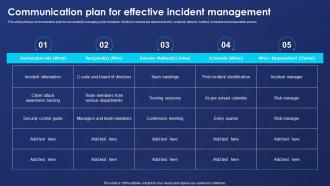
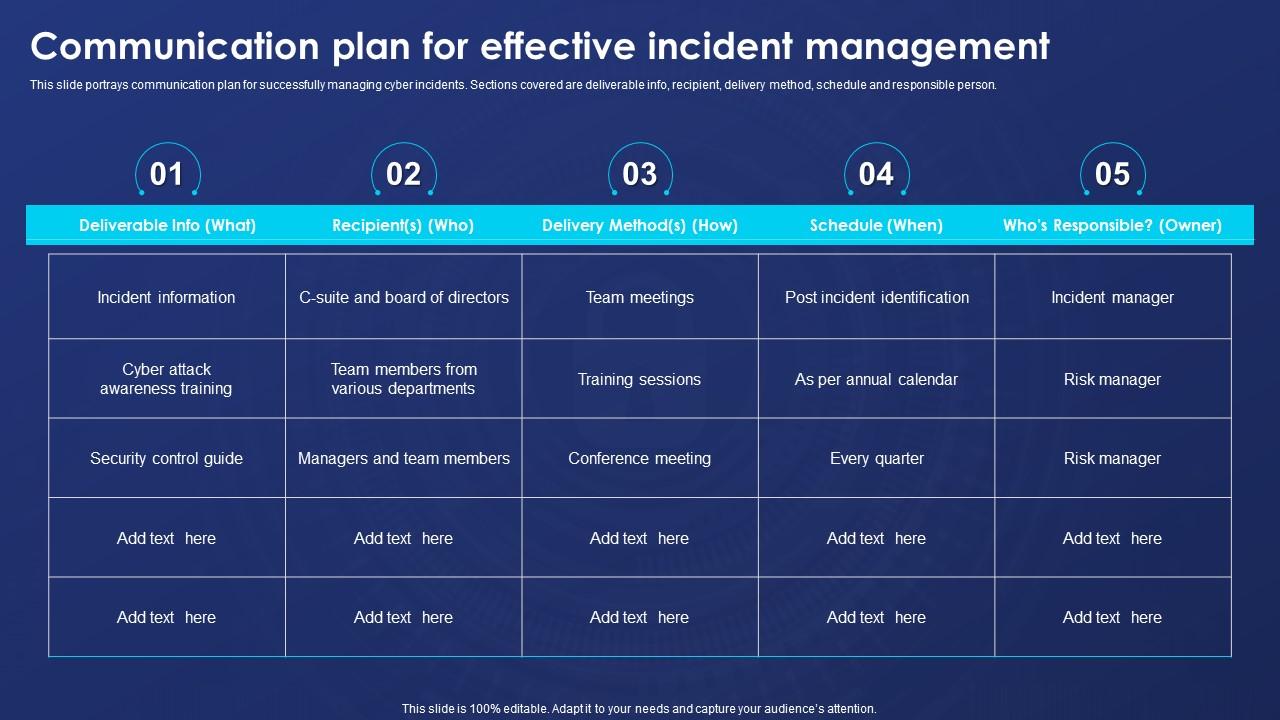
This slide portrays communication plan for successfully managing cyber incidents. Sections covered are deliverable info, recipient, delivery method, schedule and responsible person.
People who downloaded this PowerPoint presentation also viewed the following :
Incident Response Playbook Communication Plan For Effective Incident Management with all 6 slides:
Use our Incident Response Playbook Communication Plan For Effective Incident Management to effectively help you save your valuable time. They are readymade to fit into any presentation structure.
FAQs for Incident Response Playbook Communication Plan For
Start by figuring out who calls who when things go sideways. Draft your templates ahead of time for different scenarios - trust me, you don't want to be writing customer emails while your servers are melting down. The trickiest part? Not overwhelming people with updates. Pick specific channels and stick to them, otherwise everyone's constantly pinging you asking what's happening. Include all the obvious folks - leadership, legal, customers, vendors. Oh and actually test the thing regularly. I've seen too many "perfect" plans that nobody could execute when stuff hit the fan.
Get your communication sorted out way before any incident hits. Dedicated Slack channels, contact lists with multiple ways to reach people - cell, email, whatever works. Oh and define who calls who based on how bad things get. Honestly, phone trees during a crisis are the worst. Templates help too since you're not scrambling for words when everything's breaking. The real trick? Actually test this stuff with practice runs. I've seen teams fall apart because nobody knew where to go when shit hit the fan. Don't be those people.
You gotta know who you're dealing with before you write anything - that's like communication 101. Map out everyone first: executives, customers, vendors, regulatory people, the whole crew. They all need different info at different times, which honestly can be a pain to manage. I totally bombed this during an outage situation once and it was rough. Your tone, channels, all that stuff depends on your audience. Short sentences work better than I used to think. Create a stakeholder matrix with their preferences and escalation levels before you even touch message templates - saves you so much headache later.
Match your tone to who you're talking to and how bad things are. Minor stuff? Keep it technical with your IT people. Major outages or breaches hitting customers need way broader communication - and drop the jargon completely. Data breaches are honestly a nightmare because legal gets involved too. External messages should sound formal and calm everyone down, but internal updates can be way more blunt about what's actually broken. Oh, and make templates beforehand for different scenarios. Trust me, you don't want to write emails from scratch when everything's melting down.
Got it - so incident communication is all about being simple and super frequent. Pick one channel (Slack works great) and have just one person handling comms so you don't get mixed messages everywhere. Here's what saved me: update every 15-30 minutes even when nothing's happening. Trust me, silence makes everyone panic and then you get random exec calls during the worst possible moments! Your updates should cover what's broken, what you're doing, and when you'll check in again. Oh and write everything down as you go - future you will thank you when it's post-mortem time.
Track response times first - how fast did alerts actually go out? Then check if everyone got the message (email bounces are annoying but happen). Post-incident surveys are honestly your best friend here - ask people if they understood what to do and felt kept in the loop. Look for communication gaps that caused confusion during the real thing. Message reach and stakeholder feedback matter too. I'd set up a basic dashboard to review this stuff every few months so you can catch issues before the next crisis. Short sentences mixed with longer ones help you spot patterns better.
Get your incident response tools sorted before chaos strikes. Slack or Teams are perfect for real-time coordination - just set up dedicated channels that auto-archive when you're done. PagerDuty handles all the alerting so you don't have to wake people up manually (trust me on this one). StatusPage keeps everyone updated without spamming your main channels. Zoom's crucial for the really messy incidents where you need to actually see each other's screens. Oh, and test everything beforehand! Nothing's worse than fighting with permissions when your site's down.
Pick one person to handle all media - seriously, don't let random staff talk to reporters when things go sideways. Train everyone else to redirect questions immediately. Your spokesperson should stick to approved talking points and never speculate about what went wrong or who's at fault. Reporters are like dogs with bones when they sense drama, so brief and factual is the way to go. Focus on what you're doing to fix things. Oh, and whatever you do, don't ghost them completely - silence just makes journalists assume you're hiding something worse.
Tabletop exercises are honestly your best bet - walk through real scenarios with your team so you're not fumbling when stuff actually hits the fan. FEMA has some decent online courses that cover the basics. If you've got budget, bringing in outside consultants for workshops can be really helpful (though I know that's not always realistic). Start with quarterly drills and write down where communication breaks down each time. Oh, and industry associations usually have training programs too - might be cheaper than the consultant route. The key is actually practicing what you'd say, not just talking about it.
Quarterly reviews are the bare minimum, but honestly that's not enough. Update it immediately when people join/leave or contact info changes - I've watched teams completely fall apart during real incidents because someone's number was wrong or a key person left months ago. After any major incident, review it again since you'll always find holes you missed. Set a recurring reminder and make someone actually own this process, or it'll just sit there gathering dust. Trust me, scrambling to find the right people mid-crisis is the worst feeling ever.
Oh man, crisis comms are brutal. Getting accurate info is impossible when everything's changing every five minutes. Your team will probably panic and forget the script entirely - I've seen it happen so many times. Then you've got technical stuff breaking down right when you need it most. Different departments will bombard you wanting updates, while you're trying to juggle internal chaos AND talk to the media. It's honestly a mess. Practice runs help though. Also make sure you have backup people ready because your main spokesperson might be stuck in meetings or whatever when everything hits the fan.
Look, segment who gets what info and when. Be upfront about the basics - yeah, something happened, here's our timeline, rough impact. But lock down the technical stuff, customer data details, investigation methods. Only your core team and lawyers get that. This part's honestly brutal because everyone's freaking out wanting answers NOW. I'd make two tracks: public updates that don't BS people about your process, and internal technical stuff that stays internal. Never speculate or overshare - just stick with "we're looking into it" rather than making things worse by saying too much.
Oh man, biggest mistakes? Don't let different teams say conflicting things - that's a nightmare. Also, waiting too long to tell people what's happening is terrible. Skip the tech speak when you're talking to business folks too. Honestly, the worst thing is pretending everything's under control when it's not. People aren't stupid, they'll see right through that BS and then nobody trusts you. Find the sweet spot between radio silence and spam - communicate regularly but don't blow up everyone's phone. Be upfront about what you actually know (and what you don't), give clear next steps. Set this stuff up beforehand!
Map out your severity levels first - P1 for critical stuff needing C-suite in 30 mins, P2 for major issues hitting directors after 2 hours. Then nail down who makes escalation calls and their exact contacts. So many teams I've seen just panic when things blow up because nobody knows who to call. Always have backup contacts since your main person might be MIA. Oh, and actually test this stuff quarterly - like really call people during drills. Otherwise you're just hoping it'll work when everything's on fire.
So you basically want to turn that whole mess into something everyone can learn from. Tell people what broke, why it broke, and how you're fixing it going forward. Honestly, I've watched teams just... not do this part? Then boom - same exact problem pops up months later. Share the lessons learned and any process tweaks you're making. Don't forget to give props to whoever jumped in during the chaos. Oh, and loop in everyone who needs to know - not just your dev team who was up all night fixing it.
-
The ease of modifying templates is just superb! Also, the vast collection offers plenty of options to choose from.
-
Enough space for editing and adding your own content.