

Incident Response Playbook Security Controls To Reduce The Risk Of Ransomware




Try Before you Buy Download Free Sample Product
 Impress Your
 Audience
 100%
100% Editable
 Save Hours
 of Time


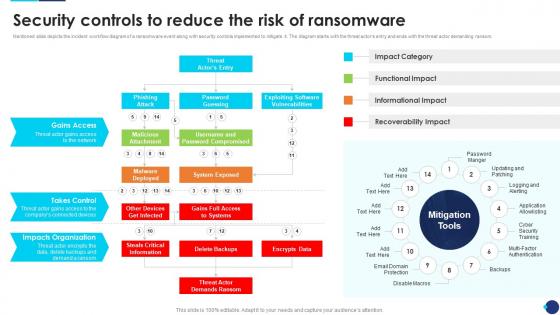
Mentioned slide depicts the incident workflow diagram of a ransomware event along with security controls implemented to mitigate it. The diagram starts with the threat actors entry and ends with the threat actor demanding ransom.
People who downloaded this PowerPoint presentation also viewed the following :
Incident Response Playbook Security Controls To Reduce The Risk Of Ransomware with all 6 slides:
Use our Incident Response Playbook Security Controls To Reduce The Risk Of Ransomware to effectively help you save your valuable time. They are readymade to fit into any presentation structure.





FAQs for Incident Response Playbook Security Controls To Reduce The
Immediate ransomware response steps include isolating affected systems, activating incident response teams, preserving forensic evidence, assessing attack scope, and implementing backup recovery procedures. Organizations across sectors like healthcare, financial services, and manufacturing streamline these protocols through automated containment systems, predefined communication channels, and tested recovery frameworks, ultimately minimizing downtime and operational disruption while maintaining business continuity.
Organizations effectively assess ransomware impact through comprehensive system audits, data integrity checks, operational continuity evaluations, financial loss calculations, and stakeholder communication assessments. This multi-faceted approach enables businesses to prioritize recovery efforts, quantify damages for insurance claims, and restore critical functions systematically, with many companies finding that structured impact assessment accelerates overall recovery timelines.
Communication serves as the backbone of ransomware incident response, coordinating internal teams, external stakeholders, law enforcement, and affected customers through predetermined channels and messaging protocols. Effective communication strategies enable organizations to maintain stakeholder confidence, ensure regulatory compliance, and coordinate recovery efforts seamlessly, with many companies finding that transparent, timely communication ultimately minimizes reputational damage while accelerating business continuity.
Organizations improve ransomware preparedness through regular backup testing, employee security training, network segmentation, incident response planning, and vulnerability management. These proactive measures streamline recovery by ensuring data restoration capabilities, minimizing lateral movement, and enabling rapid containment, with many financial institutions and healthcare systems finding that comprehensive preparedness significantly reduces downtime and operational disruption.
Ransomware detection and prevention technologies include endpoint detection and response (EDR) systems, behavioral analytics platforms, network segmentation tools, automated backup solutions, and AI-powered threat intelligence systems. These technologies enhance security by monitoring suspicious file encryption activities, isolating infected systems, and maintaining secure data recovery options, with many organizations finding that layered security approaches significantly reduce successful ransomware attacks.
Legal and regulatory implications of ransomware incidents include mandatory breach notifications, regulatory investigations, potential fines for non-compliance, litigation risks, and contractual liability issues. Organizations across sectors like healthcare, finance, and retail must navigate complex requirements including GDPR, HIPAA, and state privacy laws, while managing disclosure timelines and regulatory scrutiny that ultimately impacts operational continuity and stakeholder trust.
Organizations should evaluate backup completeness, recovery timeframes, regulatory implications, and business continuity requirements when deciding between ransom payment and restoration. While paying may seem faster, it presents legal risks and doesn't guarantee data recovery, whereas robust backup systems enable organizations to maintain operational integrity, avoid criminal funding, and ultimately deliver stronger long-term security posture.
Best practices for engaging law enforcement during ransomware incidents include immediate notification to FBI's Internet Crime Complaint Center, preserving evidence chains, maintaining detailed incident logs, coordinating disclosure timing, and establishing clear communication protocols. Through early collaboration, organizations enable faster threat intelligence sharing, access specialized cyber forensics resources, and receive guidance on legal obligations, while ensuring investigations don't compromise recovery efforts, ultimately strengthening both immediate response and long-term security posture.
Organizations can effectively train employees through regular phishing simulations, interactive cybersecurity workshops, real-time threat awareness updates, and role-specific security protocols tailored to different departments. These comprehensive training programs enhance threat recognition by combining hands-on exercises with practical scenarios, ultimately creating a human firewall that significantly reduces successful ransomware attacks and strengthens overall organizational security posture.
A post-incident review should include timeline analysis, attack vector identification, response effectiveness assessment, communication evaluation, and recovery process documentation. Through comprehensive analysis, organizations can strengthen security protocols, refine incident response procedures, and enhance team coordination, ultimately reducing future attack impact and improving organizational resilience against evolving ransomware threats.
Companies leverage threat intelligence to enhance ransomware defense by identifying emerging attack patterns, understanding threat actor tactics, and recognizing indicators of compromise before attacks occur. Through real-time intelligence feeds and behavioral analysis, organizations can proactively update security controls, train response teams on latest threats, and implement targeted defenses, ultimately reducing attack success rates and minimizing potential damage across their infrastructure.
Malware analysis plays a critical role in ransomware response by reverse-engineering malicious code, identifying attack vectors, determining encryption methods, and uncovering command infrastructure patterns. Through detailed behavioral analysis and signature identification, cybersecurity teams can develop targeted countermeasures, create detection rules, and build defensive strategies, ultimately enabling faster threat containment and improved organizational resilience against future attacks.
Organizations should track recovery time objectives, data restoration success rates, communication timeline adherence, financial impact assessment, and stakeholder notification compliance metrics. These measurements enable businesses to identify response gaps, streamline future incident protocols, and minimize operational disruptions, with many financial institutions and healthcare providers finding that comprehensive metrics ultimately deliver faster recovery times and reduced business continuity risks.
Incident response teams coordinate with IT and cybersecurity professionals through established communication protocols, clearly defined roles, centralized command structures, and real-time threat intelligence sharing. This strategic collaboration enables rapid system isolation, forensic analysis, and recovery planning, with many organizations finding that cross-functional coordination significantly reduces downtime and accelerates business continuity restoration.
Ransomware commonly exploits unpatched software vulnerabilities, weak passwords, unsecured remote desktop protocols, phishing emails, and misconfigured network permissions. Organizations address these vulnerabilities by implementing automated patch management systems, enforcing multi-factor authentication, conducting regular security awareness training, and deploying endpoint detection solutions, ultimately strengthening their security posture while reducing attack surface exposure.
-
SlideTeam was so customer-centric and quick service-provider that I doubted the amount I was paying and literally re-checked the transaction.
-
Use of icon with content is very relateable, informative and appealing.