


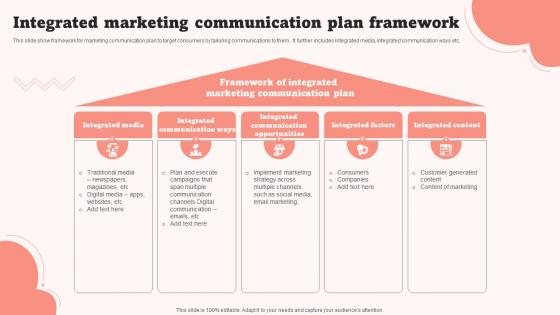
Integrated Marketing Communication Plan Framework




Try Before you Buy Download Free Sample Product
 Impress Your
 Audience
 100%
100% Editable
 Save Hours
 of Time


This slide show framework for marketing communication plan to target consumers by tailoring communications to them . It further includes integrated media, integrated communication ways etc.
People who downloaded this PowerPoint presentation also viewed the following :
Integrated Marketing Communication Plan Framework with all 9 slides:
Use our Integrated Marketing Communication Plan Framework to effectively help you save your valuable time. They are readymade to fit into any presentation structure.








FAQs for Integrated Marketing
So IMC is basically getting all your marketing channels - ads, PR, sales, emails, whatever - to tell the same story. Apple does this perfectly, but honestly most companies are a hot mess with mixed messages everywhere. Your brand voice and visuals need to match whether someone hits your Instagram or calls your sales team. I'd start by checking what you're actually saying across different platforms right now. You'll probably find some cringeworthy inconsistencies. The main components are advertising, sales promotion, public relations, direct marketing, and personal selling - just make sure they're all on the same page.
IMC is basically your brand's way of staying consistent everywhere. You know how some companies sound totally different on Instagram vs their emails? Super confusing. So you create one master guide that everyone follows - same tone, same key messages, same vibe. Your social team, email people, and ad folks all work from it. Honestly saves you from looking scattered. The trick is getting those standards down first, then actually making sure teams stick to them. Otherwise you'll end up with that weird disconnect where your website sounds corporate but your TikTok is trying way too hard to be trendy.
So data analytics is like having x-ray vision for your IMC campaigns. You'll actually see which channels are crushing it and where people bail out of your funnel. Instead of throwing money around blindly, you can track real customer journeys and shift budget to what's working. Honestly, there's nothing better than when the numbers back up your gut feeling about a campaign. The trick is setting up tracking across everything - not just looking at individual metrics but how it all connects. That way you're always tweaking and improving instead of just hoping for the best.
Honestly, you need to track everything - surveys for brand awareness, website traffic, social engagement, sales data. The annoying part? Figuring out if that Instagram post actually led to someone buying later. I'd set up UTM codes and use attribution tools to connect those dots. Brand tracking studies help with message consistency too. Survey customers about where they found you first - that's gold. Oh, and definitely establish your baseline metrics before launching anything, otherwise you're just guessing if it worked. Customer feedback is clutch for the qualitative stuff.
So first, figure out your brand's main story - like what you're really about. Then break it into pieces for different platforms. Social media could be the hero's journey vibe, emails might focus on customer wins, video shows behind-the-scenes stuff. The trick is keeping that same emotional core running through everything (people actually care about stories way more than boring features, trust me). Your story needs characters people relate to, some kind of problem, and how it gets solved. I'd honestly start by mapping out the whole narrative first, then figure out how each channel tells its own piece of that bigger story.
Okay so segmentation is huge for your IMC plan - like you literally can't skip this step. Here's the thing: if you don't know who you're talking to, your messaging ends up being this bland, generic mess that nobody connects with. I learned this the hard way lol. Think about it - what works for millennials scrolling Instagram is totally different from what'll grab Gen X in their inbox. You've gotta map out your main segments first, then figure out how to hit each group on their preferred channels. It's honestly the difference between campaigns that flop and ones that actually work.
Honestly, getting all your teams to actually work together is gonna be your biggest nightmare. Marketing, PR, sales - they all love doing their own thing. Budget gets weird too when you're trying to hit every channel at once. Plus tracking data across everything? Total mess unless your systems can actually talk to each other. Timing is another beast entirely - like trying to herd cats sometimes. Oh and measuring what actually moves the needle vs what just looks pretty in reports... that's fun. Start by literally putting everyone in the same room and hammer out how you'll communicate. Sounds basic but trust me, skip this and you're screwed.
Think of it as one big conversation, not separate campaigns. Your TV ad and Instagram posts should feel like they're coming from the same brand - same vibe, same look. Timing's huge too. Radio drives people to a landing page, print ads get hashtags that tie into social. I'm big on tracking how people jump between channels because that's where you see the real magic happen. Oh and honestly? Most brands mess this up by treating each channel like its own island. Don't do that. It's all connected storytelling, just different platforms telling different pieces.
Pick one main message and just tweak it for different places instead of starting over each time. Figure out what you're really trying to say first - your big selling point and main themes. Then make versions that fit each platform naturally. Like your Instagram stuff can be way more visual and chill, but it should still hit the same points as your emails. I swear, some brands sound like totally different companies depending where you find them. Super confusing. Make a quick messaging guide your team can check, and every now and then do a sweep to see if things are getting off track.
Think of social media as your megaphone, not its own separate thing. Take your main campaign idea and flip it into different formats - TV ad becomes Instagram stories, LinkedIn posts, TikTok videos, whatever. Keep your brand voice consistent but let each platform do its thing, you know? The coolest part? You get instant feedback that traditional media just can't give you. That's gold for adjusting your campaign on the fly. Map out which messages work best on each platform first, then build a content calendar that syncs with your overall timeline. Oh, and don't forget visual consistency - that's what ties everything together.
Okay so the biggest things happening right now? AI personalization is huge - like, scary good at predicting what people want. Voice search optimization too, since everyone's just talking to their phones now. AR/VR stuff is getting pretty wild for brands. Oh and third-party cookies are basically dead, so privacy-first marketing isn't optional anymore. Real-time data platforms are kind of a must-have now for that smooth experience across all channels. Social commerce is blowing up too - people buy straight from TikTok and Insta without leaving the app. I'd honestly just audit what tech you're already using and see where you can plug these in.
So basically, IMC makes your customers feel like they're talking to the same brand everywhere - whether that's Instagram, email, or walking into your store. No more confusing mixed messages! It builds trust because people aren't getting different vibes from different channels. Think of it like... you wouldn't want your friend to act totally different every time you see them, right? Plus you can actually track how customers move between touchpoints and use that data to personalize stuff better. Honestly, just start by checking if your messaging is consistent across platforms - you'd be surprised how often it's not.
So basically, feedback loops save your ass by letting you fix stuff while your campaign's still running. Track each touchpoint first, then do weekly data check-ins. You'll spot which channels actually work and where people bail out of your funnel. Way better than the old "throw money everywhere and hope" strategy - that never worked anyway. When something's bombing, you can shift budget to what's performing or quickly fix messaging that isn't landing. Real-time adjustments are honestly what separate campaigns that crush it from ones that just burn through budget.
Dude, cross-functional collaboration is make-or-break for IMC. Your marketing, sales, PR, and customer service teams need to be on the same page - otherwise you'll confuse the hell out of customers. Like, imagine your social media is promoting one thing while sales tells prospects something totally different. Recipe for disaster. The key is getting everyone aligned on your core message first, then let each team adapt it for their channel. I always tell people to literally get all the teams in one room initially (or Zoom, whatever). It's messy but worth it.
Look at Nike's "Just Do It" and Coke's "Share a Coke" campaigns - total IMC gold. What made them work? They stuck to one clear message but adapted it for each platform. Nike's motivational thing has been going strong for decades (which is kinda crazy when you think about it). Coke did the same with personalization. The trick isn't being on every channel - it's making sure your voice sounds consistent whether it's a TV ad or some random Instagram post. Your brand should feel like the same person talking, just in different contexts. That's really what separates the campaigns that actually stick from the forgettable ones.
-
Great quality slides in rapid time.
-
Use of different colors is good. It's simple and attractive.