


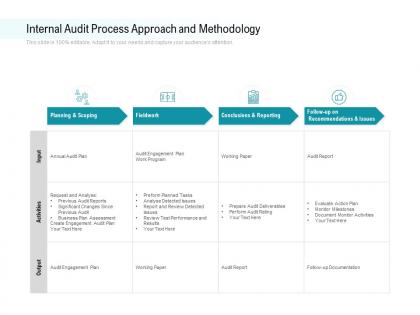
Internal audit process approach and methodology




Try Before you Buy Download Free Sample Product
 Impress Your
 Audience
 100%
100% Editable
 Save Hours
 of Time


The focus of our Internal Audit Process Approach And Methodology is always on achieving brilliance. Excellence is inherent in it.
People who downloaded this PowerPoint presentation also viewed the following :
Internal audit process approach and methodology with all 2 slides:
Discover the inherent brilliance of our Internal Audit Process Approach And Methodology. Increase the impact your ideas generate.
FAQs for Internal audit process
**INPUT**: What are the key components of an effective internal audit methodology? **OUTPUT**: Effective internal audit methodology includes risk assessment frameworks, standardized testing procedures, comprehensive documentation protocols, stakeholder communication processes, and continuous monitoring systems. These components work together by streamlining audit efficiency, enhancing regulatory compliance, and delivering actionable insights, with many organizations finding that structured methodologies ultimately reduce operational risks while strengthening internal controls and strategic decision-making capabilities. **Word count: 58 words**
Risk assessment integrates into internal audit through systematic risk identification, comprehensive risk mapping across organizational processes, stakeholder consultation, and continuous monitoring frameworks. This strategic combination enables auditors to prioritize high-impact areas, allocate resources efficiently, and focus on vulnerabilities that pose the greatest threats, ultimately delivering more targeted audit coverage and enhanced organizational protection.
Technology revolutionizes modern internal audit methodologies by enabling continuous monitoring, automated testing, advanced analytics, risk assessment automation, and real-time reporting capabilities. Through AI-powered tools and data analytics platforms, organizations streamline audit processes, enhance accuracy, and identify risks more effectively, while reducing manual workloads and delivering faster, more comprehensive audit insights.
Organizations should tailor their internal audit methodologies by incorporating industry-specific regulatory requirements, risk frameworks, compliance standards, and operational benchmarks that align with their sector's unique challenges. Financial services firms adapt methodologies for regulatory compliance and risk management, while healthcare organizations focus on patient safety and data privacy standards, ultimately delivering more targeted audit insights and enhanced regulatory alignment.
Common challenges when implementing an internal audit methodology include resource constraints, resistance to change, inadequate stakeholder buy-in, insufficient documentation, and technology integration difficulties. These obstacles can significantly impact audit effectiveness, with many organizations finding that proactive change management, comprehensive training programs, and phased implementation approaches ultimately streamline adoption while delivering enhanced compliance and operational transparency.
Data analytics enhances internal audit processes by automating risk assessment, enabling continuous monitoring, and providing deeper transaction analysis through pattern recognition and anomaly detection. These technologies streamline audit planning, reduce manual testing, and deliver real-time insights, with many organizations finding that analytics-driven audits identify risks faster, improve accuracy, and ultimately strengthen overall governance and compliance frameworks.
Stakeholder engagement in internal audits ensures comprehensive risk assessment, enhanced audit scope accuracy, and improved implementation of recommendations through collaborative input from management, process owners, and business units. This strategic approach enables auditors to identify operational blind spots, prioritize critical areas more effectively, and secure organizational buy-in, ultimately delivering actionable insights and sustainable process improvements.
Internal audit methodologies address compliance by implementing risk-based assessments, continuous monitoring systems, and comprehensive documentation processes that align with regulatory frameworks. These approaches enable organizations to proactively identify compliance gaps, streamline reporting procedures, and maintain audit trails, with many financial institutions and healthcare organizations finding that structured methodologies significantly reduce regulatory violations while enhancing operational transparency.
Risk-based internal audit approaches deliver enhanced resource allocation, improved strategic alignment, proactive risk identification, increased stakeholder confidence, and optimized audit coverage. Through systematic risk assessment methodologies, organizations streamline audit processes, focus efforts on high-impact areas, and strengthen governance frameworks, with many financial services and manufacturing companies finding significantly improved operational efficiency and regulatory compliance outcomes.
Internal auditors ensure objectivity and independence through organizational separation from audited operations, rotation of audit assignments, mandatory independence training, and adherence to professional standards like IIA guidelines. These methodological safeguards enable unbiased risk assessments, transparent reporting structures, and credible audit findings, with many organizations finding that independent audit functions ultimately deliver enhanced governance, stakeholder confidence, and strategic oversight across diverse business operations.
**INPUT**: What methods can be employed to evaluate the effectiveness of an internal audit? **OUTPUT**: Internal audit effectiveness can be evaluated through stakeholder feedback surveys, audit quality assessments, recommendation implementation tracking, compliance measurement, and performance benchmarking against industry standards. These evaluation methods enhance audit credibility by measuring impact on risk mitigation, operational improvements, and regulatory compliance, with many organizations finding that systematic evaluation ultimately strengthens governance frameworks and delivers measurable value. [Word count: 60 words]
Continuous monitoring integrates into internal audit methodology by providing real-time data analysis, automated risk detection, and ongoing compliance tracking throughout audit cycles. This approach enables auditors to identify anomalies immediately, focus resources on high-risk areas, and deliver proactive insights, with many organizations finding that continuous monitoring enhances audit efficiency while strengthening overall risk management capabilities.
Essential skills for auditors include analytical thinking, risk assessment expertise, regulatory knowledge, communication abilities, and technology proficiency in audit software and data analytics. Through comprehensive training programs, organizations enhance auditor capabilities in fraud detection, compliance evaluation, and process improvement, with many financial institutions and healthcare systems finding that well-trained audit teams deliver more accurate assessments and strategic insights.
Internal audit methodologies evolve by integrating advanced analytics, continuous monitoring systems, risk-based frameworks, and real-time data assessment capabilities to address emerging threats. These adaptive approaches enable organizations to identify cybersecurity vulnerabilities, regulatory changes, and operational disruptions more effectively, while enhancing predictive capabilities and streamlined compliance processes for sustained competitive advantage.
Internal audit documentation best practices include maintaining standardized templates, ensuring clear evidence trails, categorizing findings by risk severity, providing actionable recommendations, and establishing consistent reporting timelines. These methodologies streamline audit processes by enhancing transparency, facilitating management responses, and enabling better risk tracking, with many organizations finding that structured documentation ultimately delivers improved compliance outcomes and stronger internal controls.
No Reviews