


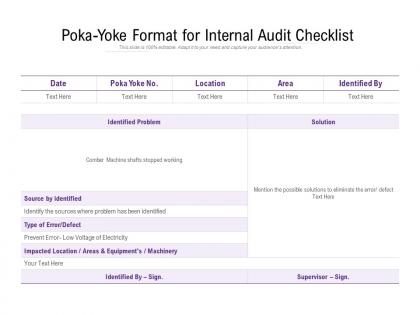
Poka yoke format for internal audit checklist




Try Before you Buy Download Free Sample Product
 Impress Your
 Audience
 100%
100% Editable
 Save Hours
 of Time


Keep your chin up with our Poka Yoke Format For Internal Audit Checklist. Face up to whatever comes with your ideas.
People who downloaded this PowerPoint presentation also viewed the following :
Poka yoke format for internal audit checklist with all 2 slides:
Chisel away with our Poka Yoke Format For Internal Audit Checklist. Give your thoughts the perfect shape.
FAQs for Poka yoke format for
So poka-yoke is all about designing things so you literally can't mess up - or if you do, you'll know right away. Like those parts that only fit together one way, or how hospitals use different colored syringes so you don't grab the wrong one. Software does this too with those annoying confirmation pop-ups (though honestly they work). The whole point is spotting where people usually screw things up in your process, then building in simple fixes that either stop the mistake cold or immediately flag when something's off. Way easier than trying to train perfect humans, you know?
So poka-yoke is basically about making errors impossible or super obvious right when they happen. Like, you'd use guides that force parts to fit only the correct way, or sensors that shut down machines the second they detect something off. Color-coding works great too - mistakes literally stand out. My favorite thing? Most solutions are ridiculously simple once you think of them. You want to build these safeguards directly into your process so workers spot issues immediately instead of downstream headaches. Just look at where you mess up most often and figure out foolproof ways to stop it there.
Oh man, once you notice poka-yoke it's everywhere! Your car won't start unless it's in park. USB cables only go in one way (though USB-C kinda ruined that). ATMs make you grab your card before spitting out cash - honestly genius design there. Manufacturing uses tons of these tricks. Jigs that won't fit unless parts are positioned right. Sensors stopping production when something's missing. Even your microwave door has to be closed or it won't run. The really good ones are invisible - you don't even realize they saved you from screwing up. Just look for wherever people consistently mess things up in your process.
Oh dude, poka-yoke is genius - it stops screw-ups before they even happen. You know how USB cables finally got designed so you can't plug them in wrong? That's the idea. Build your process so mistakes are literally impossible to make. Way better than catching problems after the fact and dealing with angry customers. I mean, nobody wants to be in firefighting mode constantly. Quality goes up, complaints go down, customers actually trust you. Just look at your biggest mess-ups and figure out simple ways to make them physically can't-happen. Prevention beats fixing every time.
Training your team is make-or-break for poka-yoke stuff. Show them how the systems actually work and why they're there in the first place. I've watched so many workers just work around the safety measures because no one bothered explaining the point. Cover the technical side, sure, but also get them thinking about continuous improvement - that mindset matters. Your people know the job better than anyone, so push them to suggest their own error-proofing ideas. Oh, and don't forget refresher sessions when you change processes. Nothing worse than outdated training.
Sensors can automatically catch defects that manual checks would miss. RFID systems make sure workers grab the right parts every time. Barcode scanners prevent assembly screw-ups too. Machine vision is honestly pretty impressive - it spots visual flaws way better than human eyes. You can set up automation so step B won't even start until step A is done. Makes everything faster and more consistent than old-school physical methods. Don't go crazy right away though. Start with basic sensors first, then work up to the fancy smart factory stuff once you've got the hang of it.
Most people think poka-yoke is about catching errors after they happen, but it's actually meant to stop mistakes before they occur. Simple fixes work best - you don't need fancy or expensive solutions. Here's what bugs me: everyone assumes it slows things down when it actually makes processes faster by cutting out all that rework later. Oh, and don't fall for the myth that it has to be complicated. Just figure out where your team screws up most often, then find the easiest way to make that mistake literally impossible. Start small and build from there.
So for service businesses, you'll want to mistake-proof your customer interactions instead of worrying about physical stuff. Digital checklists work great - they stop staff from skipping steps during onboarding. Hotels are actually pretty smart about this with key cards that only work during your actual stay dates. Form validations catch incomplete applications before they get submitted, which saves everyone headaches. You can set up mandatory confirmation screens before processing refunds too. Color-coded systems help staff handle different service tiers without mixing things up. Honestly, just map out where your team typically screws up in the customer journey and then build simple barriers to stop those mistakes from happening again.
Honestly, Minitab and those Gemba Academy tools work pretty well for the software side. You can even use Zapier to automate workflows - prevents a lot of dumb mistakes. CAD software's great if you're designing physical fixtures or jigs. But here's the thing - don't overthink it. Excel actually works fine for tracking error patterns, and I've seen people get crazy results with simple barcode scanners and digital checklists. Sensor systems are cool but might be overkill depending on your setup. Just map out where things usually go wrong first, then pick whatever directly fixes those specific problems. Sometimes the basic stuff works better than fancy solutions anyway.
So first thing - get your baseline numbers locked down or you're flying blind. Track defect rates before and after your poka-yoke stuff goes live. I always check cycle times too since good error-proofing usually makes things faster (bonus!). Look at rework costs and customer complaints over time. Here's what really matters though - are operators actually catching issues or just going through the motions? That tells you if your system's working or if it's just theater. Oh, and don't forget error frequencies. Start measuring this stuff now if you haven't already.
Honestly, poka-yoke is genius because it gets people thinking ahead instead of just putting out fires. Your team stops being reactive and starts spotting problems before they blow up. I've seen this work - once you put in a few error-proofing tricks, employees start suggesting their own improvements everywhere. They're like "oh wait, we could prevent this too." It totally changes how they see processes. Ask your team where they waste time fixing the same mistakes over and over. That's where you'll find your best opportunities, and it's usually stuff that drives everyone crazy anyway.
Honestly, the biggest pain is usually money and people hating change. Your team might get defensive - like you're saying they suck at their jobs or something. Technical stuff gets messy too: retrofitting costs a fortune, and actually designing good mistake-proofing takes forever. Management won't care unless they see quick returns. Here's what worked for me though - start with cheap, easy wins first. Show some fast results, then use that momentum to push for the bigger poka-yoke stuff. Way easier to get buy-in once you've proven it works.
So basically you want to make errors physically impossible, right? Color-coded meds work great - our hospital has these connectors that literally won't fit wrong lines, which is honestly genius. Barcode scanning for patient IDs is another easy win. Start by figuring out what mistakes happen most in your place first. Then build barriers around those specific screw-ups - could be digital checklists that force confirmation steps, or just better physical design. Oh, and standardized processes help too, but the physical stuff is where you'll see real results fast. Make it foolproof and you won't have to rely on people remembering protocols.
So traditional quality control is basically damage control - you find problems after they've already screwed things up. Poka-yoke is the opposite. It stops mistakes from happening in the first place by building safeguards right into your process. Like guardrails on a cliff road vs. just hoping people drive carefully (no contest there). Regular QC means inspecting, testing, fixing stuff downstream. Poka-yoke means designing your workflow so the error literally can't happen. Honestly, if you're dealing with the same stupid problem over and over, that's screaming for some mistake-proofing.
Oh yeah, poka-yoke stuff works great at home! I always put my keys in the exact same bowl - saved me so much time. Phone alarms are clutch for important things. My vitamin game was trash until I started keeping the bottle right next to my coffee maker, now I actually remember. Also try putting your gym bag by the door the night before you need it. Physical setup matters too - I keep apples at eye level and hide the cookies way up high. Honestly just figure out where you mess up most, then make a dead simple system so you can't screw it up.
No Reviews