


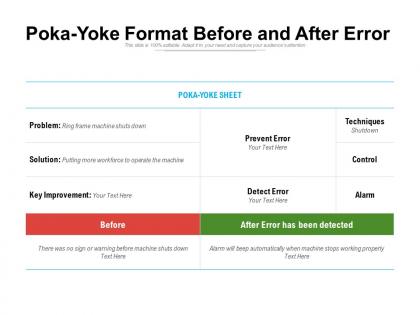
Poka yoke format before and after error




Try Before you Buy Download Free Sample Product
 Impress Your
 Audience
 100%
100% Editable
 Save Hours
 of Time


There is something childlike about our Poka Yoke Format Before And After Error. They will be good companions for your baby.
People who downloaded this PowerPoint presentation also viewed the following :
Poka yoke format before and after error with all 2 slides:
Bells will chime to your thoughts. Set the notes with our Poka Yoke Format Before And After Error.
FAQs for Poka yoke format before
So Poka Yoke is basically about stopping mistakes before they even happen - way better than catching them later. You design stuff so errors are either impossible or super obvious right away. Like how USB cables only go in one direction, you know? Pretty genius if you ask me. This cuts way down on defects and saves money since you're not inspecting everything afterward. Instead of playing cleanup crew, you're building safeguards right into the process. Just look at where people usually mess up and figure out simple ways to prevent it.
Start with whatever's driving you crazy - find your biggest defect spots first. Build in simple fixes right there: physical guides, sensors, visual cues, anything that makes screw-ups impossible or super obvious. Wrong parts getting used? Missed steps? Fix those pain points. The workers actually doing the job usually have the best ideas (seriously, they see stuff you don't), so get them involved in brainstorming. Don't try fixing everything at once - that's a recipe for burnout. Pick one problem area, test something simple, tweak it until it works, then move on. Way less overwhelming that way.
Oh man, once you notice Poka Yoke you'll see it literally everywhere! McDonald's has those fry timers that beep when food's ready - pretty foolproof. Toyota started the whole thing with assembly fixtures that make it impossible to install parts backwards. Your car's full of examples too - can't pull your key out unless you're in park, doors won't lock with keys inside (though I swear mine has malfunctioned before). Hospitals use IV pumps with dose limits to prevent overdoses. Even surgical trays have shaped slots so surgeons instantly know if something's missing. The really good ones are invisible - you don't even realize they're protecting you from screwing up.
So here's the thing about Poka Yoke - it totally flips how people think. Instead of scrambling to fix stuff that's already broken, your team starts hunting down problems before they happen. It's like a sixth sense develops or something. The solutions are usually dead simple, which is great because when employees come up with their own fixes, they actually care about making them work. Way better than management dropping new rules from nowhere. I'd honestly just ask your team to find one tiny mistake-prone thing they do every day and brainstorm how to idiot-proof it. Watch how fast it spreads from there.
Honestly, most people think Poka Yoke is just some fancy Japanese term for basic error-proofing. Not true though - it's actually got specific principles behind it. USB ports are perfect examples, right? They only go in one way. Simple but genius. Another thing - everyone assumes you need expensive tech solutions when the best ones are usually dead simple. Oh, and it's not just for manufacturing either. You can use this stuff for software, paperwork, whatever. My advice? Don't overthink it. Figure out where your biggest screw-ups happen, then brainstorm the easiest way to make those mistakes literally impossible.
Oh man, visual aids are everything for Poka Yoke! Like, you need your error-prevention to be so obvious that problems jump out immediately. Color-coded parts work great. Shape templates too. Bright warning lights - you get the idea. We've all grabbed the wrong cable because everything looks identical, and that's exactly what you're trying to avoid. Good visual cues make the right choice obvious and wrong ones stick out big time. The trick is making it work even when people are rushed or distracted (which is always). Map out your common mistakes first, then figure out how to make the correct option visually foolproof.
So Poka Yoke basically tackles three types of screw-ups: forgetting steps entirely, doing something the wrong way, and picking the wrong stuff. Think skipping assembly steps, putting parts in backwards, or grabbing from the wrong bin - you know how it is when you're on autopilot. What's cool is it stops these mistakes before they turn into major headaches later. Most people mess up when they're rushing or doing repetitive tasks they could do in their sleep (guilty as charged). I'd say look at where your team trips up most often first. Then just add simple visual cues or make it physically impossible to do wrong.
Honestly, IoT makes Poka Yoke way more powerful. Sensors catch defects immediately and can auto-stop production lines or send alerts without anyone touching anything. Real-time data lets you spot patterns across your whole operation too - like finding weak spots before they blow up into bigger issues. The smart move? Start with just one critical process and add sensors there. Don't go crazy trying to connect everything at once (learned that the hard way at my last job). Once you see how much smarter connected equipment gets, you'll want to expand from there.
Try FMEA and root cause analysis - they're actually pretty useful. Go through each step and ask "what breaks here?" Your historical data will show you patterns, but honestly, just talking to the people doing the work tells you way more than any report. Do some gemba walks if you can - there's always stuff happening that's not in the documentation. Those handoff points between teams? That's where everything falls apart, I swear. Oh, and don't try to fix everything at once. Pick your worst 3 areas first and map those out.
So Poka Yoke is all about stopping mistakes before they happen - way smarter than fixing them later. You know how USB cables only fit one way? That's the idea. Build these little safeguards right into your process so people literally can't mess up. Your team stops wasting time on rework and actually gets stuff done. The cost savings hit pretty quick - less waste, fewer inspections, no more putting out fires every day. Honestly, it's one of those things that seems obvious once you see it. Just look at where you're screwing up most and make those errors impossible.
Honestly, the worst part is dealing with people who think you're basically calling them idiots. Employees get defensive because they see it as "we don't trust you to do this right." Getting past that mindset is brutal. Then there's the money thing - leadership sees upfront costs and gets squeamish, even though it saves cash long-term. You'll waste time debating which mistakes are actually worth preventing too. My advice? Start with something cheap and obvious that shows quick results. Once people see it working, the bigger stuff becomes way easier to sell. Build momentum first, tackle the complex implementations later.
Honestly, just track your defect rates before and after - that's the big one. Error frequency, rework costs, customer complaints over time. How fast do people catch mistakes now vs. before? That detection time is pretty crucial. Don't forget employee feedback since they're actually living with these systems every day. For ROI, compare what you spent implementing against the money you saved from preventing errors. Oh and start simple with your metrics - you can always get more sophisticated once you've got some baseline data coming in. The fancy analysis can wait.
Your training has to be rock solid or the whole thing falls apart. People will just work around the safeguards if they don't get why they're there. Show them the purpose behind each mechanism, not just how to use it. Hands-on practice sessions work way better than just explaining stuff. I've watched teams completely ignore Poka Yoke systems because nobody bothered explaining the reasoning. Oh, and focus on shifting their mindset from catching mistakes to preventing them - that's honestly the hardest part. Trust me, spending time on proper training upfront saves you from dealing with creative workarounds later.
Yeah, totally doable! Start by spotting where people usually mess up in your service, then build in safeguards. Checklists work great for complex stuff. Hotels do this well - their key cards only work during your actual stay dates, so you can't accidentally get into someone else's room later. Banking's another good example with all those verification steps before transfers. For customer service, maybe create templates that walk agents through troubleshooting - saves time and catches mistakes. Form validation's huge too, prevents bad data from getting in. Oh, and automatic confirmations before anything major happens. Pretty much just make errors either impossible or super obvious when they do happen.
Poka Yoke is honestly a game-changer for keeping customers happy and your products solid. Basically, you're stopping defects before they even get out the door. Your customers receive better quality stuff consistently, which means fewer headaches from complaints and returns. Nobody wants to deal with that mess. The reliability boost is massive too - preventing problems beats finding them later every time. Your products just work better in real situations. Oh, and here's what I'd do first: figure out where things usually go wrong, then build simple safeguards around those trouble spots.
No Reviews