


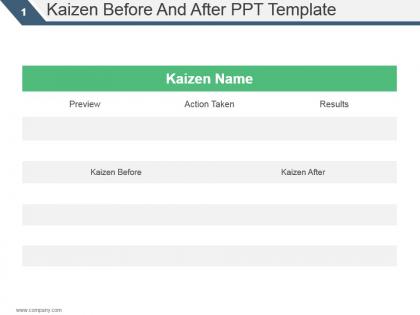
Kaizen before and after ppt template




Try Before you Buy Download Free Sample Product
 Impress Your
 Audience
 100%
100% Editable
 Save Hours
 of Time


Engage the competition till the end with our Kaizen Before And After Ppt Template. You will be able to endure the long haul.
People who downloaded this PowerPoint presentation also viewed the following :
Kaizen before and after ppt template with all 5 slides:
Use our Kaizen Before And After Ppt Template for your storyboard. Get every scene down to the last detail..


FAQs for Kaizen before and
So kaizen is basically about making tiny improvements constantly instead of those huge changes that stress everyone out. Get your whole team involved - like, everyone should be throwing out ideas daily. I mean, why wouldn't you want more brains working on problems, right? Pick one process you guys use all the time and have everyone suggest just one small tweak this week. Don't overthink it. Focus on cutting waste and standardizing stuff so people feel comfortable experimenting. The trick is building it into your regular routine rather than treating it like some big separate thing.
Get leadership actually doing the work, not just talking about it. Train people on basic Kaizen but - and this is crucial - give them real work time to find and fix problems. Don't punish failed experiments or you'll kill the whole thing. Quick story: saw a company say they wanted improvement then wrote people up for trying stuff. Disaster. Set up easy ways for ideas to flow in. Implement the small wins super fast. Honestly, celebrating those tiny victories publicly works way better than most people realize. Recognition beats bonuses sometimes.
Honestly, employee engagement makes or breaks Kaizen - I've watched so many improvement programs crash and burn because leadership skipped this part. Your team knows where the real problems are since they deal with the work every day. They'll naturally find solutions if they feel heard. But force changes from the top? People just ignore them or push back. What works is asking your employees what bugs them most in their daily routine - that's pure gold for finding improvement opportunities. Oh, and actually implement their small suggestions when possible. Shows you're serious about their input.
Oh man, Toyota's the classic example - they basically created Kaizen and transformed how cars get made. Hospitals have had crazy success with it too, cutting wait times and preventing errors. Manufacturing companies are obviously all over it, but I've seen tech teams use it to fix their messy development processes. Banks and retail stores do it for customer stuff. Honestly, the key is just starting super small with your team. Pick one process that drives everyone nuts and chip away at improving it each week. Don't overthink it.
You gotta measure stuff if you want Kaizen to actually work - can't fix what you don't track, right? Start by getting your baseline numbers first. Then pick the metrics that matter most: cycle times, defect rates, customer satisfaction, whatever fits your process. Here's what really works - make those numbers visible to everyone. Dashboards, simple charts, weekly team check-ins. People get way more engaged when they can see the progress happening. Don't overcomplicate it with fancy analytics though, especially at the start. Simple measurements your team can actually do something about are way better. Oh, and review weekly so you can tweak things as you go.
So there's a bunch of tools people use for Kaizen stuff. Value stream mapping helps spot waste, and 5S keeps workspaces organized. Root cause analysis is solid - fishbone diagrams work great for that. Then you've got standardized work procedures, A3 problem-solving, and gemba walks where you literally go watch people work. PDCA cycles are everywhere too (plan-do-check-act). Oh, and kaizen events for quick improvements. Honestly, I'd start with 5S since it's pretty straightforward and people actually see results fast. Builds momentum for the harder changes later.
Honestly, you gotta get people involved instead of just telling them what to do. Explain what's in it for them personally - not just "this helps the company." Let them spot the problems and come up with fixes themselves. Nobody likes changes they had zero say in, you know? Communication matters big time here. Some folks will be skeptical no matter what, but focus on quick wins to prove it works. Oh, and your managers better be doing this stuff too - if leadership's not participating, forget about it. People see right through that.
Leadership support is seriously the make-or-break factor for Kaizen. I've watched so many efforts just die without it - people can smell when something isn't really a priority. Your leaders need to jump in themselves, not just delegate it. They should celebrate wins publicly and actually remove roadblocks when teams get stuck. Honestly, the adoption rates are night and day different when leadership is genuinely engaged versus just paying lip service. If you're thinking about launching this, nail down real leadership commitment first. Everything else falls into place after that. Don't skip this step - I'm telling you it matters more than the fancy tools or training.
Honestly, tech makes Kaizen way easier once you get going. IoT sensors track your metrics automatically, and dashboards show bottlenecks right when they happen. Your team can submit improvement ideas through mobile apps too. Don't get sucked into expensive AI stuff though - I've watched companies blow budgets on that. Simple tools work just fine. Digital kanban boards are solid, plus basic analytics help you see if changes actually matter. Oh, and workflow automation saves tons of time on repetitive tasks. Just start with whatever your people already use daily. No point making it complicated.
Don't just bolt sustainability onto your Kaizen stuff later - weave it in from the start. Document everything that works and train people properly on the new methods. Honestly, I've watched so many solid improvements just die because nobody was actually responsible for keeping them alive. Set up regular check-ins to spot backsliding early. Assign someone to own each change long-term, and track metrics to see if things are actually sticking. Oh, and celebrate wins publicly - people need that motivation to keep pushing forward.
Dude, biggest mistake is trying to change everything overnight - I've watched so many companies crash and burn this way. Get leadership actually committed first, not just nodding along in meetings. Focus on culture over fancy tools and metrics (seriously, this trips up like 90% of transformations). Start with a small pilot area instead of going company-wide. Listen to your frontline people since they actually know what's broken. Quick wins help prove it's not just another flavor-of-the-month thing. Oh, and let people mess up safely while they're learning - that's huge.
Yeah, culture totally changes how Kaizen works out. In places with strict hierarchies, get the bosses on board first - otherwise people won't speak up about improvements (they think it's like criticizing management). Americans love the individual recognition part, but in team-focused cultures you gotta sell it as group wins. I've watched rollouts crash and burn because they just copy-pasted the same approach everywhere, which is honestly pretty dumb. The improvement mindset translates everywhere though. Just figure out how your people actually handle change and feedback first, then adjust from there.
Yeah, totally! Kaizen, Lean, and Six Sigma actually work great together - I've watched companies do this successfully. Kaizen gets everyone in that continuous improvement mindset first. Then Lean comes in with all the waste-elimination stuff, and Six Sigma handles the heavy data analysis for complex problems. Honestly though, don't dump all three on people at once - that's a recipe for confusion. Pick one to start with (usually Kaizen since it's more cultural), get that rolling smooth, then slowly add the others. Most teams I've seen do Kaizen events first to get buy-in, then layer in the rest as people get more comfortable with the whole improvement thing.
Start with hands-on workshops focused on problem-solving and visual management. Basic Kaizen and root cause analysis work great - people actually get pumped when they see real issues fixed. Train your frontline folks first since they catch problems early. Leadership coaching is huge too though, they need to know how to back these improvements. Gemba walks are clutch for getting people out to where stuff actually happens. Oh and definitely pilot this with one group first - their wins will sell everyone else way better than any presentation could.
So Toyota's the classic example - they basically created Kaizen and use it everywhere in manufacturing. Boeing cut their aircraft assembly time in half with it. Even hospitals like Virginia Mason used these principles to slash patient wait times. Amazon does this constantly in their warehouses too, which honestly makes sense given how obsessed they are with efficiency. The key thing all these companies figured out? Make tons of tiny improvements instead of waiting around for some massive breakthrough. Way more realistic that way. You should try spotting just one small thing that's inefficient in your daily work routine and fix that first.
-
Great quality slides in rapid time.
-
Helpful product design for delivering presentation.