

Internal Customer Services Product Clear Expectations Service




Try Before you Buy Download Free Sample Product
 Impress Your
 Audience
 100%
100% Editable
 Save Hours
 of Time


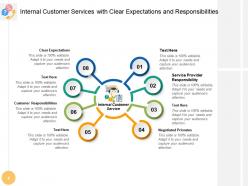
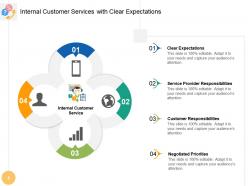
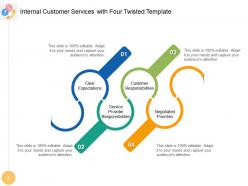
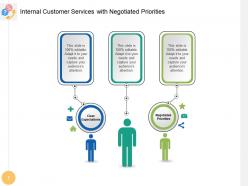
Our Internal Customer Services Product Clear Expectations Service are topically designed to provide an attractive backdrop to any subject. Use them to look like a presentation pro.
People who downloaded this PowerPoint presentation also viewed the following :
Internal Customer Services Product Clear Expectations Service with all 9 slides:
Use our Internal Customer Services Product Clear Expectations Service to effectively help you save your valuable time. They are readymade to fit into any presentation structure.

FAQs for Internal Customer Services Product
Internal customer service focuses on supporting employees, departments, and stakeholders within an organization, emphasizing collaboration, process efficiency, and operational alignment, while external customer service targets paying customers with sales-focused interactions and brand representation. Internal service typically involves longer-term relationships, cross-departmental problem-solving, and resource optimization, whereas external service prioritizes immediate satisfaction, revenue generation, and market competitiveness, with many organizations finding that strong internal service ultimately enhances external customer experiences.
Organizations measure internal customer service effectiveness through employee satisfaction surveys, internal Net Promoter Scores, response time metrics, resolution rates, and cross-departmental feedback systems. These measurement approaches enable HR, IT, and support teams to identify bottlenecks, streamline processes, and enhance workplace efficiency, with many companies finding that systematic tracking ultimately delivers improved employee retention and organizational productivity.
Employee engagement significantly enhances internal customer service by fostering collaboration, improving response times, and building stronger cross-departmental relationships. Engaged employees proactively support colleagues, streamline workflows, and deliver more responsive assistance, with many organizations finding that higher engagement levels directly correlate with improved internal satisfaction scores and operational efficiency.
Employee feedback can be effectively gathered through regular surveys, focus groups, one-on-one meetings, suggestion boxes, and digital feedback platforms that encourage honest input. These methods enable organizations to identify service gaps, streamline internal processes, and enhance workplace efficiency, with many companies finding that systematic feedback collection ultimately delivers improved employee satisfaction and stronger operational performance.
Essential training includes communication skills development, conflict resolution techniques, empathy building workshops, service standards education, and cross-departmental collaboration methods. These programs enhance internal relationships by fostering mutual respect, streamlining interdepartmental processes, and improving problem-solving capabilities, with many organizations finding that comprehensive internal service training ultimately delivers faster project completion and higher employee satisfaction.
Technology enhances internal customer service through automation platforms, self-service portals, AI-powered chatbots, workflow management systems, and real-time analytics dashboards. These solutions streamline request processing, reduce response times, and enable seamless communication across departments, with many organizations finding that automated ticketing and knowledge bases significantly improve employee satisfaction while reducing operational costs.
Common challenges include inadequate communication channels, unclear service level agreements, insufficient staff training, limited resource allocation, and lack of performance metrics. These barriers often result in delayed response times, inconsistent service quality, and frustrated internal stakeholders, with many organizations finding that poor internal service ultimately impacts external customer experiences and overall operational efficiency.
Internal customer service significantly impacts organizational productivity by streamlining interdepartmental workflows, reducing response times for internal requests, and minimizing operational bottlenecks. When departments like HR, IT, and finance deliver efficient internal support, organizations experience faster project completion, improved employee satisfaction, and enhanced collaboration, ultimately delivering competitive advantage through optimized resource allocation and operational efficiency.
Managers can foster inter-team collaboration through cross-functional project teams, regular interdepartmental meetings, shared performance metrics, collaborative technology platforms, and joint training sessions. These strategies streamline communication and break down silos, with many organizations finding that integrated workflows, shared accountability systems, and unified communication tools ultimately enhance operational efficiency and deliver superior internal customer experiences.
Internal customer service aligns with company values by integrating core principles into employee interactions, creating consistent service standards that reflect organizational mission, and establishing clear communication protocols. Through values-based training programs and mission-driven performance metrics, organizations enhance workplace culture, improve cross-departmental collaboration, and ultimately deliver external customer experiences that authentically represent their brand identity and strategic objectives.
Internal customer satisfaction metrics include response time to requests, resolution rates, service quality ratings, employee satisfaction surveys, and feedback scores from cross-departmental interactions. These measurements enable organizations to streamline workflows, enhance collaboration, and improve operational efficiency, with many companies finding that strong internal service metrics ultimately deliver better external customer experiences and competitive advantage.
Conflict resolution strategies enhance internal customer service by promoting open communication, establishing clear escalation procedures, and fostering collaborative problem-solving approaches. These methods streamline workplace interactions, reduce interdepartmental friction, and accelerate issue resolution, with many organizations finding that structured conflict management ultimately delivers improved employee satisfaction and operational efficiency.
Internal customer service training can be incorporated through role-playing exercises, departmental shadowing programs, mentorship pairings with experienced staff, interactive workshops on communication protocols, and cross-functional collaboration simulations. These comprehensive onboarding approaches enable new employees to understand interdepartmental dynamics, develop effective communication skills, and build lasting professional relationships, ultimately delivering improved workplace efficiency and enhanced organizational culture across all business units.
Internal customer service can adopt best practices like establishing clear service level agreements, implementing ticketing systems for request tracking, conducting regular satisfaction surveys, and providing comprehensive self-service resources. These approaches streamline interdepartmental workflows by enhancing communication transparency, reducing response times, and standardizing processes, with many organizations finding that applying external service excellence internally ultimately delivers improved employee satisfaction and operational efficiency.
Recognition programs boost internal customer service by acknowledging outstanding support behaviors, creating positive reinforcement cycles, and establishing clear service excellence standards. When employees receive recognition for helping colleagues effectively, it motivates consistent collaboration, reduces interdepartmental friction, and ultimately enhances overall organizational efficiency, with many companies finding that recognized employees become internal service champions.
-
Great designs, Easily Editable.
-
Commendable slides with attractive designs. Extremely pleased with the fact that they are easy to modify. Great work!
-
Very unique and reliable designs.
-
Topic best represented with attractive design.
-
It saves your time and decrease your efforts in half.