

Sales and customer service ppt slide template




Try Before you Buy Download Free Sample Product
 Impress Your
 Audience
 100%
100% Editable
 Save Hours
 of Time


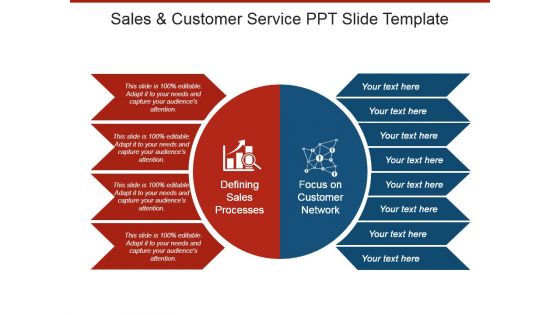
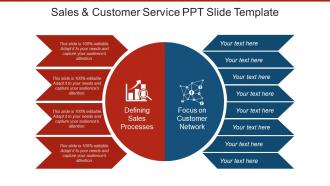
Make a great first impression of your end to end business activities by setting goals and targeting your consumers with our sales and customer service PPT slide template. This presentation template of sales and customer service is helpful for your business to display how sales can bring new customers while customer service can retain and delight your new and previous customers. This PPT presentation on customer service excellence gives impression to your potential buyers as to how reliable and trustworthy your customer support is. This Sales And Customer Service presentation can be used to show your customer handling skills to reduce customer response time, to display customer satisfaction template and higher sales. This Sales And Customer Service PPT slide allows you to know your consumers, target certain types of consumers, better understanding of its consumers, customize your customer service and offer product as per different requirements. Service and sales based, this template can be used to demonstrate as to how high quality customer service can significantly increase sales and strengthen the brand image to sell more products. Get applauded instantaneously with our Sales And Customer Service Ppt Slide Template. Your effort will be immediately appreciated.
People who downloaded this PowerPoint presentation also viewed the following :
Sales and customer service ppt slide template with all 5 slides:
Gain control over any instability that arises with our Sales And Customer Service Ppt Slide Template. It will cure the hiccups.
FAQs for Sales and customer service
Sales is all about bringing new customers in - they're hunting prospects and closing deals to hit revenue targets. Customer service? Totally different beast. They're focused on keeping existing customers happy after the sale, solving problems and building loyalty. Honestly, most companies do a terrible job connecting these teams when they should be best friends! Your sales team brings people through the door, then service keeps them around long-term. Pro tip: make sure both sides actually share customer info. That's where you'll see real results instead of just spinning your wheels.
Honestly, the best sales approach is just treating people like actual humans. Ask good questions first - like "what's your biggest challenge with..." instead of diving into features. Nobody wants to feel sold to, but we all love getting helpful advice. Listen to what they're actually saying, then show how your thing solves their specific problem. Makes the whole thing feel way less pushy and more like you're just helping them figure stuff out. I learned this the hard way - consultative selling beats the old-school pitch every time. Trust me on this one.
Dude, customer feedback is like having a cheat code for sales. Instead of guessing what people want, you're getting the real deal straight from their mouths. I always tell my team to track the common complaints and compliments monthly - that's where the gold is. You'll start noticing patterns in why people say no, which features they actually care about, and honestly? Sometimes you'll realize your pitch is way off. Set up some kind of feedback system, whether it's quick surveys or just casual follow-ups after calls. Way more reliable than those internal "we think customers want this" meetings that go nowhere.
Your CS team is sitting on a goldmine - they hear customer complaints and pain points all day. I'd grab coffee with the CS lead weekly if I were you. They know which features people actually use vs what they *think* they need, plus all the stuff that makes customers mad. Super helpful for your demos. Instead of getting caught off guard during pitches, you can tackle those objections head-on. It's honestly like having insider info for better sales conversations. Oh, and they'll tell you the real deal about what works and what doesn't.
Honestly, start with conversion rates and average deal size for sales - those numbers don't lie. Response times and customer satisfaction scores are clutch for service stuff. Revenue per customer is probably what I'd watch most closely though, gives you the real story. But here's the thing - you can totally get lost in all this data if you're not careful. Pick maybe 3 or 4 metrics that actually matter to your goals and stick with those. Figure out where your funnel's bleeding customers first, then focus your tracking there. Sales cycle length and pipeline velocity are solid too if you're trying to speed things up.
Dude, you can't just copy-paste your sales approach across cultures - it'll blow up in your face. Japan? Build relationships first, read between the lines. Germany? Skip the small talk, hit them with facts. I bombed a pitch in Tokyo once because I rushed straight into numbers like an idiot. Communication styles are night and day different. Some places want you schmoozing for months before they'll buy a paperclip. Others think you're wasting their time if you don't get to the point immediately. Honestly, just do your homework on local business culture before you dive in. Saves so much awkwardness later.
Honestly, role-playing scenarios is huge - gets your team comfortable with tricky situations before they happen for real. Most complaints happen because customers feel ignored, so work on actually listening instead of jumping straight into sales mode (guilty of this myself lol). Your team needs to know the products cold too. Nothing tanks credibility like stumbling over basic features. Oh, and don't skip feedback sessions - they're annoying but they work. Try mixing real customer calls with practice scenarios monthly. Keeps everyone sharp without making it feel like school.
Honestly, the biggest game-changer is just getting both teams looking at the same data. No more of that awkward "hold on, let me ask sales what we promised this customer" nonsense. Good CRM systems let service reps see exactly what deals were closed and what expectations were set. The reverse works too - sales gets to see which customers are actually happy vs. constantly calling support. Shared dashboards make handoffs way smoother. Just don't go crazy buying random tools that don't actually talk to each other (learned that one the hard way).
Dude, personalization is honestly a game changer - can bump satisfaction up 20-30%. Like, when customers feel you actually know their history and preferences instead of treating them like ticket
-
Great product with highly impressive and engaging designs.
-
Enough space for editing and adding your own content.