

Interview Scoring Sheet For Grading Candidates Optimizing HR Operations Through




Try Before you Buy Download Free Sample Product
 Impress Your
 Audience
 100%
100% Editable
 Save Hours
 of Time


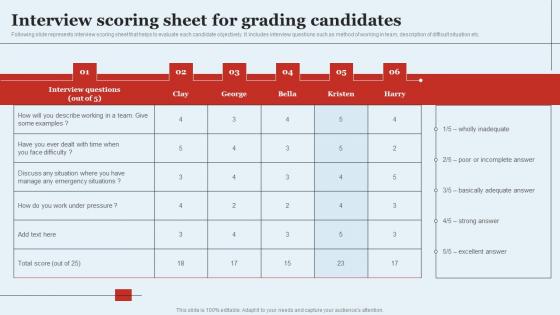
Following slide represents interview scoring sheet that helps to evaluate each candidate objectively. It includes interview questions such as method of working in team, description of difficult situation etc.
People who downloaded this PowerPoint presentation also viewed the following :
Interview Scoring Sheet For Grading Candidates Optimizing HR Operations Through with all 9 slides:
Use our Interview Scoring Sheet For Grading Candidates Optimizing HR Operations Through to effectively help you save your valuable time. They are readymade to fit into any presentation structure.









FAQs for Interview Scoring Sheet For Grading Candidates Optimizing
Focus on technical skills for the role, plus communication and problem-solving abilities. Cultural fit matters too - don't skip that part. Experience relevance and growth potential are huge though, honestly those have saved me from some terrible hires! I always check how they handle hypothetical scenarios and whether they ask good questions back. Use a 1-5 scale so you can actually compare people later. The trick is being specific enough that different interviewers would score similarly, but not so rigid that you miss what actually predicts success in the job.
Honestly, scoring sheets are game-changers for interviews. They kill the bias thing where you hire someone just because they're charming or whatever. Instead of going "eh, they seemed cool," you're actually rating people on stuff that matters for the job. I learned this the hard way after some questionable hires lol. Now I just pick like 5-6 skills that actually matter and rate everyone 1-5 on each one. Makes comparing candidates so much easier. Plus you've got documentation if anyone questions your decision later, and candidates get real feedback instead of generic rejection emails.
I'd go with 1-5 honestly. You get enough range to tell candidates apart without overthinking whether someone's a 7 vs 8. Here's how I set mine up: 1 means zero evidence, 3 is solid/meets the bar, 5 is when they blow you away. Some people swear by 1-4 scales because it forces a decision (no sitting on the fence), but that feels unnecessarily harsh to me? The real game-changer is defining what each number means before you start. I literally write those definitions on my scoresheet so I'm not winging it mid-interview. Your scoring becomes way more consistent that way.
Honestly, the biggest thing is getting super specific with your criteria - none of that "cultural fit" nonsense where bias sneaks right in. Break down each skill into actual behavioral indicators you can measure. Use the same numerical scale for everyone. Get multiple people scoring separately, then compare afterward. I learned this the hard way - your gut will lie to you every time. Make sure you're judging the exact same concrete stuff for each candidate. Oh, and check your scoring patterns later to see if you're being weird about certain things. Structure it so feelings can't override real evidence.
Split your scoring sheet into two main parts - technical skills and culture fit. Technical stuff covers job-specific abilities, problem-solving, experience. Culture section hits communication, teamwork, company values alignment. Honestly, scenario questions are gold because they reveal both sides at once. Use rating scales (1-5 works great) plus room for notes on each section. This beats just writing random thoughts everywhere. The whole point is comparing candidates fairly later instead of relying on whatever vibe you caught that day. Oh, and leave extra space - you'll always write more than expected.
Honestly, most companies totally blow this by using the same generic scorecard for every role. Look at your best people first - what actually makes them good at the job? For sales roles, weight communication and relationship stuff heavily. Developers? Focus on technical problem-solving instead. I'd pick maybe 4-6 things that really matter for success and build your scoring around those. Don't forget to adjust your rating scales too. Technical people might need deeper assessments while customer-facing roles are more about soft skills. It's way better than those cookie-cutter sheets everyone uses.
Most companies give experience about 20-30% weight on interview scorecards. You're basically looking at whether their background matches what you need - industry time, company size, tech skills, all that stuff. Some places split it into "must-have" vs "nice-to-have" experience, which honestly makes way more sense. But here's the thing - don't let years of experience be everything. I've seen too many hiring managers get obsessed with that number. Define what "relevant" actually means for your role first, otherwise you'll just default to thinking more experience automatically equals better candidate. Short punchy evaluation works better than overthinking it.
Look, scoring sheets are honestly a lifesaver for this stuff. Your team stops arguing over random gut feelings and actually looks at real data instead. Like instead of "Sarah seemed nice" you're comparing actual numbers on communication, tech skills, culture fit - whatever matters most. The trick is getting everyone to agree on maybe 4-5 key things to rate before you even start interviewing. Trust me, those post-interview meetings where nobody can agree? They'll be so much shorter. Patterns jump out when you're all using the same measuring stick. I learned this the hard way after way too many hiring disasters.
Check your scoring sheet every few interviews to spot what's actually helping vs what's useless. We had this terrible "culture fit" question that was so vague it told us nothing - learned that one the hard way! Short sentences work. Questions that stump everyone? Trash them. Same goes for criteria that never help you pick between candidates. Get other interviewers to tell you which parts feel pointless. Your scoring scale might look good on paper but suck in real life. I'd say update quarterly minimum, but honestly? If something feels broken mid-process, just fix it then and there.
For every score you give, jot down 1-2 specific examples of what they actually did. Like "walked through their debugging process step-by-step" instead of just slapping down "good technical skills." Numbers mean nothing when you're reviewing candidates weeks later - trust me on this one. Your comments need to back up whatever score you gave. Focus on stuff you actually observed rather than just gut reactions. Did they explain their thinking clearly? Write that down. Were they all over the place? Note that too. This way you can actually justify your decisions later and other interviewers will get why you rated them that way.
Check if different interviewers are scoring the same people consistently - that's your first red flag if something's off. Then track how your high scorers actually perform 6-12 months later. Does the sheet predict success? Time-to-hire matters too since good rubrics should speed up decisions. But honestly, half the companies I know build these fancy scoring systems that interviewers just ignore. Are people actually filling them out completely? Ask your team if the criteria make sense or feel pointless. Oh, and don't try measuring everything at once - pick like 2-3 metrics that align with what you're really trying to fix in hiring.
Grab everyone's individual score sheets first, then get the team together for a calibration session. Go through each criteria and hash out the differences - honestly, people get pretty passionate about their picks so brace yourself! When scores are way off, dig into the reasoning behind each rating. That's usually where the good stuff comes out. Don't just average everything though. Talk it through until you reach actual consensus. Have someone take notes on the big concerns and wins that shaped your final call, then let one person pull it all together into the final scorecard.
Honestly, if you're already using an ATS like Greenhouse or Lever, just use their built-in scoring - it'll save you time. Google Forms is my go-to for custom templates though, super easy to set up. Excel works too if you want total control over the layout. HireVue and CodeSignal are worth it if you need fancy analytics, but they're probably overkill unless you're hiring tons of people. I'd start simple with whatever you already have access to. You can always get fancier later if the basic stuff isn't cutting it.
Check your interview scoring sheets first - that's where the gold is. Find patterns where people are scoring all over the place or consistently missing the mark. Those weak spots? That's what you should train on. Most interviewers think they're killing it naturally (spoiler: they're usually not). Grab some anonymized examples from real scoresheets to build practice scenarios. Way better than made-up training stuff. New interviewers can actually see what good evaluation looks like vs the messy reality. It's honestly pretty eye-opening when you show them side-by-side comparisons.
Honestly, scoring sheets are a game changer for interviews. You'll ask everyone the same questions and judge them on identical criteria - no more of that sketchy "I just have a feeling" stuff that's usually biased anyway. Candidates get a way better experience since they know what's coming. The feedback you can give afterward is actually useful because you wrote down specific notes. Oh, and you won't spend forever trying to remember who said what - that alone makes it worth it. Just set up your criteria beforehand so you're not comparing totally different things.
-
SlideTeam is my one-stop solution for all the presentation needs. Their templates have beautiful designs that are worth every penny!
-
I had them make a presentation for an office retirement party. They were very helpful in understanding what we wanted and delivered the perfect presentation. Highly recommended!