


Vorstellung im Vorstellungsgespräch über sich selbst Powerpoint-Präsentationsfolien





Try Before you Buy Download Free Sample Product
 Impress Your
 Audience
 100%
100% Editable
 Save Hours
 of Time


Gewinnen Sie die Aufmerksamkeit Ihres Publikums mit unseren PowerPoint Präsentationsfolien für Vorstellungsgespräche. Unser Team hat diese Präsentationsfolien entworfen, um detaillierte Arbeitserfahrungen zu präsentieren, die Ihnen helfen, einen bleibenden Eindruck bei Ihren Zuschauern zu hinterlassen. Mit einem visuellen Lebenslauf-PPT-Layout können Sie Ihre Fähigkeiten und Kompetenzen in einem anschaulichen Stil präsentieren. Diese PowerPoint-Vorlage ist ideal, um eine Interviewpräsentation zu strukturieren. Die PPT-Folie zur Selbsteinführung umfasst eine breite Palette von Infografik-Folien wie Karriereweg, SWOT-Analyse, persönliche Qualifikationen, Leistungen, Ausbildung, Erfahrung, Fallstudie, Sprachkenntnisse und Hobbys usw. Die Selbstpräsentation ist abgeschlossen Deck enthält auch vorgefertigte Vorlagen für Säulendiagramme, Flächendiagramme, Liniendiagramme, Clipart-Symbole und Roadmaps. Mit diesen Folien können Sie Ihre Qualifikationen und Erfahrungen in einem organisierten Format erstellen. Laden Sie sich PPT-Folien herunter, um die beste Interviewpräsentation aller Zeiten zu liefern. Weisen Sie die Praktikanten mit unserer Vorstellungsgespräch-Präsentation auf sich selbst Powerpoint-Präsentationsfolien an. Machen Sie sie mit den Grundlagen der Ersten Hilfe vertraut.
People who downloaded this PowerPoint presentation also viewed the following :
Inhalt dieser Powerpoint-Präsentation
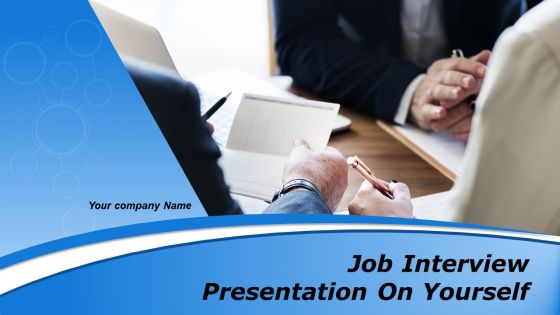
Folie 1 : Diese Folie zeigt eine Vorstellung von Vorstellungsgesprächen über sich selbst. Geben Sie den Firmennamen an und beginnen Sie.
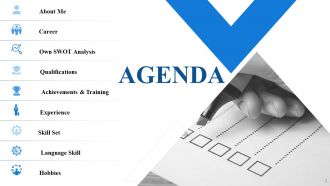
Folie 2 : Dies ist eine AGENDA-Folie mit Über mich, Karriere, eigene SWOT-Analyse, Qualifikationen, Leistungen und Training, Erfahrung, Fähigkeiten, Sprachkenntnisse, Hobbys.
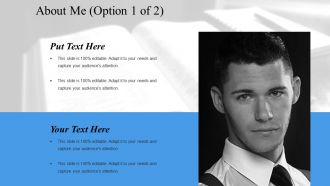
Folie 3 : Dies ist eine Folie über mich. Hier können Sie Text nach Ihren Wünschen hinzufügen.
Folie 4 : Dies ist eine „Über mich“-Folie mit den folgenden Daten, die Sie verwenden, hinzufügen oder bearbeiten können – Kontaktinformationen, Fähigkeiten und Sprachen, Berufserfahrung, persönliches Profil, Erfolge, Bildung, Hobbys.
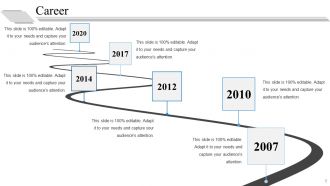
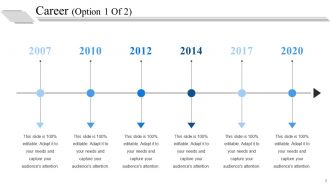
Folie 5 : Diese Folie zeigt die Karriere-Roadmap mit der Anzahl der Jahre. Sie können es nach Bedarf hinzufügen/bearbeiten.
Folie 6 : Diese Folie zeigt auch die Karriere-Roadmap. Sie können es nach Bedarf hinzufügen/ändern.
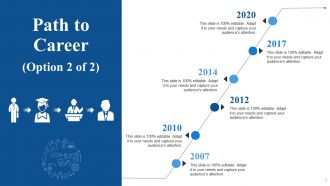
Folie 7 : Diese Folie zeigt den Weg zur Karriere. Text nach Bedarf hinzufügen/bearbeiten.
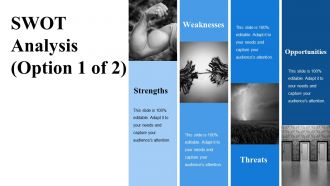
Folie 8 : Diese Folie präsentiert die SWOT-Analyse. Verwenden Sie es, um Ihre Stärken, Schwächen, Bedrohungen, Chancen anzugeben.
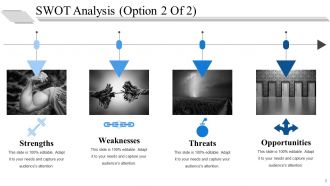
Folie 9 : Diese Folie zeigt auch die SWOT-Analyse.
Folie 10 : Diese Folie zeigt berufliche Qualifikationen. Geben Sie hier Ihre Qualifikationen professionell an.
Folie 11 : Dies ist eine Erfolgsfolie. Beschreiben Sie hier Ihre verschiedenen Erfolge.
Folie 12 : Diese Folie zeigt das Training mit Beschreibung und Textfeldern.
Folie 13 : Dies ist die Folie Erfahrungsprojekte. Geben Sie sie hier an.
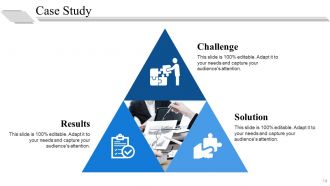
Folie 14 : Dies ist eine Fallstudienfolie, die Herausforderung, Lösung, Ergebnisse zeigt.
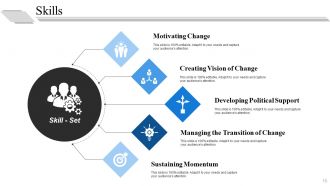
Folie 15 : Diese Folie zeigt Fähigkeiten wie: Vision des Wandels schaffen, politische Unterstützung entwickeln, den Übergang des Wandels managen, Dynamik aufrechterhalten, Veränderungen motivieren.
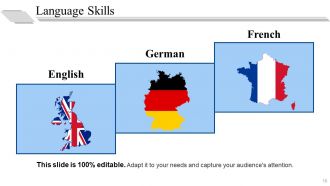
Folie 16 : Diese Folie zeigt Sprachkenntnisse in 3 Sprachen. Sie können je nach Ihren Kenntnissen weitere hinzufügen - Englisch, Deutsch, Französisch.
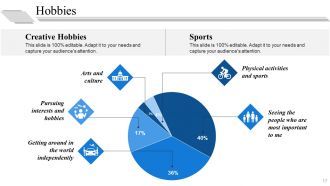
Folie 17 : Diese Folie zeigt Hobbys. Wir haben einige erwähnt, um Ihnen eine Vorstellung zu geben. Hier können Sie Ihre eigenen Hobbys hinzufügen.
Folie 18 : Dies ist eine Kaffeepause-Folie zum Anhalten. Inhalte nach Bedarf hinzufügen/ändern.
Folie 19 : Diese Folie geht weiter zu Charts & Graphs. Nach Bedarf bearbeiten.
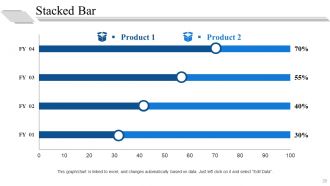
Folie 20 : Dies ist eine gestapelte Balkendiagrammfolie, um den Produkt-/Entitätsvergleich, Spezifikationen usw.
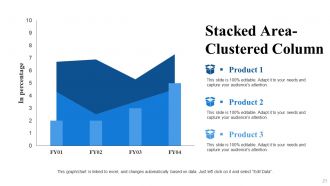
Folie 21 : Dies ist eine Folie mit gestapelten flächengeclusterten Spalten, um den Produkt-/Entitätsvergleich, Spezifikationen usw.
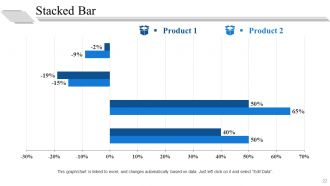
Folie 22 : Dies ist eine gestapelte Balkendiagrammfolie, um das Wachstum von Produkten/Einheiten, Vergleiche, Spezifikationen usw.
Folie 23 : Diese Folie trägt den Titel Zusätzliche Folien, um vorwärts zu gehen. Sie können den Folieninhalt nach Bedarf ändern.
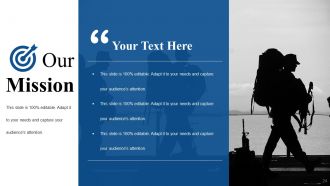
Folie 24 : Diese Folie zeigt unsere Mission. Zeigen Sie hier Ihre Unternehmensmission und -ziele.
Folie 25 : Diese Folie zeigt unser Team mit Namen und Bezeichnung zum Ausfüllen.
Folie 26 : Dies ist eine Über uns-Folie. Geben Sie hier Team-/Firmenspezifikationen an.
Folie 27 : Dies ist die Folie „Unser Ziel“. Geben Sie hier Ihre Ziele an.
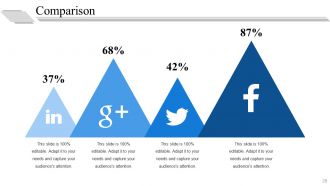
Folie 28 : Dies ist eine Vergleichsfolie, um Vergleiche, Analysen usw. anzuzeigen.
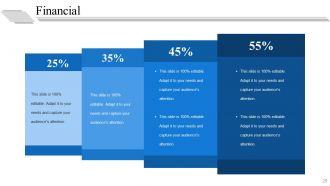
Folie 29 : Dies ist eine Finanzbewertungsfolie, die hier die finanziellen Aspekte zeigt.
Folie 30 : Dies ist eine Zitate-Folie, um Botschaften, Überzeugungen usw.
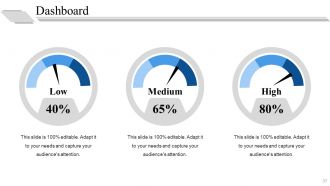
Folie 31 : Dies ist eine Dashboard-Folie, um niedrige, mittlere und hohe Aspekte, KPIs, Metriken usw. anzugeben.
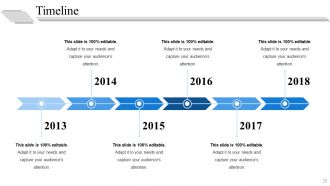
Folie 32 : Dies ist eine Timeline-Folie, um wichtige Daten, Reise, Entwicklung, Meilensteine usw.
Folie 33 : Dies ist unsere Zielbildfolie. Geben Sie hier Ihre Ziele an
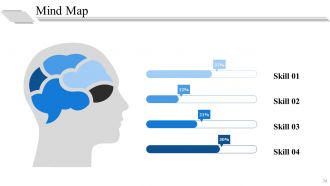
Folie 34 : Diese Folie präsentiert eine Mindmap mit Textfeldern.
Folie 35 : Dies ist eine Glühbirnen- oder Ideen-Bildfolie, um Informationen, Ideen, Spezifikationen usw.
Folie 36 : Diese Folie zeigt eine Lupe mit Bildern und Textfeldern.
Folie 37 : Dies ist eine Dankesfolie mit Adresse# Hausnummer, Stadt, Bundesland, E-Mail-Adresse, Kontaktnummern.
Präsentation zum Vorstellungsgespräch über sich selbst Powerpoint-Präsentationsfolien mit allen 37 Folien:
Initiieren Sie mit unseren Powerpoint-Präsentationsfolien für Vorstellungsgespräche über sich selbst Maßnahmen, um die Lücke zu schließen. Es hilft, jedes Defizit zu beheben.





FAQs for Job Interview Presentation On Yourself
Okay so three things matter: structure, content that actually relates to the job, and not sounding like a nervous wreck. Map out an agenda first - people like knowing what's coming. Then hit your main points with real examples from work you've done. Skip the random college stuff unless it's super relevant. Practice your slide transitions because awkward pauses are painful for everyone. Oh, and definitely prep for questions - they'll throw some curveballs. Wrap up by connecting everything back to what they're looking for. Run through it out loud at least twice though, seriously. You don't want to be fumbling around when you're trying to land the job.
Check out their website and Glassdoor reviews first - you want to match their vibe completely. Startups hate when you show up all corporate and stiff. I learned this the hard way! Look at how they actually talk about problems on their site, then use that same language in your presentation. If they're super collaborative, don't bring some rigid PowerPoint that screams "consulting firm." Mirror their energy level. Oh, and throw in specific examples that prove you get their day-to-day reality, not just their mission statement. It's honestly the difference between landing the job and getting ghosted.
Keep it super simple - 5-7 slides tops with minimal text and clean fonts. Data? Charts work great. But skip the crazy animations, they're just annoying honestly. I'd use professional colors, maybe even their company colors if you're feeling ambitious. The whole point is supporting what you say, not having people stare at busy slides while you talk. Oh, and definitely practice beforehand so you're not just reading everything word for word - that's awkward for everyone.
Okay so here's what works for me - open with something specific about their company, then tell it like a story. Problem, your fix, what happened. I do a quick intro, then 2-3 examples that show you're getting better at stuff, plus how you'd tackle their issues. Each example needs the situation, what you actually did, and numbers if you have them. Most people talk way too much honestly. Oh and definitely end with "here's my first 90 days" - they love that shit. Practice saying it out loud and time yourself because you want them asking questions, not checking their watch.
Don't overload your slides with text - nobody wants to read a novel. Practice out loud beforehand, seriously. I've seen too many people wing it and just read word-for-word from their deck. Test your tech stuff early too because there's nothing worse than fighting with HDMI cables while everyone watches. Time yourself when you practice so you don't run over. Skip the basic company research they already know about themselves. Instead, dig into their actual problems and come with real solutions. Oh, and do at least two full run-throughs before you go in there.
Honestly, stories make such a huge difference in interviews. Facts and achievements are boring - but when you tell them how you actually solved that problem or got your team through a crazy deadline? That's when they see you as a real person, not just another resume. I always think stories are way easier to follow than random bullet points anyway. Plus you're showing your skills in action instead of just talking about them. Just keep them short and relevant to what they're looking for. Oh, and definitely practice a few examples beforehand so you don't freeze up when the perfect moment comes.
Start with their website - mission, leadership bios, recent press releases. LinkedIn's amazing for getting a feel for company culture and seeing who might be in your meeting. I'm kind of obsessed with Glassdoor reviews because they reveal so much about internal drama and challenges. Check their social media too, plus any industry reports that mention them. Oh, and definitely research their main competitors so you can position your pitch better. Financial performance matters if it's public info. Honestly, block out like 3 hours for this - it's worth it.
Okay so definitely practice out loud a bunch - I know it feels weird but just do it. Record yourself too because you'll catch all those "ums" you don't even realize you're saying. Time it so you're not going over their limit. Oh and practice the Q&A part! That's honestly where most people mess up because they get curveball questions. If you can, grab a friend to listen and ask random stuff you haven't prepped for. Your opening and closing need to be rock solid though - like you could say them in your sleep. Those parts really make or break the whole thing.
Dude, body language is everything! You could have the best content ever but if you're slouching and staring at your shoes, you're done. I've literally watched amazing candidates bomb just because they looked nervous - so frustrating to see. Stand up straight and make eye contact with people around the room. Use your hands when you talk, but don't go crazy waving them everywhere. And definitely don't pace back and forth like a caged animal lol. Pro tip: practice in front of a mirror first. You'll be shocked at the weird stuff you do without realizing it.
Just breathe and give yourself a sec - say "great question" or "let me think about that." Honestly, if you don't know something, just say so. Way better than trying to BS your way through it. Interviewers actually respect the honesty more than you'd expect. Then you can pivot to "here's how I'd figure that out" or connect it to something you actually know well. Oh, and definitely prep for the tough questions ahead of time - especially stuff that might poke holes in your presentation. They're not trying to sabotage you though. They just want to see how your brain works when things get tricky.
Okay so here's what works - hit them with your three best points, one sentence each. Like "I can boost your sales 15%, I've got direct experience in your target market, and I'm available to start right now." People are basically checked out by the end anyway, so keep it punchy. Then tie it back to their actual problem: "This solves your biggest issue - expanding into that midwest market you mentioned." I always finish with something confident like "I'm excited to talk about next steps" instead of just... ending awkwardly. Works way better than rambling on forever.
Okay so first thing - don't rush your answers! Take a beat before you respond, even if it feels awkward. Honestly, I've watched people just word-vomit when they panic and it's painful. If you need a sec, just say "good question, let me think about that." Way better than rambling through something weak. Oh and definitely practice the obvious questions beforehand - you'll feel way more confident. Try to keep answers focused and tie them back to your main points when you can. The biggest thing though? It's a conversation, not some weird interrogation. Ask for clarification if you need it. They actually want you to do well.
Okay so first thing - open with something that'll grab them. Like a crazy stat or question that actually connects to the job. Don't just stare at the hiring manager the whole time either, look around at everyone there. Here's something that works: present your main points in groups of three since people remember those way better. Also? Don't wait until the end for questions - pause halfway through and ask if they want to jump in. Shows you're not nervous about your stuff. But honestly the biggest thing is telling them a real story about how you'd fix their actual problems. Nobody cares about your boring bullet points, but they'll pay attention when you paint a picture they can see working.
Definitely ask for specific feedback if they just said "we went with someone else" - that's useless. What you want are patterns: too much detail? Not engaging? Racing through slides? I used to talk way too much until someone finally told me, which was honestly embarrassing but super helpful. Record yourself doing practice runs or grab some friends to listen. Keep notes after each interview so you can spot what keeps coming up. The stuff that tanked you last time? That's exactly what you'll crush next time.
So basically, highlight whatever you're actually good at that matches the job. Problem-solving, analytical stuff, whatever your thing is - work those into your examples. Let your personality come through naturally when you're talking too. Skip the random hobbies unless they actually matter (like, I don't need to know you climb rocks on weekends unless it shows leadership or something). What really works is sharing your specific take on industry challenges. Oh, and make sure it all connects back to why they'd want you for THIS job specifically. That's honestly the most important part.
-
Great product with effective design. Helped a lot in our corporate presentations. Easy to edit and stunning visuals.
-
Very well designed and informative templates.