


Kaizen 5S Framework Training Ppt





Try Before you Buy Download Free Sample Product
 Impress Your
 Audience
 100%
100% Editable
 Save Hours
 of Time


This set of slides in depth covers the 5S methodology i.e., seiri sort, seiton set in order, seisou shine, seiketsu standardize, and shitsuke sustain. It also highlights the advantages that 5S Kaizen offers to organizations, such as increased productivity and efficiency, increased workplace safety, reduced waste, effective cost control, and improved employee commitment.
People who downloaded this PowerPoint presentation also viewed the following :
Content of this Powerpoint Presentation
Slide 2
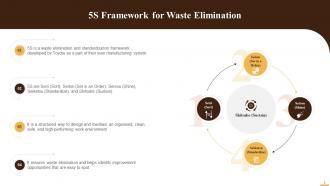
This slide contains information about the 5S methodology i.e., seiri (sort), seiton (set in order), seisou (shine), seiketsu (standardize), and shitsuke (sustain). 5S is a structured way to design and maintain an organized, clean, safe, and high-performing work environment.
Slide 3
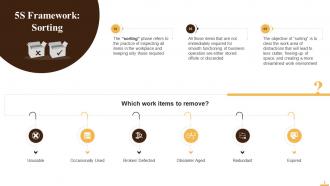
This slide contains details regarding the sorting phase of the 5S framework, which is inspecting all items in the workplace and keeping only those that are required.
Slide 4
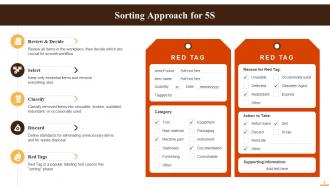
This slide includes information about the techniques to deploy to complete the “sorting” phase of 5S at the workplace. It also contains details about the Red Tag, a popular labeling tool used in the “sorting” stage.
Slide 5
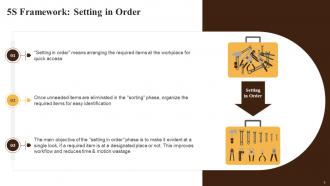
This slide contains details regarding the setting in order phase of the 5S framework. The objective of the "setting in order" phase is to make it eviden, if a required item is at a designated place or not, as it will improve workflow and reduces time & motion wastage.
Slide 6
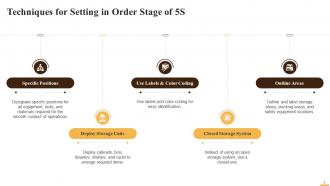
This slide lists multiple approaches that can be deployed to set items in order at the workplace as per the 5S methodology. The major techniques are specific positions, install storage units, use labels & color-coding, deploy closed storage system, and outline areas.
Slide 7
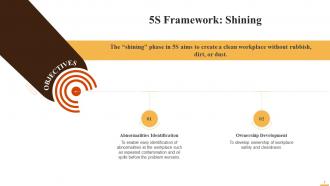
This slide provides information about the shining phase in the 5S methodology. It includes details on objectives of the shining stage i.e. abnormalities identification and ownership development.
Slide 8
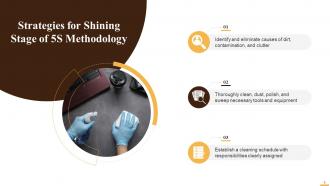
This slide highlights approaches for the shining step of the 5S methodology. The primary technique is identifying and eliminating causes of dirt, contamination, and clutter at the workplace.
Slide 9
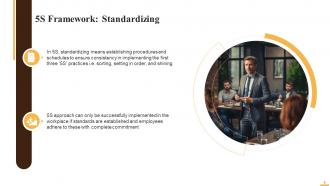
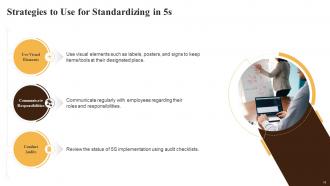
This slide provides information about the standardizing phase in the 5S framework. In 5S, standardizing means establishing procedures and schedules to ensure consistency in implementing the first three ‘5S’ practices i.e. sorting, setting in order, and shining.
Slide 10
This slide provides information about approaches such as using visual elements, communicating responsibilities, and conducting audits to standardize 5S Principles at the workplace.
Slide 11
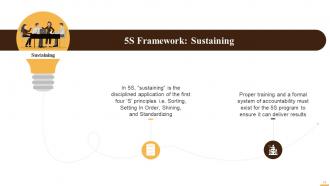
This slide covers the concept of sustaining in 5S methodology, i.e., the disciplined application of the first four ‘S’ principles: sorting, setting in order, shining and standardizing.
Slide 12
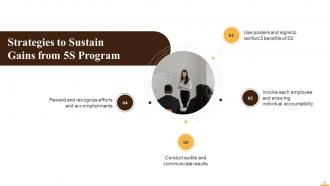
This slide list techniques to sustain gains from the 5S program at the workplace, such as using posters and signs to highlight the benefits of 5S, involving each employee and making them accountable, etc.
Slide 13
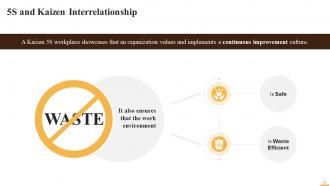
This slide provides information about the relationship between 5S and Kaizen. It highlights that a Kaizen 5S workplace showcases that an organization values and implements a continuous improvement culture.
Slide 14
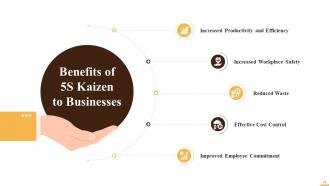
This slide highlights the advantages that 5S Kaizen offers to organizations, such as increased productivity and efficiency, increased workplace safety, reduced waste, effective cost control, and improved employee commitment.
Instructor’s Notes:
- Increased Productivity and Efficiency: 5S framework components make the workplace more organized, resulting in improved productivity and efficiency
- Increased Workplace Safety: Proper storage systems and clutter-free workspace reduces accidents, creating a safe environment
- Reduced Waste: 5S Kaizen ensures waste reduction with the removal of unwanted items/equipment/tools from the workplace
- Effective Cost Control: Embracing the 5S system can significantly reduce direct and indirect costs such as machine replacement, employees' insurance claims, etc.
- Improved Employee Commitment: Since 5S Kaizen implementation requires employees' active participation, it leads to increased engagement and creates a work culture in which employees take pride in their work and contributions
Slide 15
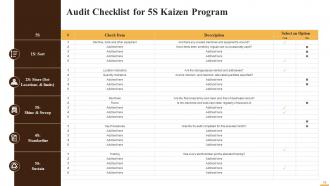
This slide showcases an audit checklist that businesses can use to investigate the effectiveness of the 5S Kaizen Program. It contains details of the checked item and a description of each 5Ss, i.e., sort, set in order, shine, standardize, and sustain.
Kaizen 5S Framework Training Ppt with all 34 slides:
Use our Kaizen 5S Framework Training Ppt to effectively help you save your valuable time. They are readymade to fit into any presentation structure.
-

Kaizen 5S Framework
-
5S Framework for Waste Elimination
-
5S Framework Sorting
-
Sorting Approach for 5S
-
5S Framework Setting in Order
-
Techniques for Setting in Order Stage of 5S
-
5S Framework Shining
-
Strategies for Shining Stage of 5S Methodology
-
5S Framework Standardizing
-
Strategies to Use for Standardizing in 5S
-
5S Framework Sustaining
-
Strategies to Sustain Gains from 5S Program
-
5S and Kaizen Interrelationship
-
Benefits of 5S Kaizen to Businesses
-
Audit Checklist for 5S Kaizen Program
-

Thank You
-
Comprehensive Training Curriculum on Kaizen Icons Slide
-
Additional Slides
-
About Us
-

Vision Mission Goal
-
Our Team
-
Idea Generation
-
Kaizen 5s Framework Training
-
Timeline
-
Roadmap
-
Training Completion Certificate
-

-

-

-

-

-

-

-

FAQs for Kaizen 5S
So 5S breaks down into five steps: Sort (ditch unnecessary stuff), Set in Order (organize what's left), Shine (keep it clean), Standardize (make processes consistent), and Sustain (actually stick with it long-term). You can't really jump around - each step builds on the last one or everything just falls apart. The goal is making problems super obvious at a glance. Honestly, start tiny. Pick your desk or just one corner of your workspace and nail that first. Once it's running smoothly, then spread out. I've seen too many people try to tackle entire departments right away and it's a disaster every time. Way better to prove it works small scale first.
Honestly, 5S is one of those things that actually works when people stick with it. You sort out the junk, organize everything properly, and suddenly your team isn't wasting half their day hunting for stuff. I watched one group literally cut their setup time in half - pretty crazy results for something so simple. Standardizing processes means less confusion and fewer screwups too. The tricky part is keeping it going long-term, but that's where the discipline comes in. Start small though - pick one area and just focus on sorting and organizing first. Once people see how much smoother things run, they'll be way more motivated to keep going.
Dude, organization is literally the backbone of 5S - it's the "Seiton" step. You're setting up designated spots for all your tools and materials so people don't waste time hunting around. Honestly, this part makes the biggest difference in my experience. Label everything and use visual controls so your team can actually maintain it. When done right, you'll cut down on errors from grabbing wrong items and instantly spot when something's missing. Sure, it looks cleaner too, but the real win is eliminating all that time wasted searching for stuff.
So basically make a simple checklist for each of the 5S things - Sort, Set in Order, Shine, Standardize, and Sustain. Rate each area 1-5 on stuff like clutter and cleanliness. Take photos too because honestly, pictures don't let people make excuses later! Do it monthly when you're starting out. The scoring has to be consistent though - that's where most people mess up. Share results with your team right away and make action plans for anything that scored crappy. Walking through systematically is key.
Honestly, the biggest pain points are people hating change and management not caring. Everyone loves their chaotic desk setup - I totally get it! Once that initial cleanup high fades, keeping momentum is brutal. Plus finding time for regular check-ins when you're already drowning? Good luck with that. Different teams doing their own thing just makes everything confusing. Start with just one small area though. Get at least one manager on your side. Build those check-ins into your calendar right away or they'll never happen. Don't go crazy trying to fix everything at once - you'll burn out fast.
Oh totally! Just think of 5S as digital decluttering instead. First, go through your computer files and dump anything useless - seriously, we all have random screenshots from 2019. Create consistent folder structures and maybe clean up that disaster of a desktop. Update your software regularly and clear out downloads (mine's always a nightmare). Get your team using the same naming conventions and templates so nobody's confused. Schedule like 15 minutes weekly to tidy up digitally, plus quick daily resets. Honestly just start with organizing your desktop and one project folder - don't overwhelm yourself trying to do everything at once.
5S is basically about cleaning up your actual workspace - you know, making sure tools have homes and you're not digging through piles of junk. Other lean stuff like kanban focuses more on workflow and timing. Honestly, 5S is way more satisfying because you get that instant "wow, I can actually see my desk" moment. The other methods are more abstract - they're about customer value and process improvements you can't always see right away. Most people start with 5S though. Hard to streamline processes when your workspace looks like a tornado hit it. Get organized first, then tackle the fancy lean techniques.
Honestly, tech makes 5S way easier to track and stick with. Digital checklists work great for each step, plus you can snap before/after pics to show progress. I've seen teams use QR codes on machines that pull up cleaning schedules - saves so much time hunting for manuals. Apps with automated reminders help too, otherwise people just forget the maintenance stuff. Dashboards let you see which areas are slipping without walking around constantly. Just don't go overboard with complicated software that nobody wants to learn. Simple tools that people will actually use beat fancy ones gathering digital dust.
Honestly? Start simple with just tracking how long people spend hunting for tools - that number should plummet once you get Sort and Set in Order down. Safety stuff matters too, like incidents and near-misses dropping off. I do weekly visual audits where you score each area on the 5S basics. Don't skip employee surveys though - if your team thinks the whole thing's stupid, it'll fall apart fast. Management loves the hard numbers, so cycle time improvements and waste reduction are gold. Oh, and seriously don't track everything at once or you'll go crazy with data overload.
Look, 5S only works if your people actually care about it. I've watched so many companies roll this out like it's just another cleanup day - total waste of time. Your team needs to understand why they're doing it, not just get told to organize stuff. When they see how it makes their job easier and safer, they'll actually stick with it. The trick? Get them involved in creating the standards instead of forcing rules on them. Trust me, nobody wants to follow someone else's system. Let them figure out what works best for their area, and you'll have way better luck with the whole thing.
Yeah, it works great with other systems! Most companies I've seen actually use 5S as their jumping-off point before tackling bigger stuff like Six Sigma. Makes sense too - when your workspace is organized, collecting data and spotting problems becomes way easier. You can totally weave it into ISO processes. The visual management stuff pairs nicely with lean manufacturing and even agile (though that one's a bit of a stretch honestly). I'd start by just looking at where your current systems already overlap with 5S principles. You'll probably spot more connections than you think.
Toyota's the classic example - they basically created 5S and still use it everywhere. Boeing tried it too and saw huge drops in defects and time wasted hunting for tools. Hospitals have gotten into it as well; Virginia Mason cut millions from inventory costs while speeding up patient care. Honestly, I think the best part is you don't need a factory to benefit from it. Even organizing your desk using 5S principles makes a real difference. You'll notice less stress and way better productivity almost immediately.
Skip the boring classroom stuff and get them working in their actual space. Have them sort through real clutter and organize tools they use every day - way more effective than another PowerPoint session nobody remembers. Pick a few 5S champions from each area to keep momentum going. Do follow-ups every couple weeks (honestly, people need the reinforcement). The before/after photo thing works great too - everyone loves showing off what they accomplished. Small groups work better than big meetings. Just make sure it connects to what they're actually doing daily.
Okay so here's the thing about 5S - it basically forces you to notice problems because everything has its place. When stuff gets messy or processes go off track, you can't miss it anymore. The five steps (Sort, Set in Order, Shine, Standardize, Sustain) make your team constantly ask "what's not working here?" Plus everyone becomes a detective for issues, not just the boss. Honestly, the visual part is what really sells me on it. You'll catch things that usually get buried under all the daily chaos. Just try it in one corner first - I swear the improvement bug spreads fast.
Look, 5S only works if you actually stick with it long-term. Think of it like going to the gym - you can't just do it once and expect results. When your team keeps up with workplace organization consistently, it becomes automatic. People stop wasting time hunting for tools, safety improves, and quality gets better. The sweet spot is when nobody has to think about it anymore (honestly, took our team like 6 months to get there). But here's the thing - skip it for a few weeks and you're back to square one. Total chaos. My advice? Set up monthly 5S check-ins. Make it routine, not some big dramatic overhaul every quarter.
-
The presentations are very helpful. I am always able to get appropriate templates for the different topics related to my profession.
-
Superb! The innovative and inspiring template designs provide an edge to the presentation.