


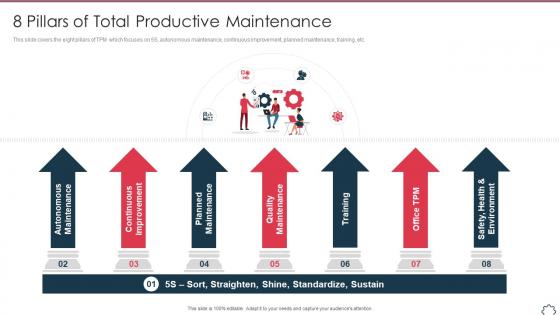
Total productivity maintenance 8 pillars of total productive maintenance




Try Before you Buy Download Free Sample Product
 Impress Your
 Audience
 100%
100% Editable
 Save Hours
 of Time


This slide covers the eight pillars of TPM which focuses on 5S, autonomous maintenance, continuous improvement, planned maintenance, training, etc.
People who downloaded this PowerPoint presentation also viewed the following :
Total productivity maintenance 8 pillars of total productive maintenance with all 6 slides:
Use our Total Productivity Maintenance 8 Pillars Of Total Productive Maintenance to effectively help you save your valuable time. They are readymade to fit into any presentation structure.





FAQs for Total productivity maintenance 8 pillars of
So TPM has eight main principles that get your whole team involved in maintenance instead of just leaving it to the maintenance guys. Operators start taking care of their own equipment daily. You're also doing planned maintenance, focusing on quality, and managing equipment from day one. Honestly, the best part is catching problems before they turn into expensive disasters. There's training for everyone, better admin processes, safety stuff, and just constantly improving things. When operators actually care about their machines and spot issues early, you'll see way less downtime and better quality. I'd start small - pick one machine first.
Start with getting your operators doing the basic stuff - daily checks, cleaning, small adjustments. I know it sounds obvious but seriously, this catches most problems early. Right now they probably just call maintenance when things break, right? Train them to actually own their equipment instead. Pick one line as a test run to prove it works. Your maintenance crew can focus on the bigger preventive work while production handles the day-to-day care. Honestly the hardest part is just getting everyone to buy into it, but once they see fewer breakdowns they're usually sold.
Dude, training is make-or-break for TPM. Can't just dump new procedures on people and hope it works out. Your operators need the basics - maintenance tasks, spotting problems, understanding why they actually matter in preventing disasters. Leadership loves to skip this part (drives me crazy honestly) then wonders why everything falls apart. Oh and it's not one-and-done either. TPM's about building that continuous improvement mindset, so you'll need ongoing stuff. Start small with pilot groups first - way easier to manage and people get excited seeing early wins. Trust me on this one.
TPM can seriously bump your OEE by 15-25%, maybe more if you're starting from a rough baseline. Your operators handle the daily checks and small fixes themselves, so you catch issues before they turn into full breakdowns. Way less surprise downtime that way. Equipment runs smoother when it's actually maintained - faster cycle times, fewer defects, the whole deal. I'd start tracking your current OEE first though, otherwise you won't know if it's working. Then get autonomous maintenance going. Honestly feels like cheating once you see those numbers start climbing.
Honestly, the biggest pain points are gonna be people resisting change and leadership not really backing you up. Operators hate being told they now own maintenance stuff - can't blame them, it's totally different from before. Training usually sucks too, and companies try to do everything at once which is dumb. Get leadership on board first and explain why you're doing this. Don't skip training, seriously. Start small with just one line or area instead of going crazy company-wide. Oh, and celebrate any little wins early on - builds momentum and keeps people motivated.
So IoT sensors and predictive analytics are game-changers - they'll catch problems before stuff breaks down on you. CMMS software handles all your scheduling automatically and tracks everything. Real-time dashboards show equipment health (honestly feels like cheating sometimes). Your techs can pull up work orders and equipment history right on their phones too. Oh, and automated reporting cuts way down on paperwork nobody wants to do anyway. Don't go crazy though. Start with something simple like vibration monitoring or digital work orders first, then expand from there once you get the hang of it.
Focus on OEE and how much downtime you're actually cutting. Track maintenance costs as a percentage of your operating budget - that's where you'll see real money. Safety incidents are huge too, honestly more important than anything else. Defect rates should drop when equipment runs better. Employee engagement scores matter more than people think - TPM fails without buy-in. Oh, and track how many suggestions get implemented. Get your baseline first, then check monthly. The magic happens around month 6-12 when everything starts clicking together consistently.
So cross-functional teams are honestly what makes TPM actually work. Instead of departments blaming each other when stuff breaks, you get operators, maintenance people, engineers, and quality control all talking to each other. Your machine operator starts noticing weird sounds early, and maintenance can show them simple upkeep stuff. It's pretty cool when everyone gets on the same page about equipment health. Problems get fixed way faster this way, plus you'll prevent tons of breakdowns. Oh, and start small - pick one machine that's giving you headaches and get everyone in the same room. Trust me on this one.
TPM works across different industries, but you've gotta tweak it based on what matters most. Manufacturing focuses on machine uptime and cutting defects. Hospitals use it for medical equipment and HVAC - imagine an MRI crapping out during someone's scan, yikes. Service companies might apply it to IT systems or facility maintenance instead. The basic ideas don't change (autonomous maintenance, planned upkeep, continuous improvement), but honestly, you just adapt the details to whatever equipment keeps your business running. Start by figuring out which assets would hurt most if they failed, then build around those.
Honestly, you're looking at about 15-25% less maintenance costs in year one, maybe 10-15% better equipment performance overall. The real money comes from avoiding those surprise breakdowns - your operators start spotting problems early instead of dealing with catastrophic failures. Emergency parts ordering becomes way less frequent (thank god, because that stuff adds up fast). Most places see 20-30% fewer safety issues too since everything's actually working properly. ROI hits around 3:1 by the second year. Oh, and definitely start tracking your current downtime costs now so you can actually prove the improvements later.
So TPM gets your operators actually owning the equipment instead of just babysitting it. They start doing daily inspections, catching weird noises or whatever before things blow up. Pretty cool how it shifts the whole mindset - suddenly everyone's thinking like "how can we make this better?" rather than just waiting for stuff to break. Your team becomes way more engaged because they're not just button-pushers anymore, they're problem-solvers. I'd start small though - have them do basic daily checks and actually listen when they say something feels off. Once people get the hang of it, you'll see improvements everywhere.
So basically, traditional maintenance is just "fix it when it breaks" - maybe some scheduled stuff too. TPM is totally different though. Your operators actually take care of their own equipment daily instead of waiting for the maintenance crew. It's like... you know how some people never check their car's oil until something goes wrong? TPM is more like doing those little checks yourself regularly. Operators get trained on basic equipment inspections, and honestly it works way better because problems get caught early. Everyone shares the responsibility instead of dumping it all on maintenance. You should start with operator training.
Honestly, data analytics is a game-changer for TPM. Predictive stuff helps you catch equipment failures before they happen - way better than scrambling during breakdowns. Track your OEE trends and you'll spot where things are dragging. Plus analyzing maintenance schedules shows you the sweet spot for timing repairs. I'd start by pulling data from sensors, maintenance logs, production records - whatever you've got. Dashboards make it super easy to see patterns emerge. My advice? Pick one critical piece of equipment first. Prove it works there, then roll it out everywhere else.
Look, TPM dies without real leadership buy-in - I've watched it happen too many times. Your supervisors can't just preach from their desks while expecting operators to suddenly care about equipment. They need to get their hands dirty doing maintenance alongside the team. Management treating this like some corporate initiative they can check off? Yeah, that's a recipe for failure. Get leaders who'll actually invest in training people and celebrate the small stuff when it goes right. Also sounds obvious but accountability matters - you can't let standards slide. Start with supervisors on the floor first.
Dude, you gotta speak their language first. Executives? Show them ROI and less downtime costs. But operators just want to know if it'll make their job easier and safer - totally different concerns. Quick wins are everything here, especially stuff people can actually see working right away. Honestly, real numbers from other plants work way better than fancy presentations. Skip the TPM buzzwords that confuse everyone. Get some visual dashboards going with clear before/after stuff. Your early adopters will become your best salespeople if you let them. Here's the thing though - tie it all back to job security. When equipment runs smoother, the whole company stays stable and everyone keeps their jobs.
-
It saves your time and decrease your efforts in half.
-
Best way of representation of the topic.