


Total productivity maintenance powerpoint presentation slides




Try Before you Buy Download Free Sample Product
 Impress Your
 Audience
 100%
100% Editable
 Save Hours
 of Time


Total productive maintenance maintains and improves the productivity, safety, and quality systems through machines, processes, and employees, which will add business value to the organization. Here is a competently designed template on Total Productivity Maintenance TPM that has the main objective of improving the overall equipment effectiveness and developing a schedule of preventive maintenance of each equipment. The current state analysis covers the weekly defects in manufacturing firms, relative costs to fix manufacturing defects, defect classification, Pareto chart of the flaws, and analyzing accident records of the company. We have discussed the challenges faced by the quality department, the need for TPM, solutions offered by TPM, and its objective in this module. The maintenance workflow and 8 pillars of TPM are focused on safety, health, and the environment. The OEE model has been shared in this template and significant goals of total productive maintenance and overall equipment effectiveness programs. Implementation of TPM is also discussed here based on the steps involved in the implementation and rollout plan. The impact of introducing TPM in the organization is evaluated by focusing on targets achieved, the companys productivity, etc. Different dashboards are also covered in this presentation. Get access to it now.
People who downloaded this PowerPoint presentation also viewed the following :
Content of this Powerpoint Presentation
Slide 1: This slide introduces Total Productivity Maintenance. State Your Company Name and begin.
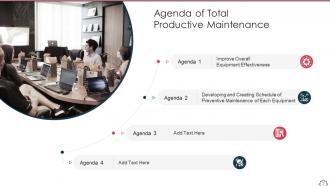
Slide 2: This slide shows Agenda of Total Productive Maintenance.
Slide 3: This slide presents Table of Contents for Total Productivity Maintenance.
Slide 4: This slide shows Table of Contents for Total Productivity Maintenance.
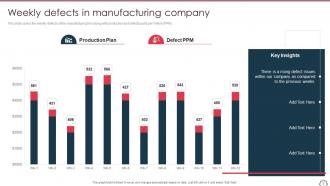
Slide 5: This slide displays weekly defects of the manufacturing firm along with production and defects parts per million (PPM).
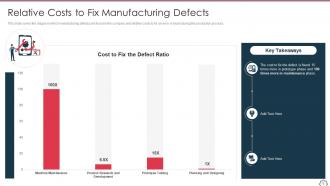
Slide 6: This slide represents stages in which manufacturing defects are found in the company.
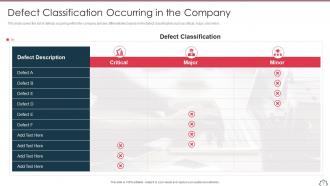
Slide 7: This slide shows list of defects occurring within the company and are differentiated based on the defect classification.
Slide 8: This slide presents different defects happening within the company along with its frequency of occurrence and cumulative percentage of defects.
Slide 9: This slide shows Analyzing Accidents Records within the Organization.
Slide 10: This slide displays Table of Contents for Total Productivity Maintenance.
Slide 11: This slide represents Challenges Faced by Quality Department of the Company.
Slide 12: This slide covers the need of TPM in the company such as downtime, speed loss, defects, etc.
Slide 13: This slide presents the challenges of total productive maintenance along with its solutions to overcome the challenges.
Slide 14: This slide covers the objective of TPM which focuses on quality, productivity, cost, delivery, moral, safety, etc.
Slide 15: This slide displays Table of Contents for Total Productivity Maintenance.
Slide 16: This slide represents the current business model followed by the company which is linear model that focuses on take, make and waste steps.
Slide 17: This slide shows Table of Contents for Total Productivity Maintenance.
Slide 18: This slide presents eight pillars of TPM which focuses on 5S, autonomous maintenance, continuous improvement, etc.
Slide 19: This slide shows 1st pillar of TPM which is 5s foundation that focuses on sort, set locations, shine, standardizing, and sustain.
Slide 20: This slide displays Checklist Needed to Consider 5S in the Company.
Slide 21: This slide represents pillar 2 named as autonomous maintenance along with its steps required for developed operators.
Slide 22: This slide shows checklist which must be maintained by the company to follow the steps involved in 2nd pillar of TPM
Slide 23: This slide presents checklist which must be maintained by the company to follow the steps involved in 2nd pillar of TPM
Slide 24: This slide classifies 16 types of loses based on various categories such as equipment efficiency, work efficiency, etc.
Slide 25: This slide displays 16 types of loses based on various categories such as equipment efficiency, work efficiency, etc.
Slide 26: This slide represents various steps required in 5th pillar of TPM i.e. quality maintenance and focus on the preventive actions for process failure.
Slide 27: This slide shows various steps required in 6th pillar of TPM i.e. training and education strategy.
Slide 28: This slide presents various steps required in 7th pillar of TPM which is activated once four other pillars of TPM are activated.
Slide 29: This slide shows various parameters which must be focused during office total productive maintenance for different quarters.
Slide 30: This slide displays 8th pillar of total productive maintenance which focus on SHE vision to cultivate a continuous improvement culture.
Slide 31: This slide represents Steps Implemented for SHE & AM Pillar Integration.
Slide 32: This slide covers the main areas of SHE excellence which focuses on breakdown, safety and quality for various equipment..
Slide 33: This slide presents Table of Contents for Total Productivity Maintenance.
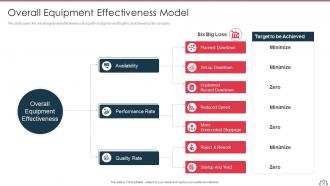
Slide 34: This slide covers the overall equipment effectiveness along with six big loss and target to be achieved by the company.
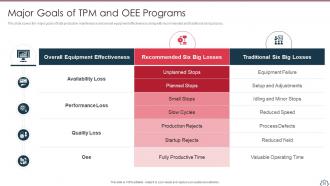
Slide 35: This slide displays the major goals of total productive maintenance and overall equipment effectiveness.
Slide 36: This slide represents Table of Contents for Total Productivity Maintenance.
Slide 37: This slide shows Steps Required to Implement TPM in the Organization.
Slide 38: This slide presents steps required to implement total productive maintenance within the organization.
Slide 39: This slide shows current business model followed by the company which is linear model that focuses on take, make and waste steps.
Slide 40: This slide displays Table of Contents for Total Productivity Maintenance.
Slide 41: This slide represents impact of TPM within the company such as better customer satisfaction, zero customer complaint, high OEE, etc.
Slide 42: This slide shows Targets Achieved After Introducing Total Productive Maintenance.
Slide 43: This slide presents Impact of Total Productive Maintenance Company’s Productivity.
Slide 44: This slide shows Impact of TPM on Customer Complaints and Equipment Failures.
Slide 45: This slide displays Impact of TPM on Delivery Compliance and Operating Profits.
Slide 46: This slide represents Table of Contents for Total Productivity Maintenance.
Slide 47: This slide shows dashboard of production management which focuses on produce time, labor cost, multi measures, etc.
Slide 48: This slide presents the dashboard of production quality which focuses on stats, volume, downtime causes, etc.
Slide 49: This slide shows dashboard of production process analytics that focuses on process cycle, defect types, completion count, etc.
Slide 50: This slide displays Icons for Total Productivity Maintenance.
Slide 51: This slide is titled as Additional Slides for moving forward.
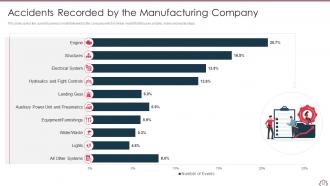
Slide 52: This slide shows Accidents Recorded by the Manufacturing Company.
Slide 53: This slide presents Venn diagram with text boxes.
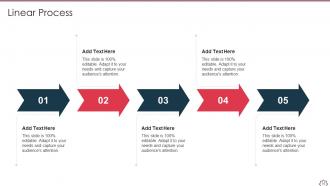
Slide 54: This slide shows Linear Process with related imagery.
Slide 55: This slide displays Roadmap with additional textboxes.
Slide 56: This slide represents Post It Notes. Post your important notes here.
Slide 57: This slide shows Puzzle with related icons and text.
Slide 58: This slide presents 30 60 90 Days Plan with text boxes.
Slide 59: This is a Comparison slide to state comparison between commodities, entities etc.
Slide 60: This is a Thank You slide with address, contact numbers and email address.
Total productivity maintenance powerpoint presentation slides with all 60 slides:
Use our Total Productivity Maintenance Powerpoint Presentation Slides to effectively help you save your valuable time. They are readymade to fit into any presentation structure.
-
Total Productivity Maintenance
-
Agenda of Total Productive Maintenance
-
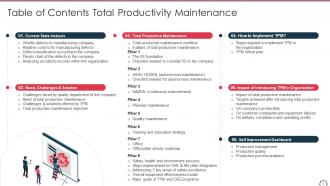
Table of Contents Total Productivity Maintenance
-
Table of Contents for Total Productivity Maintenance
-
Weekly defects in manufacturing company
-
Relative Costs to Fix Manufacturing Defects
-
Defect Classification Occurring in the Company
-
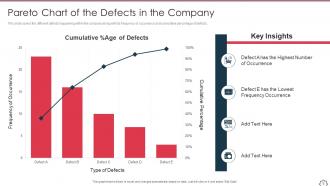
Pareto Chart of the Defects in the Company
-
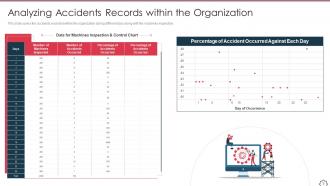
Analyzing Accidents Records within the Organization
-
Table of Contents for Total Productivity Maintenance
-
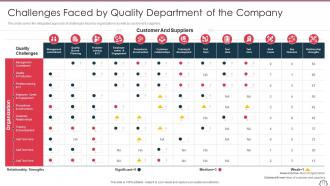
Challenges Faced by Quality Department of the Company
-
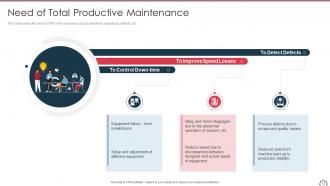
Need of Total Productive Maintenance
-
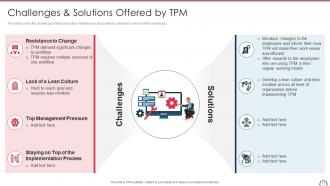
Challenges Solutions Offered by TPM
-
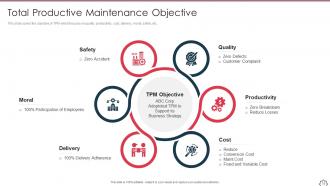
Total Productive Maintenance Objective
-
Table of Contents for Total Productivity Maintenance
-
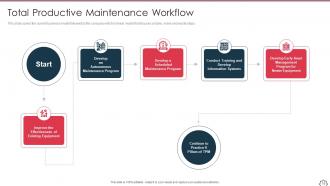
Total Productive Maintenance Workflow
-
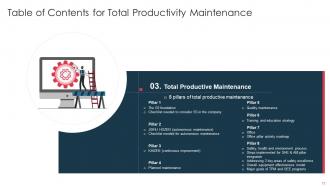
Table of Contents for Total Productivity Maintenance
-
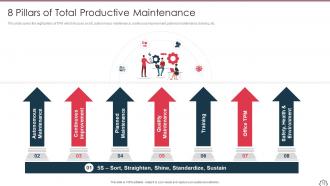
8 Pillars of Total Productive Maintenance
-
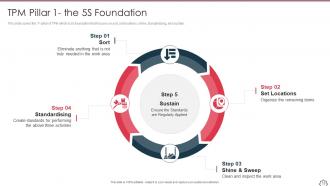
TPM Pillar 1 the 5S Foundation
-
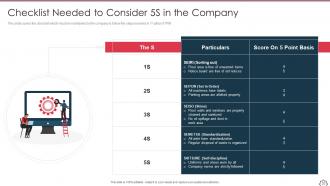
Checklist Needed to Consider 5S in the Company
-
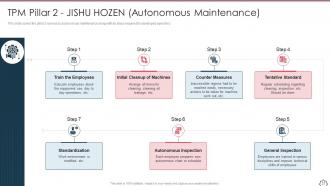
TPM Pillar 2 JISHU HOZEN Autonomous Maintenance
-
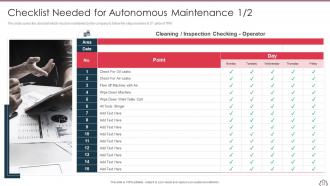
Checklist Needed for Autonomous Maintenance 1 2
-

Checklist Needed for Autonomous Maintenance 2 2
-
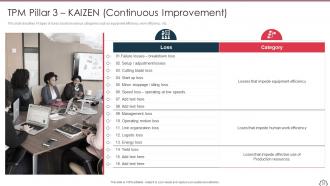
TPM Pillar 3 KAIZEN Continuous Improvement
-
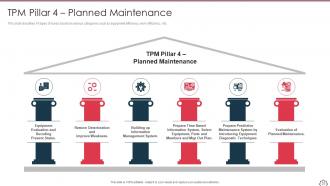
TPM Pillar 4 Planned Maintenance
-
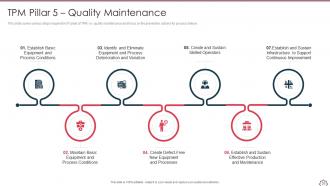
TPM Pillar 5 Quality Maintenance
-
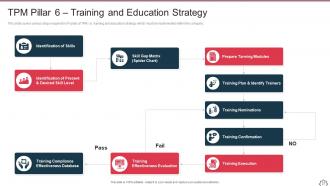
TPM Pillar 6 Training and Education Strategy
-
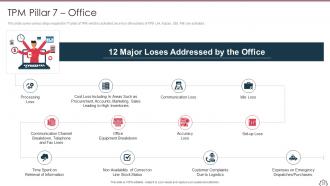
TPM Pillar 7 Office
-
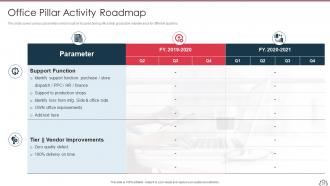
Office Pillar Activity Roadmap
-
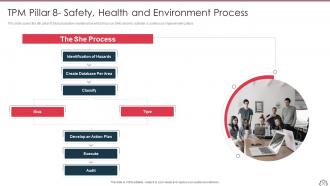
TPM Pillar 8 Safety Health and Environment Process
-
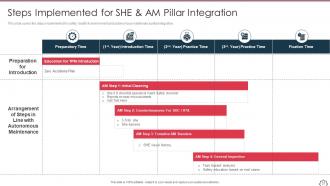
Steps Implemented for SHE AM Pillar Integration
-
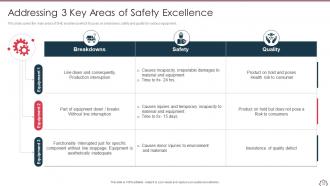
Addressing 3 Key Areas of Safety Excellence
-
Table of Contents for Total Productivity Maintenance
-
Overall Equipment Effectiveness Model
-
Major Goals of TPM and OEE Programs
-
Table of Contents for Total Productivity Maintenance
-
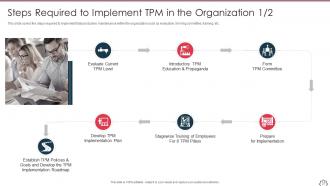
Steps Required to Implement TPM in the Organization 1 2
-
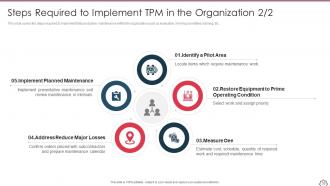
Steps Required to Implement TPM in the Organization 2 2
-
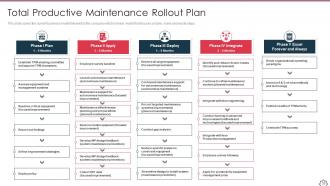
Total Productive Maintenance Rollout Plan
-
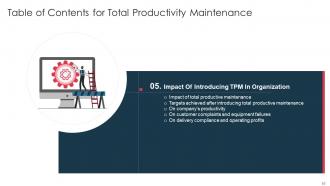
Table of Contents for Total Productivity Maintenance
-
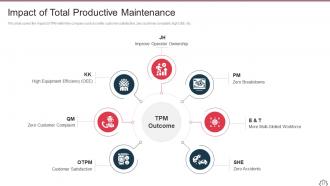
Impact of Total Productive Maintenance
-
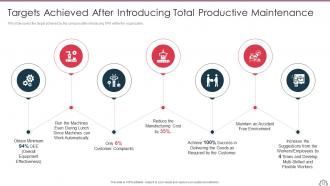
Targets Achieved After Introducing Total Productive Maintenance
-
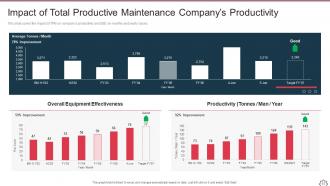
Impact of Total Productive Maintenance Company s Productivity
-
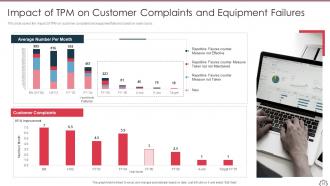
Impact of TPM on Customer Complaints and Equipment Failures
-
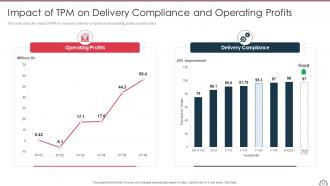
Impact of TPM on Delivery Compliance and Operating Profits
-
Table of Contents for Total Productivity Maintenance
-

Production Management Dashboard
-
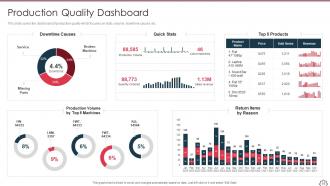
Production Quality Dashboard
-
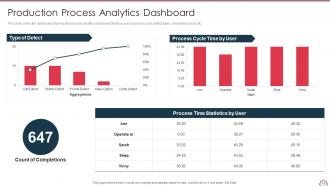
Production Process Analytics Dashboard
-
Icons Slide for Total Productivity Maintenance
-

Additional Slides
-
Accidents Recorded by the Manufacturing Company
-
Venn Diagram
-
Linear Process
-
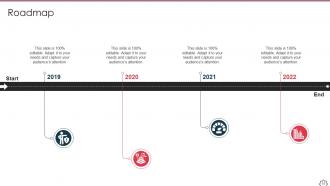
Roadmap
-
Post it Notes
-
Puzzle
-
Total Productivity Maintenance
-
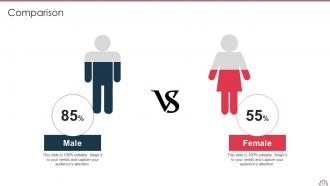
Comparison
-

Thanks for Watching
FAQs for Total productivity maintenance
So TPM has eight main principles - autonomous maintenance lets operators do their own basic upkeep, then there's planned maintenance for scheduled stuff and quality maintenance to stop defects before they happen. Focused improvement is where kaizen events really shine. You've also got early equipment management, training, safety/health/environment, and administrative TPM for the office people too. Look, it seems overwhelming at first but honestly they all connect. The whole point is getting everyone involved, not just your maintenance crew. My advice? Pick one principle and nail it down before jumping into the rest.
So TPM hits all three OEE pieces - availability, performance, and quality. Your operators catch problems early with daily checks, which means way fewer surprise breakdowns killing your availability. Preventive maintenance keeps machines running at proper speeds instead of crawling along. Well-maintained equipment makes fewer defective parts too, so quality stays solid. Honestly, it's just like maintaining your car - skip it and everything falls apart faster. Track your current OEE first, then start basic TPM stuff. You'll see those numbers go up pretty quick.
Your front-line people are everything for TPM - they're the ones catching problems before they blow up. Getting operators to actually own their equipment instead of just running it? That's the hard part. It's basically turning them into part-time maintenance folks, which sounds weird but totally works. Training matters obviously, but honestly the biggest thing is showing them why it matters. I'd start with whoever's already engaged and let them get the others excited about it. Once people start doing their own inspections and small fixes, you'll see the difference pretty quick.
Hey! So TPM is honestly amazing for cutting down accidents. Your operators start doing these daily equipment checks - like 5-minute walkarounds - and they catch stuff before it becomes dangerous. Broken machines are accident magnets, especially when people panic and try quick fixes. With regular maintenance, those surprise breakdowns basically disappear. Your team gets way more familiar with how everything should run normally. They'll spot weird noises or loose parts during cleaning routines. It creates this whole culture where everyone's actually looking out for safety issues instead of just hoping nothing goes wrong.
Honestly, the biggest pain is getting operators on board - they think maintenance isn't their problem. Training's another nightmare because people just follow checklists without actually understanding the equipment. Management hates spending money upfront on training and upgrades, which makes everything harder. The initial excitement always dies off too, and then you're stuck trying to keep momentum going. My advice? Start with a small pilot area where people actually want to participate. Celebrate those early wins hard - you need credibility to spread it everywhere else. Trust me on this one.
So TPM basically flips everything around - instead of having your maintenance guys handle everything, you get the actual operators involved. They do daily inspections, basic cleaning, minor repairs on their own machines. Makes sense when you think about it, right? These people run the equipment every single day. Rather than just preventing breakdowns, you're going for overall equipment effectiveness. Way different from those rigid preventive schedules or just fixing stuff when it breaks. Oh, and you'll need to train your operators first - can't expect them to know this stuff automatically.
OEE is your go-to metric here - it rolls availability, performance, and quality into one solid number. MTBF and MTTR matter too since TPM's whole thing is preventing breakdowns and speeding up repairs. Track equipment uptime, maintenance costs per unit, and safety incidents as well. Honestly, I've seen too many companies try to measure absolutely everything and just confuse themselves. My old manager used to say "measure what moves the needle" and he wasn't wrong. Start with these basics, then layer on more metrics once you've got the program running smoothly.
Yeah, TPM and Lean/Six Sigma work great together - honestly I think more companies should try this combo. TPM keeps your equipment running smoothly, which cuts down on waste (classic Lean win). Six Sigma gives you the numbers to actually prove your TPM stuff is working. I've watched teams use DMAIC to roll out TPM programs and it's pretty smooth. Start by mapping out your maintenance mess with Lean tools, then let Six Sigma's stats show you where equipment's bleeding money. Don't pit them against each other - they're way better as teammates.
Start with operator training on the basics - cleaning, lubing, simple checks. That's your foundation right there. Cross-train your maintenance crew on different equipment systems too. Honestly, the hardest part is getting everyone's mindset to shift. Management needs TPM training as well, plus visual aids and checklists work great. External certification programs help, though they can get pricey. Most places bring in a consultant at first to set things up properly - probably worth it. Oh, and definitely pilot it on just one line before going company-wide. Don't try to boil the ocean.
Honestly, IoT is a game changer for maintenance stuff. You get real-time data from sensors instead of just guessing when things might break. Predictive maintenance becomes actually possible - like, you'll know weeks ahead if a motor's going bad. The coolest part? Everything can be automated. Alerts pop up, trends get tracked, work orders create themselves when something's off. Though I'd definitely start with just one important machine first (learned that the hard way at my last job). Get some basic sensors on it, prove it works, then expand from there.
Toyota's probably your best example - they cut equipment breakdowns by 75% and boosted productivity 30%. Nissan got similar results with 50% fewer defects. Even P&G jumped on this and improved equipment efficiency over 20%, which honestly surprised me since they're not automotive. The secret sauce? These companies trained their operators to do basic maintenance instead of always calling the maintenance crew. Don't try to roll this out everywhere at once though. Pick one production line first and make sure your operators actually buy into it - that's where most attempts fall apart.
So here's what happens - when you roll out TPM, operators become the actual owners of their machines. They're doing daily checks, basic maintenance, reporting problems right away. Can't just walk past issues anymore hoping someone else deals with it. The mindset shift is wild honestly. People start taking real pride in their workspace because it's THEIR responsibility now, not just maintenance's problem. You'll see them keeping areas super clean and functional. Just don't go crazy at first - give them small tasks they can actually handle before piling on more stuff.
Look, you're gonna hit some serious upfront costs - training programs, new equipment, plus your team's productivity will tank initially while they figure everything out. Could be $50K or way more depending on how big your place is. The training hours alone will be brutal for your operators. But honestly? Most places break even within 12-18 months because downtime drops like crazy. Your maintenance budget actually shrinks long-term since you're catching problems early instead of dealing with massive breakdowns. Oh, and definitely start with just one area first to prove it works before going all-in.
Focus on your most critical stuff first - whatever would completely screw you if it broke down. Honestly, those old machines can be the worst when you need parts. Calculate your downtime costs and safety risks too. Make sure your team can actually handle the maintenance on complex equipment before jumping in. I'd create a basic scoring system with all those factors, then tackle maybe 3-5 pieces max for your pilot. Don't go crazy trying to do everything at once - that's where most people mess up. Start with your highest scores to show it actually works.
So there's actually a bunch of options here. CMMS software like Fiix or UpKeep are solid for work orders and scheduling stuff. You've also got specialized TPM platforms - Limble and MPulse are pretty decent. Some old-school teams still love their whiteboards though, which honestly isn't the worst idea for visual stuff. Excel works fine for tracking OEE and metrics, but if you want something fancier, Tableau or Power BI are good picks. My cousin's plant still uses clipboards for half their checklist stuff, believe it or not. Just pick whatever your people will actually stick with.
-
Easy to edit slides with easy to understand instructions.