


Optimizing Spare Parts Inventory Management PPT Slides





Try Before you Buy Download Free Sample Product
 Impress Your
 Audience
 100%
100% Editable
 Save Hours
 of Time


Spare Parts Management involves controlling and organizing spare parts storage, supply, and distribution. Our comprehensive presentation Optimizing Spare Parts Inventory Management presents strategies to efficiently manage service parts to reduce downtime and maintenance costs. This complete deck begins with the identification of spare parts management challenges, such as declining equipment reliability and performance. It also measures its negative impact on business operations, financial implications, and customer satisfaction. Additionally, this PPT conducts a gap analysis to identify the need to optimize spare parts management. This complete deck further presents considerations for spare parts management, including service level objectives, timeline, team roles and responsibilities, and checklist for streamlined management. Moreover, our deck implements strategies to optimize spare parts management. These include implementing preventive strategies, creating standard work order processes, controlling inventory, knowing equipment lead times, calculating risks for equipment, utilizing bill of materials, improving stockroom security, and investing in CMMS. Lastly, this PPT module presents budget, addresses inventory management challenges, and continuous optimization. Download this PPT today to manage your service parts inventory and optimize business results.
People who downloaded this PowerPoint presentation also viewed the following :
Content of this Powerpoint Presentation
Slide 1: This slide highlights the presentation title: Optimizing Spare parts inventory management.
Slide 2: This slide states Agenda of the presentation.
Slide 3: This slide shows Table of Content for the presentation.
Slide 4: This slide highlights title for topics that are to be covered next in the template.
Slide 5: This slide analyses the current spares parts management issues currently faced by the organization. It includes issues such as, declining equipment reliability & performance, inventory management issues & cost escalation, maintenance challenges & downtime, etc.
Slide 6: This slide highlights title for topics that are to be covered next in the template.
Slide 7: This slide analyses the impact of poor spare parts inventory management on business operations. It measures the increase in average downtime, and maintenance expenses, cost of emergency repairs per quarter, etc.
Slide 8: This slide examines the financial implications of poor spare parts inventory management. It measures impact on metrics such as revenue loss , emergency procurement cost, and excess inventory expenses.
Slide 9: This slide examines the impact of issues in spare parts management leading to delays in services thus hindering customer satisfaction. It measures poor customer satisfaction, delayed delivery times, service interruptions, and poor reputation.
Slide 10: This slide highlights title for topics that are to be covered next in the template.
Slide 11: This slide presents a gap analysis to identify the need for effective spare parts management. It covers aspects such as area of operation, score, current state, gaps and ideal future state.
Slide 12: This slide highlights title for topics that are to be covered next in the template.
Slide 13: This slide presents strategies for optimizing spare parts inventory management to reduce expenses, improve operational efficiency. It includes strategies such as implement preventive strategy, create standard work order process, control your inventory, etc.
Slide 14: This slide highlights title for topics that are to be covered next in the template.
Slide 15: This slide shows Establishing service level objectives for spare parts management.
Slide 16: This slide presents a timeline for implementing various strategies that help in improving spare parts management. It includes phases such as project preparation, strategies implementation, and monitoring impact.
Slide 17: This slide showcases the roles and responsibilities of spare parts management team. It includes responsibilities of position including spare parts manager, spare parts executive. Deputy manager, manager, etc.
Slide 18: This slide presents a checklist for streamlined spares part management. It includes strategies such as, inventory classification, accurate demand forecasting, supplier relationship management, life-cycle management, etc.
Slide 19: This slide highlights title for topics that are to be covered next in the template.
Slide 20: This slide presents a strategy to conduct thorough preventive equipment inspections using historical data. It covers steps such as gather data, set reorder points, implement ABC classification, and continuously monitor & adjust.
Slide 21: This slide helps in implementing preventative maintenance schedules for organizing activities holistically to ensure you locate potential hidden problems. It covers item number, activity, frequency, completed, and observation.
Slide 22: This slide showcases how to utilize condition monitoring sensors to detect early signs of equipment failure. It mentions sensors such as vibration sensor, thermal camera, and acoustic sensor.
Slide 23: This slide highlights title for topics that are to be covered next in the template.
Slide 24: This slide presents steps for developing a standardized work order templates for different types of maintenance tasks. It includes best practices to standardize the work order process, including steps such as set goal & metrics, define roles, schedule frequency, etc.
Slide 25: This slide presents a standardized work order templates for different types of maintenance tasks. It covers aspects such as job details, quantity, customer ID, department, etc.
Slide 26: This slide presents a training program to train maintenance staff on the proper procedure for creating and completing work orders. It covers training modules such as creating work order requests, approving work order, etc.
Slide 27: This slide presents a comparative analysis to select and implement a digital work order management system to streamline the process and track work order status. It compares on the basis of aspects such as, description, key features, price and rating.
Slide 28: This slide highlights title for topics that are to be covered next in the template.
Slide 29: This slide presents a matrix to conduct regular inventory audits to identify obsolete or excess inventory. It covers aspects such as, part number, description, on-hand quantity, last use date, equipment location, etc.
Slide 30: This slide implement an inventory management system that helps in controlling spares parts inventory. It covers information about software applications and features such as automatic data backups, expense tracking, inventory optimization, etc.
Slide 31: This slide establishes clear inventory storage and labeling protocols to minimize errors and improve spares parts management efficiency. It includes strategies such as, watch inventory set up central storage area, keep records of parts, etc.
Slide 32: This slide highlights title for topics that are to be covered next in the template.
Slide 33: This slide showcase steps to maintain a database of lead times for different suppliers and parts for efficient lead time planning. It includes steps such as, collect data, enter dara, update regularly, monitor, analyze, etc.
Slide 34: This slide helps in analyzing historical lead time data to predict future spare parts procurement needs. It includes steps such as define lead time components, analyze demand patterns, determine service level & inventory policy, etc.
Slide 35: This slide matrix showcasing buffer stock levels to account for variability in lead times and demand for spare parts. It covers aspects such as, part number, lead time, demand, standard deviation of demand, safety factor, etc.
Slide 36: This slide highlights title for topics that are to be covered next in the template.
Slide 37: This slide presents strategy to create an equipment criticality assessment matrix that helps in conducting risk assessments for each piece of equipment based on criticality and failure consequences. It includes steps such as, create an equipment list, define criticality ranking criteria, determine severity levels, etc.
Slide 38: This slide presents a presents a risk matrix to conduct risk assessments for each piece of equipment based on criticality and failure consequences. It highlights the intersections of severity and probability levels.
Slide 39: This slide presents a contingency plans for high-risk equipment to minimize downtime. It covers aspects such as, equipment's, consequences of failures, severity, likelihood of failure, example, and contingency strategy.
Slide 40: This slide highlights title for topics that are to be covered next in the template.
Slide 41: This slide presents steps to efficiently manage BOMs including steps to create, update, and maintain an organized and accurate list of components and materials required for manufacturing. It helps in regularly reviewing and updating BOMs to reflect changes in equipment configurations or specifications.
Slide 42: This slide showcases how to integrate BOM management with inventory control systems to ensure accurate parts procurement. It includes applications such as, materials planning, inventory tracking, and demand forecasting.
Slide 43: This slide presents an online course to train staff on how to interpret and use BOMs effectively for maintenance planning and execution. It covers aspects such as, modules, topics covered, skill level, and user progress.
Slide 44: This slide highlights title for topics that are to be covered next in the template.
Slide 45: This slide conduct regular security audits to identify and address vulnerabilities in stockroom security protocols and helps in adopt new regulations. It covers aspects such as, issue areas, vulnerabilities, risk factors, and new regulations.
Slide 46: This slide implement surveillance cameras and access control systems to monitor stockroom activity. It mentions systems such as , surveillance cameras, access cards, and remote access/smart locks.
Slide 47: This slide presents a training program to educate employees on critical spare parts management. It covers aspects such as lessons, topics covered, responsible person, training methods, timeline and deliverable.
Slide 48: This slide highlights title for topics that are to be covered next in the template.
Slide 49: This slide researches and evaluates different CMMS options to find one that meets your organization's specific needs. It compare son the basis of aspects such as features, ease of use, customization, price, etc.
Slide 50: This slide highlights title for topics that are to be covered next in the template.
Slide 51: This slide presents a training program to train maintenance staff on how to use the CMMS effectively for maintenance planning, scheduling, and spares parts inventory management. It covers information about training stage, method, content covered, etc.
Slide 52: This slide presents strategies to regularly update and maintain the CMMS to ensure optimal performance and reliability. It includes practices such as, regular updates, strategic upgrades, bug fixes, optimal performance, and future-proofing.
Slide 53: This slide presents a budget allocation chart showcasing overview of how funds will be distributed across various aspects of spare parts inventory management. It includes aspects such as task, area, actual budget, spent and variance.
Slide 54: This slide four major issues of streamlined spares part management and solutions to overcome the same. It addresses issues such as, low data accessibility & quality, low penetration of prediction tools, and information silos.
Slide 55: This slide presents a strategy for continuously improving spare parts management process and result. It includes steps such as habitual outcome improvement, sustem-level goal alignment, small changes, big impact, continuous improvement culture, etc.
Slide 56: This slide highlights title for topics that are to be covered next in the template.
Slide 57: This slide analyses the impact of effective spares parts management on various efficiency metrics. It tracks KPIs such as, increasing equipment reliability & performance, efficient inventory management & cost reduction, maintenance improvement & decreased downtime, etc.
Slide 58: This slide analyses the impact of efficient spare parts management on company’s revenue. It tracks the decrease in average revenue loss per month due to downtime and key inisghts.
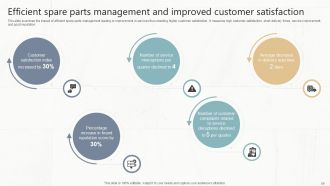
Slide 59: This slide examines the impact of efficient spare parts management leading to improvement in services thus enabling higher customer satisfaction. It measures high customer satisfaction, short delivery times, service improvement, and good reputation.
Slide 60: This slide tracks the overall equipment effectives to measure the ROI i.e. impact of investments in production improvements. It includes key reasons for increase is due to higher availability, performance and quality.
Slide 61: This slide highlights title for topics that are to be covered next in the template.
Slide 62: This slide presents a case-study analysis to understand the strategies adopted by a company to improve it’s spare parts management efficiency. It covers aspects such as, problem, root causes, solution, and results.
Slide 63: This slide contains all the icons used in this presentation.
Slide 64: This slide is titled as Additional Slides for moving forward.
Slide 65: This slide shows Post It Notes. Post your important notes here.
Slide 66: This is an Idea Generation slide to state a new idea or highlight information, specifications etc.
Slide 67: This is a Timeline slide. Show data related to time intervals here.
Slide 68: This is Our Target slide. State your targets here.
Slide 69: This is a Financial slide. Show your finance related stuff here.
Slide 70: This is a Thank You slide with address, contact numbers and email address.
Optimizing Spare Parts Inventory Management PPT Slides with all 78 slides:
Use our Optimizing Spare Parts Inventory Management PPT Slides to effectively help you save your valuable time. They are readymade to fit into any presentation structure.












-
The service is fast, and I could access any presentation after buying the subscription. I don’t think I’ll ever have to worry about a presentation in my life.
-
Delighted to see unique and eye-catching PowerPoint designs that are so easy to customize.