


0514 total productive maintenance powerpoint presentation




Try Before you Buy Download Free Sample Product
 Impress Your
 Audience
 100%
100% Editable
 Save Hours
 of Time


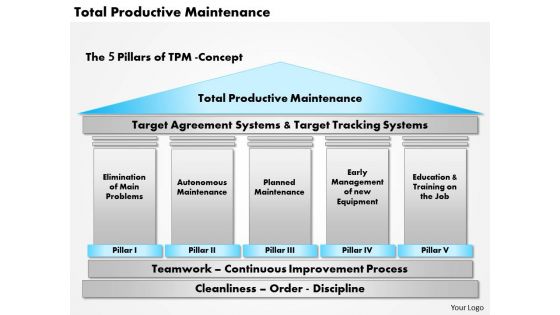
For appropriate management of communication tunnel from encoding, channeling and decoding, a good steady and effective PPT presentation is of excellent use. A unique and professional manner is required for communicating opinions, thoughts, viewpoints and conclusions and when you have a presentation slide show with special art graphic, half of the work is already done. Use this professional diagram template in your presentation and get better output for your business to display total productive maintenance of any business related task. Five pillars of what looks like a Greek traditional building show the five stages of the process and topics like the elimination of main problems, autonomous maintenance, planned maintenance, early maintenance of new equipment, education and training on the job are used here to achieve total productive maintenance. Vital presentations need outstanding design and the idea is to communicate your great ideas through our readymade 0514 total productive maintenance PowerPoint presentation. Create an everlasting experience and leave an obstinate consequence. Earn more marks with our 0514 Total Productive Maintenance Powerpoint Presentation. Tick all the right boxes with our 0514 Total Productive Maintenance Powerpoint Presentation.
People who downloaded this PowerPoint presentation also viewed the following :
0514 total productive maintenance powerpoint presentation with all 5 slides:
Putting on the perfect presentation can be hard. Flawless 0514 Total Productive Maintenance Powerpoint Presentation design can help take the pressure off.


FAQs for 0514 total productive
So TPM has eight pillars, but basically you want everyone doing maintenance - not just the maintenance guys. The whole point is catching problems before stuff breaks down. You'll focus on autonomous maintenance, planned maintenance, that kind of thing. Honestly? It's pretty overwhelming when you first dive in, but it actually works. Main thing is training your operators to handle basic maintenance tasks themselves, plus you're trying to eliminate the six big losses - breakdowns, setup delays, all that fun stuff. Oh and creating a culture where people actually give a shit about the equipment. Start with just one line though, don't try to do everything at once.
Honestly, TPM is like having your operators become part-time mechanics instead of just button-pushers. They're doing daily equipment checks and catching problems before stuff breaks down completely. Way different from the old approach where you either wait for things to explode or just follow some rigid schedule. Your operators spot weird noises or vibrations early, handle basic upkeep themselves. Fewer emergency calls at 3am, which your maintenance crew will definitely appreciate. Equipment lasts longer too. It's basically turning reactive firefighting into actual teamwork - though it does take some getting used to for everyone involved.
Honestly, operators are the backbone of TPM. Since they're with the machines all day, they catch weird noises or vibrations before anyone else would. Train them on basic stuff - cleaning, lubrication, simple adjustments. It's pretty smart when you think about it. Instead of just running equipment, they become your first defense against breakdowns. Pick your best people first, the ones who actually care about their work. Once they get the hang of basic maintenance tasks, problems get spotted early and your lines stay up. Way better than waiting for everything to fall apart.
Honestly, start with OEE - that's your golden metric right there. It rolls availability, performance, and quality into one number that actually tells you something useful. MTBF and MTTR are solid too (how often things break vs how fast you fix them). Oh, and don't sleep on the people side - track how engaged your team is with maintenance stuff and whether they're throwing out suggestions. I mean, half of TPM is getting everyone bought in anyway. Build around OEE first, then add the others once you've got momentum. The data gets pretty addictive once you see improvements.
Honestly, management buy-in is your biggest hurdle - if they're not all in, forget it. Operators will definitely resist doing maintenance they've never touched before, which makes sense when you think about it. Poor training screws everything up too. Oh, and departments that don't talk to each other? Recipe for disaster. Don't try implementing everything at once - I've seen that fail so many times. Start with one area where you can get some quick wins. Build momentum there first, then expand. Makes the whole thing way less overwhelming for everyone involved.
So OEE is what you want to focus on first - it rolls availability, performance, and quality into one number that actually means something. MTBF and MTTR are solid too since they show you the real reliability picture. Don't get me wrong, some companies track like 15 different things and just confuse themselves. Planned maintenance completion rates work well, plus breaking down downtime by what caused it. But seriously, nail that 85% OEE consistently and you're golden. Weekly tracking helps you catch issues before they get expensive - learned that one the hard way.
So TPM is pretty cool - it basically gets your operators doing their own maintenance instead of just running machines. Once they're hands-on with the equipment daily, they catch little problems before they blow up into expensive disasters. People start asking "why did this break?" instead of just calling maintenance every time. Honestly, it's wild how creative folks get when they actually understand their machines inside and out. You'll see improvement ideas coming from places you never expected. Just start small - have them handle basic maintenance stuff first, then build from there.
So you're gonna want to hit three main things: basic maintenance stuff like troubleshooting equipment and preventive care, problem-solving methods (root cause analysis, 5 Whys - that kind of thing), and teamwork since TPM is basically all about different departments working together. The mindset change is honestly the trickiest part. Getting people to actually own their equipment instead of just passing problems along. Oh, and don't forget equipment-specific training for whatever machinery you've got, plus data collection and continuous improvement basics. I'd start with a skills assessment to see where you're at, then build some mix of hands-on and classroom training.
So basically tech turns your maintenance from constantly putting out fires to actually seeing problems coming. IoT sensors can track vibration, temperature, all that stuff - machines literally tell you when they're getting cranky if you're paying attention. Instead of equipment randomly dying on you, you'll spot the warning signs and fix things during scheduled downtime. Way less stressful than the whole "oh crap, everything's broken" scenario. I'd say start with just one important machine, throw some basic monitoring on it, then expand once you see how much data you're actually getting. The whole predictive thing is honestly kind of addictive once you start.
Look, TPM is pretty genius when you think about it - you train your operators to catch stuff before it breaks instead of waiting for disaster. Way fewer surprise shutdowns that way. Your maintenance crew gets to actually plan instead of running around like crazy putting out fires all day. Equipment lasts longer, quality stays consistent, and honestly? The cost savings add up fast. I'd say pick one machine that's critical to your operation and start there. Get your operators doing the basic daily checks and small fixes. Once they see how much smoother things run, they'll buy into the whole system.
Look, Toyota's basically the poster child for TPM - they cut equipment failures by 85% and boosted productivity 40%. Pretty crazy numbers. Nissan did something similar with 30% less downtime and way cheaper maintenance costs. Alcoa's another good example, though they're obviously not automotive. What's interesting is everyone starts the same way - small pilot programs on their most critical equipment first, then they expand from there. Honestly, if you're thinking about this stuff, just study what Toyota did. They basically created the whole playbook that everyone else copies now.
So you know how TPM is usually just scheduled maintenance? Well, Industry 4.0 actually makes it work properly. Your sensors feed real-time data straight into maintenance schedules, which is honestly game-changing. IoT devices catch problems before they blow up your budget - way better than waiting for something to break. I'd start with your most expensive equipment first, obviously. The whole system becomes predictive instead of just hoping nothing goes wrong. Pretty much turns maintenance from "oh crap" moments into actual planning. Data collection builds up over time too.
Honestly, employee engagement makes or breaks TPM programs. Your operators need to feel like they own the equipment, not just run it. When people actually care, they catch problems early and reliability goes through the roof. But if they're just going through the motions? Good luck with that. Get them involved in root cause analysis meetings - and here's the thing that actually matters - you have to implement their ideas. Otherwise they'll just tune out. Once they see you're serious about their input, that's when the magic happens. Equipment stewardship becomes real instead of some poster on the wall.
First thing - figure out what shape your current maintenance is actually in. You can't plan ahead without knowing where you're starting from. Pick one small area as your pilot (trust me, don't go for the whole plant right away). Get your TPM teams together and train them on those 8 pillars. Build out a realistic timeline - we're talking 2-3 years for the full rollout, which honestly feels long but it's worth doing right. Track stuff like OEE, how often things break down, safety incidents. The whole "start small then scale up" approach really works here. I've seen too many places try to do everything at once and it just becomes a mess.
TPM won't stick if you treat it like some project that ends. Build it right into everyone's daily routine instead - embed those maintenance checks into your standard procedures. Visual boards help too, so people can actually see progress happening. Honestly, celebrating the small wins matters way more than most managers think. When that initial excitement wears off (and it will), you'll need regular training refreshers and cross-functional teams to keep things moving. Connect your TPM numbers to real business results so leadership doesn't lose interest. Start with just one line as your showcase - prove it works there first.
-
Understandable and informative presentation.
-
Commendable slides with attractive designs. Extremely pleased with the fact that they are easy to modify. Great work!